
to leave a comment.
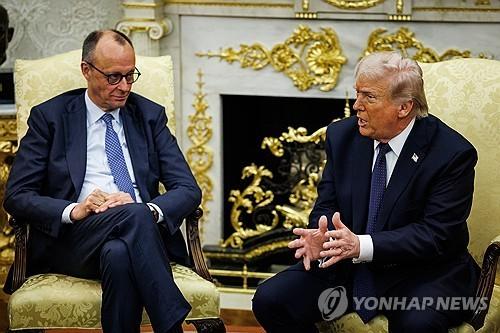
Moves to resolve the situation... Regarding questions about 'conflict with Trump, connection to US troop reduction', answers "absolutely unrelated"
Ministers also strive to ease tensions... German Foreign Minister highlights "sharing same goals with the US"
After strongly criticizing US President Donald Trump's Middle East war, German Chancellor Friedrich Merz, embroiled in the backlash of US troop withdrawal from Germany and a car tariff hike, belatedly moved to resolve the situation by emphasizing that the United States is Germany's most important ally.
According to Reuters, in an interview with local public broadcaster ARD, which aired on the night of the 3rd (local time), Chancellor Merz stated, "We have no choice but to accept that the US President has different views from us," adding, "But that does not change my conviction that the United States is our most important partner."
His remarks came amidst unprecedented frozen relations between the two countries, as President Trump, angered by the criticism of the Iran war, retaliated with a reduction of US troops stationed in Germany and an increase in tariffs on cars from the European Union (EU).
When asked if the US plan to reduce troops stationed in Germany was related to the conflict between the two leaders, Chancellor Merz replied, "There is no connection," seemingly trying to mend the rift with President Trump.
On April 27, Chancellor Merz visited a gymnasium (middle and high school) in western Germany and, during a discussion with students, strongly criticized the US for approaching peace negotiations with Iran without a clear strategy, and that the entire US was being humiliated by the Iranian Revolutionary Guard Corps.
In response, President Trump continuously attacked Chancellor Merz, without hiding his displeasure, with remarks such as, "Focus more on fixing your own broken country, including immigration and energy issues," and "The German Chancellor should spend more time ending the Russia-Ukraine war (he was completely incompetent on that issue!)."
Ultimately, President Trump issued an order to withdraw about 5,000 US troops stationed in Germany within 6 to 12 months and announced a 10 percentage point increase in tariffs on passenger cars and trucks produced in the EU, from 15% to 25%, leading to speculation that retaliation against European allies uncooperative in the Iran war was beginning.
Given that the automotive industry is one of Germany's key industries, there is also an interpretation that President Trump's announced tariff increase was largely influenced by the conflict with Chancellor Merz.
German ministers are also making strenuous efforts to resolve the strained relations between the two countries, which have resulted from the sharp exchanges between the leaders.
According to AFP, German Foreign Minister Johann Wadephul, in a phone call with Iranian Foreign Minister Abbas Araghchi on the same day, urged the reopening of the Strait of Hormuz and the abandonment of the nuclear program, emphasizing Germany's close alliance with the United States.
After the call, Minister Wadephul posted on X (formerly Twitter) that he had demanded Minister Araghchi lift the blockade of the Strait of Hormuz and abandon the nuclear weapons program, adding, "Germany has made it clear that it supports a negotiated solution."
He further added, consciously highlighting the US, "As a close ally of the United States, we share the same goal that Iran must abandon nuclear weapons in a complete and verifiable manner, as demanded by US Secretary of State Marco Rubio, and immediately open the Strait of Hormuz."
AFP interpreted Minister Wadephul's remarks that day as part of efforts by German ministers, including Wadephul, who have been striving to ease tensions arising from the recent war of nerves between the two leaders.
Newsletter
Get key news delivered to your email every morning
to leave a comment.