
to leave a comment.
Ministry of Land, Infrastructure and Transport requests investigation, Tesla software update... "Limitations of ex-post responses"
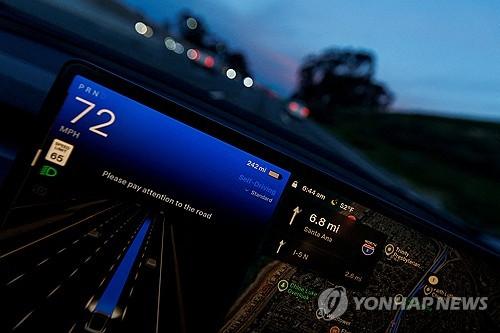
It has been revealed that there are repeated attempts to illegally activate Tesla's Full Self-Driving (FSD) feature in Korea.
Considering the surge in sales of Chinese-made Teslas, which are, in principle, not allowed to use FSD, there is a growing call for urgent and effective preventive measures.
According to the office of Representative Park Yong-gap of the Democratic Party of Korea, a member of the National Assembly's Land, Infrastructure and Transport Committee, on the 4th, the total number of attempts to illegally activate the FSD feature in Korea was 85 (as of the 28th of last month).
In Korea, Tesla's FSD feature can only be used in Model S, X, and Cybertrucks produced in the United States, but numerous attempts have been made to bypass this.
Under the Korea-U.S. Free Trade Agreement (FTA), U.S.-made vehicles are exempt from relevant domestic certification, allowing FSD activation. However, Chinese-made models, which account for most of Tesla's sales in Korea, cannot use FSD because they have not received safety standard certification.
Consequently, vehicles that can legally use FSD in Korea account for only 2.4% (4,292 units) of the total registered Teslas (180,684 units). This includes 2,708 Model X, 1,193 Model S, and 391 Cybertrucks.
However, it has been reported that some Tesla owners have attempted to illegally activate FSD using unofficial external equipment or source code.
Unauthorized FSD activation falls under the 'act of arbitrarily altering, installing, adding, or deleting software that can affect safe operation,' which is prohibited by the Automobile Management Act. Violators can face imprisonment for up to two years or a fine of up to 20 million won.
In response, the Ministry of Land, Infrastructure and Transport requested an investigation into legal violations, and Tesla Korea responded with a software update. However, critics point out that this is not a fundamental solution to prevent unauthorized activation attempts in advance.
Furthermore, a problem arises because the government cannot verify individual vehicle owner information under the Personal Information Protection Act, making it impossible to specifically identify or track violation cases.
Representative Park said, "As the adoption of electric and autonomous vehicles expands, attempts at software manipulation will become more sophisticated. Since ex-post responses like investigation requests or remote blocking have limitations, institutional improvements must be expedited."
Representative Park plans to propose a related bill soon.
Newsletter
Get key news delivered to your email every morning
to leave a comment.