
to leave a comment.
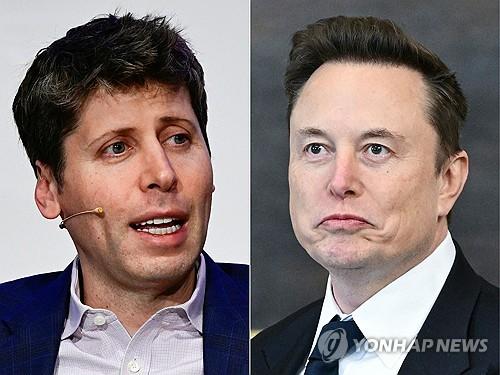
Musk's side claims in court: "It's like a souvenir shop selling off Picasso's works from a museum"
OpenAI: "Musk was aware of the plan to change to a for-profit entity"... MS: "Suddenly raising issues after ChatGPT's success"
Tesla CEO Elon Musk, who filed a lawsuit alleging that OpenAI CEO Sam Altman broke his promise of 'non-profit operation' and unjustly profited, claimed that this trial is 'a fight to protect America's culture of giving.'
According to Reuters and US economic broadcaster CNBC, CEO Musk appeared as the first witness in a suit at the Oakland Division of the US District Court for the Northern District of California on the 28th (local time) and claimed, "I came up with the idea, named it (OpenAI), recruited key talent, and taught them everything I knew."
He testified that he came up with the idea of establishing OpenAI after debating AI safety with Google co-founder Larry Page, and wanted to create an open-source alternative that could compete with Google.
Musk, who frequently thinks about AI safety, explained the background of his conception of OpenAI, saying, "AI can make us prosperous, or it can kill us all," and "We want to live in movies like 'Star Trek' created by Gene Roddenberry, not in movies like James Cameron's 'Terminator' (which features killer robots)."
He also offered the prediction, "My prediction is that AI as smart as humans will emerge next year."
He then emphasized, "I could have started (OpenAI) as a for-profit company, but I chose not to."
He described OpenAI's transformation into a for-profit company, despite his original intent at its founding to operate 'as a non-profit,' as 'plunder,' warning, "If it's okay to plunder a public interest organization, the entire foundation of American charitable giving will be destroyed."
Attorney Stephen Molloy, representing Musk's side, also emphasized in his opening statement that the defendants, including OpenAI CEO Altman and President Greg Brockman, should be held accountable because they stole a charitable organization.
Molloy compared the OpenAI Foundation, a non-profit organization, establishing OpenAI Public Benefit Corporation (PBC), which can pursue profit, to a museum opening a souvenir shop, criticizing, "A souvenir shop cannot plunder a museum and sell off Picasso's works."
Musk's side presented as evidence the fact that OpenAI's founding charter, drafted in 2015, explicitly states that OpenAI seeks to develop 'open technology for the public good' and 'is not established for the private gain of any specific individual.'
Conversely, attorney William Savitt, representing OpenAI's side, countered that CEO Musk was originally aware of OpenAI's plan to transition to a for-profit entity.
Savitt based this claim on an email sent by Shivon Zilis, a former OpenAI director who is also the mother of four of Musk's children, to Sam Teller, who worked for Musk.
The email suggested options such as changing the organizational structure to a PBC that can pursue profit, or dividing it into a general stock company and a non-profit organization.
Savitt claimed, "Musk supported a for-profit entity as long as he maintained control."
He further pointed out that Musk CEO only donated a portion of the funds he initially promised, forcing OpenAI to rush to secure additional funding.
Russell Cohen, an attorney representing Microsoft (MS), another defendant in the lawsuit, countered that CEO Musk's claims of OpenAI violating its public trust were neither aided nor aidable by MS.
Cohen specifically noted that CEO Musk made no mention of this for five years after MS and OpenAI announced their partnership, criticizing, "After ChatGPT achieved massive success, he founded xAI, a for-profit (competitive) company, and only then suddenly raised issues against MS."
Meanwhile, Judge Yvonne Gonzalez Rogers, who is presiding over the lawsuit, unusually ordered CEO Musk to refrain from using social media (SNS).
After OpenAI raised an issue regarding CEO Musk's post the previous day, which mocked the names of CEO Altman and OpenAI President Greg Brockman as 'Scam' and 'Stockman,' Judge Rogers asked CEO Musk to "try to curb your habit of using social media to resolve matters outside of court."
However, she said she was reluctant to issue a 'gag' order.
In response, CEO Musk agreed to minimize his SNS activity, and CEO Altman also agreed to participate.
Earlier, Judge Rogers announced that this trial would proceed in two stages: one to determine whether the defendants are liable, and another to decide on remedies, with the first stage expected to conclude by the 21st of next month.
CEO Musk filed a lawsuit against Altman, Brockman, the OpenAI entity, and Microsoft (MS), which funded OpenAI, claiming he was harmed when OpenAI abandoned its promise to operate as a non-profit and became a for-profit company, and that Altman and Brockman unjustly profited in the process.
In this lawsuit, CEO Musk is demanding the dismissal of CEO Altman and President Brockman and the return of $134 billion (approximately 198 trillion won) in unjust profits to the OpenAI Foundation, a non-profit organization.
CEO Altman, MS CEO Satya Nadella, and former OpenAI director Zilis are also expected to testify in this trial.
Newsletter
Get key news delivered to your email every morning
to leave a comment.