
to leave a comment.
"Start of US rate hike cycle" vs "Limited, gradual tightening"
As the U.S. Federal Reserve (Fed) raised its benchmark interest rate for the first time in 3 years and 2 months, demonstrating a strong commitment to price stability, domestic securities firms largely agreed that the Fed's decision was a 'hawkish hike'.
With another Fed rate hike likely within the year, attention is also focused on the ripple effects this measure will have on the interest rate differential between Korea and the US.
On the 17th, the financial investment industry assessed that despite anticipating the Fed's rate hike, the unanimous decision, upward revision of the dot plot, and expression of commitment to price stability were interpreted as hawkish.
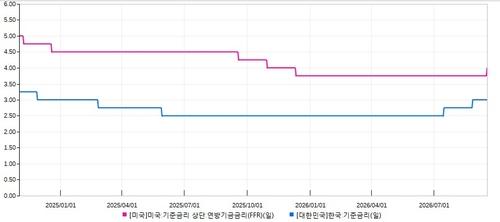
Overnight, at the September U.S. Federal Open Market Committee (FOMC), the Fed raised its benchmark interest rate by 25bp (1bp=0.01% point) to 3.75-4.00%. This is the first hike in 3 years and 2 months since July 2023.
The dot plot, released alongside, showed the median federal funds rate at 4.1% by the end of this year, suggesting that one more rate hike will be implemented within the year.
Experts predicted that while a rate hike would be a burden on short-term bond yields, the Fed's commitment to price stability would serve as a factor limiting further increases in long-term bond yields, which have recently surged.
Kong Dong-rak, a researcher at Daishin Securities, analyzed, "Full-fledged curve flattening (yield curve flattening) will become a sign of stability and rather quell market anxiety."
Kim Myung-sil, a researcher at iM Securities, also stated, "The Fed's clear demonstration of its will to control inflation is a positive factor that will curb extreme additional increases in 10-year bond yields," and predicted that a runaway increase in long-term rates would be limited under a hawkish rate hike stance.
After the FOMC, the market expected the Fed to undertake one more hike in December this year. Yuanta Securities, Kyobo Securities, Hanwha Investment & Securities, and others anticipated an additional hike in December, considering the U.S. midterm election schedule.
Kim Sung-soo, a researcher at Hanwha Investment & Securities, stated, "Also, considering the robust consumption in the U.S., it is difficult for service prices to decelerate easily, which supports an additional hike in December," adding, "For the time being, upward pressure on short-term interest rates is expected to prevail."
However, opinions were divided on whether the Fed's latest rate hike was a one-off tightening measure or the beginning of a tightening cycle.
Park Jun-woo, a researcher at Hana Securities, evaluated the unanimous decision to raise rates and the upward revision of the dot plot as hawkish factors, stating, "The market will perceive this not as a one-time measure but as the beginning of a rate hike 'cycle'." He added that the dot plot specifically suggested a risk of further rate hikes next year after two hikes within the year.
Conversely, Ahn Ye-ha, a researcher at Kiwoom Securities, stated, "At the September FOMC, upward adjustments in growth and employment, and higher inflation forecasts were confirmed, leading us to believe that the necessary hike for an 'insurance-like' adjustment was expanded beyond 25bp." She added, "It is appropriate to respond with the most conservative stance, considering factors like prolonged high oil prices." She further assessed, "While we revise the Fed's hike forecast from one to two, this is closer to limited, gradual tightening rather than a full-fledged resumption of the rate hike cycle."
Attention is also focused on the impact of the Fed's rate hike on domestic bond yields and the market.
Kim Myung-sil, a researcher, pointed out, "Following the Bank of Korea's August hike and the U.S.'s September hike decision, the Korea-US interest rate differential has widened to 100bp," emphasizing the need to closely monitor the repercussions of this widening gap between the two countries' interest rates.
Currently, Korea's benchmark interest rate is 3.0%. After the Monetary Policy Committee raised rates by 25bp in July and August, the Korea-US benchmark interest rate gap narrowed from 125bp to 75bp, but it has now widened again to 100bp due to the Fed's rate hike.
If the interest rate differential further widens with U.S. rates being higher, concerns about capital outflow to the U.S. could increase.
Newsletter
Get key news delivered to your email every morning
to leave a comment.