
to leave a comment.
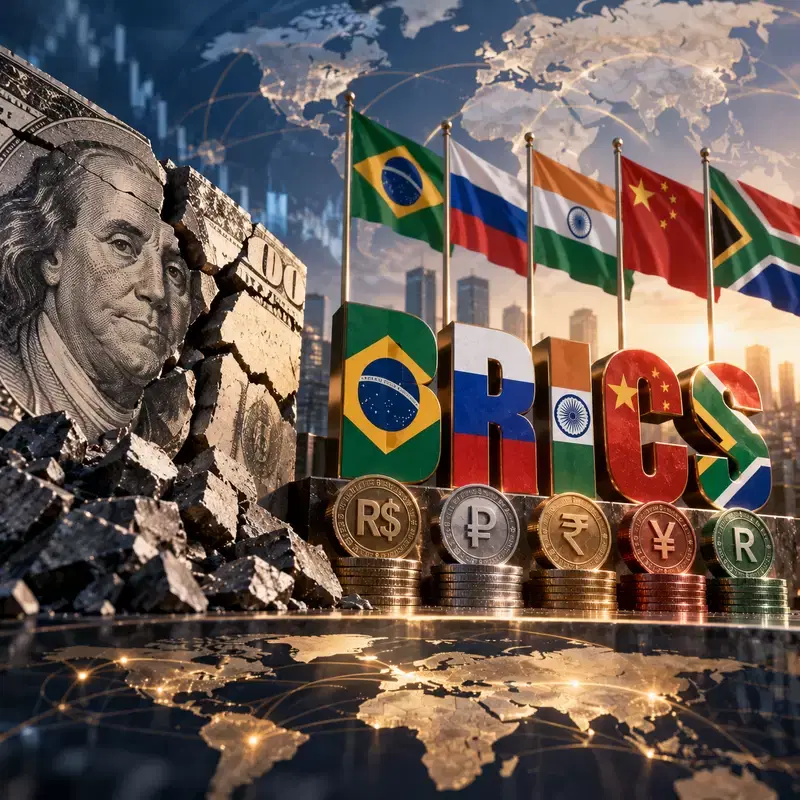
▲ BRICS, Dollar (USD)/AI-generated image
BRICS is attempting to reduce its dependence on the dollar by promoting the expansion of local currency settlements, but the size of the financial market and conflicts of interest among member states have emerged as the biggest barriers.
According to CNBC on September 16 (local time), BRICS leaders emphasized the economic influence of the Global South and the need to expand trade in local currencies at their weekend meeting. Geopolitical tensions, economic sanctions, and US tariff policies were cited as reasons for reducing dollar dependence. However, experts evaluated that it would be difficult for BRICS to break away from the dollar-centric financial system in the short term.
The dollar's market dominance remains overwhelming. According to the Bank for International Settlements (BIS), the dollar's share of the foreign exchange market in April was 89%, a 1 percentage point increase from a year ago. The Euro accounted for 29% and the Yen for 17%. South African President Cyril Ramaphosa stated at the BRICS summit that "we must expand the use of local currencies and strengthen cross-border payment systems and financial connectivity."
Russia and Iran, which are under US sanctions, urged the establishment of internal BRICS payment, clearing, and deposit infrastructure. Iranian President Masoud Pezeshkian said that the current financial system is "vulnerable to political shocks because it is concentrated on a limited number of currencies." Russia and China currently settle about 90% of their bilateral trade in rubles and yuan. However, Reema Bhattacharya, Asia Research Director at Verisk Maplecroft, explained that these changes were more influenced by US sanctions since 2022 than by common BRICS policies.
Compared to its economic size, the level of internal financial integration within BRICS is low. According to the United Nations Trade and Development, the 10 BRICS member states accounted for 27% of global production, 24% of goods exports, and 22% of foreign direct investment inflows in 2024. In contrast, trade among member states accounted for only about 5% of global trade. The 2026 BRICS declaration did not include concrete plans for introducing a common currency or expanding local currency settlements. The BRICS Payment Task Force was entrusted with developing practical solutions for cross-border payments.
Differences in interests among member states are also factors making de-dollarization difficult. Trade between China and India reached a record high of $151.1 billion in the year leading up to March 2026, but India's trade deficit with China also expanded to $112.16 billion. In contrast, trade in goods and services between India and the United States was approximately $239 billion in 2025, with India recording a surplus of $58.4 billion in goods and $4.7 billion in services. Jayant Krishna, a senior fellow at the Center for Strategic and International Studies, assessed that BRICS lacks integrated institutional, financial, and macroeconomic infrastructure to replace the dollar's "inherent liquidity and trust." Krishna Bhimavarapu, Asia Pacific Economist at State Street Investment Management, also stated, "No BRICS-led alternative currently matches the dollar's liquidity, market depth, trustworthiness, and global acceptance."
[Article Summary]
-BRICS is pushing for expanded local currency settlements and reduced dollar dependence, driven by geopolitical tensions, US sanctions, and tariff policies.
-The dollar accounted for 89% of the global foreign exchange market in April, while trade among BRICS member states accounted for only about 5% of global trade in 2024.
-Trade imbalances between China and India, differing interests among member states, and a lack of financial market liquidity have been identified as key constraints on BRICS de-dollarization.
*Disclaimer: This article is for investment reference only and we are not responsible for any investment losses based on it. The content should be interpreted for informational purposes only.*
Newsletter
Get key news delivered to your email every morning
to leave a comment.