
to leave a comment.
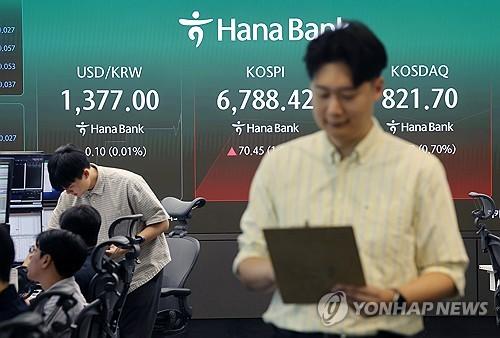
"As long-term bond interest rate hike pressure eases, KOSPI's upside resistance may also weaken."
"The higher interest rates get, the more advantageous it will be for semiconductors and energy, which have strong pricing power."
Although the U.S. raised its benchmark interest rate for the first time in 3 years and 2 months, embarking on monetary tightening, the South Korean stock market actually rose slightly, maintaining a solid trend.
Although Federal Reserve (Fed) Chairman Kevin Warsh made somewhat 'hawkish' (preferring monetary tightening) remarks, there are assessments that related concerns were already priced in, or that uncertainty has actually eased.
According to the Korea Exchange and financial information service provider Yonhap Infomax on the 17th, as of 10:16 AM today, the KOSPI is at 6,761.85, up 0.65% from the previous trading day.
The index, which started at 6,779.02, up 0.91%, rose to 6,795.53 (+1.15%) shortly after opening, and is now adjusting its gains.
The KOSDAQ also rose 0.70% from the previous trading day to 821.68.
In the KOSPI market, foreigners and institutions are net selling 532.2 billion won and 94.8 billion won, respectively.
On the other hand, individuals are net buying 268.5 billion won, and other corporations, which have recently emerged as major supply-demand players due to large-scale share buybacks by Samsung Electronics [005930] and SK Hynix [000660], are also net buying 69.9 billion won.
Samsung Electronics and SK Hynix, the 'top two' in the domestic stock market, are trading at 255,000 won and 1,761,000 won, respectively, up 0.59% and 0.11%.
Major Asian stock markets are showing a similar sentiment.
As of this time, Japan's Nikkei 255 index is at 64,263.22, up 0.53%, and Taiwan's Weighted Index is at 46,662.17, up 1.77%.
Overnight, the Fed raised its benchmark interest rate by 25bp (1bp=0.01% point) at the September Federal Open Market Committee (FOMC) meeting, bringing it to 3.75-4.00%.
The statement released alongside was assessed to have clear changes in wording towards a hawkish direction. Lee Kyung-min, a researcher at Daishin Securities, pointed out, "The phrase attributing inflation to 'supply shock' was removed, and the phrase 'solid domestic spending' was added. A sentence linking this interest rate hike to a 'sooner return' to the 2% inflation target was also added."
However, he diagnosed, "Considering that the 25bp interest rate hike probability was already priced in at 93.5% according to the Chicago Mercantile Exchange (CME) FedWatch just before the September FOMC, it was not a market shock variable."
Although bond yields soared and the decline in the New York stock market widened due to Chairman Warsh's hawkish press conference, it is also notable that a trend of attempting a rebound emerged towards the end of the session.
The researcher said, "This suggests that confidence in monetary policy and price stability has been restored through this interest rate hike, and I believe it is a change resulting from the fact that interest rate hikes have been taken for granted and concerns about hawkish rate hikes have been priced in."
In fact, according to CME FedWatch, the federal funds rate (FFR) futures market had been reflecting the possibility of the Fed raising interest rates four times between September of this year and June of next year, until last weekend (12th).
However, the researcher reported that expectations have now shifted to only three interest rate hikes: in September of this year, and in January and April of next year.
The researcher predicted that as the upward pressure on long-term bond yields gradually eases, the KOSPI's upside resistance in the 7,000-7,100 range is also likely to weaken.
The hawkish stance shown by Fed officials, including Chairman Warsh, is also interpreted as meaning that the U.S. economy is robust.
Heo Jae-hwan, a researcher at Eugene Investment & Securities, pointed out, "Chairman Warsh said in the press conference that 'only some of the accommodation has been removed, and it is difficult to describe current financial conditions as restrictive.' This leaves room for further interest rate hikes," but "conversely, it means they are optimistic about the U.S. economy."
Indeed, the growth rate forecast for this year was raised from 2.2% in June to 2.3%, and the core PCE inflation forecast was also raised from 3.3% in June to 3.4%, and Heo analyzed, "raising both inflation and growth rates simultaneously reflects a higher risk of the economy overheating rather than a supply shock due to rising oil prices."
Heo predicted, "If oil prices remain stable, the burden on the economy or corporate earnings is unlikely to be significant. Instead, as interest rates rise, companies with lower pricing power are likely to fall out of the stock rally," adding, "Industries that can immediately pass on costs, such as semiconductors/energy, are expected to benefit."
While interest rate hikes are a burden on short-term rates, there is also an analysis that the Fed's commitment to price stability will serve as a factor limiting further increases in long-term rates, which have recently surged.
Gong Dong-rak, a researcher at Daishin Securities, analyzed that "full-fledged curve flattening will become a sign of stability and actually quell market anxiety."
Kim Myung-sil, a researcher at iM Securities, also stated, "The Fed's clear demonstration of its will to curb inflation is a positive factor that will suppress extreme further increases in 10-year bond yields," expecting that a runaway rise in long-term rates would be limited under a hawkish rate hike stance.
Newsletter
Get key news delivered to your email every morning
to leave a comment.