
to leave a comment.
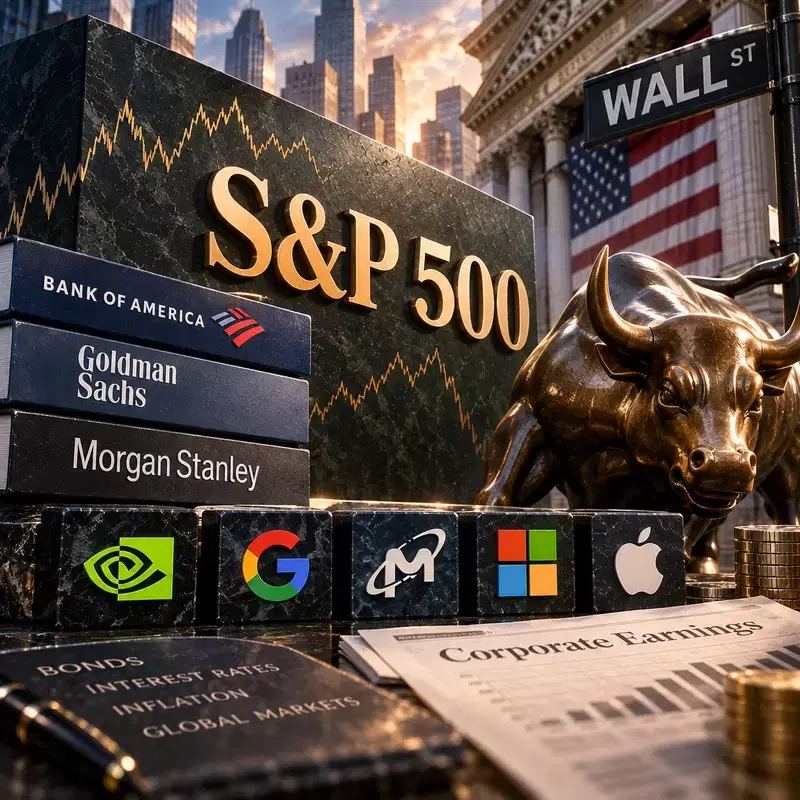
▲ Wall Street, US stock market, S&P 500, tech stocks/AI generated image
Wall Street's year-end S&P 500 forecasts are split between 7,400 and 8,000. Simultaneously, bond yields and corporate earnings have emerged as the biggest variables to determine the remaining direction of the stock market.
According to Barron's on September 14 (local time), Savita Subramanian, Head of U.S. Equity Strategy at Bank of America, raised the S&P 500's year-end 2026 target by 300 points to 7,400. This is 2.9% lower than Monday's closing price of 7,619.98. While she raised the 12-month target from 7,600 to 7,800, she maintained a cautious stance on the short-term stock market, citing worsening liquidity, geopolitical tensions, and persistent inflation.
Ben Snider, Head of U.S. Equity Strategy at Goldman Sachs, offered a contrasting outlook. He maintained his year-end S&P 500 target of 8,000. This is 5.1% higher than Monday's closing price. He believes that despite the 10-year U.S. Treasury yield briefly exceeding 5%, corporate earnings and financial health can sustain the stock market's upward trend.
Mike Wilson, Chief U.S. Equity Strategist at Morgan Stanley, also set his year-end target at 8,000. He assessed that rising interest rates are more a sign of strong economic growth than financial instability. However, he warned that if a recent surge in oil prices creates an unexpected shock, the Federal Reserve's (Fed) tightening could be prolonged. According to data cited by Barron's, Wall Street's average year-end target is 7,951.
Corporate earnings forecasts are simultaneously fueling both optimism and caution. LSEG predicts that S&P 500 companies' earnings will increase by approximately 35% in 2026, then slow to about 15.3% in 2027. Subramanian analyzed that about 27% of next year's expected S&P 500 earnings will come from five companies: NVIDIA (NVDA), Alphabet (GOOGL), Micron Technology (MU), Microsoft (MSFT), and Apple (AAPL). Semiconductor stocks are expected to account for over 60% of the total earnings growth in 2027.
The increasing reliance on AI investment and high bond yields simultaneously also pose a burden. Snider pointed out that companies with high growth rates but currently low profits are more vulnerable to rising interest rates. Subramanian also believed that the AI investment cycle could continue, but assessed that as market profits concentrate in a few AI companies, both upward and downward risks have increased.
[Key Article Summary]
-Bank of America set its year-end S&P 500 target at 7,400, while Goldman Sachs and Morgan Stanley maintained 8,000.
-S&P 500 corporate earnings are projected to increase by approximately 35% in 2026, but the growth rate is expected to slow to 15.3% in 2027.
-About 27% of next year's S&P 500 earnings are expected to be concentrated in five companies, including NVIDIA, making AI dependence a key risk.
*Disclaimer: This article is for investment reference only and we are not responsible for investment losses based on it. This content should be interpreted for informational purposes only.*
Newsletter
Get key news delivered to your email every morning
to leave a comment.