
to leave a comment.
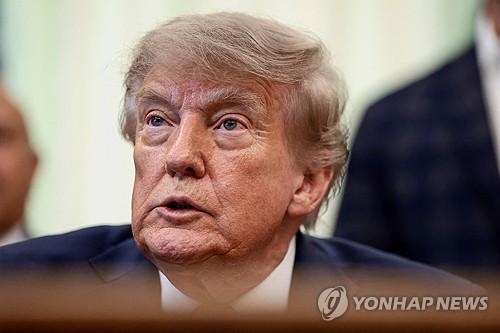
Explicitly pressuring the Fed, even mentioning the extreme card of 'halting trade'... "It will be better than tariffs"
Also mentions EU, Canada, and Mexico's trade surplus with the U.S.... If actually implemented, the U.S. is also expected to be hit
U.S. President Donald Trump announced on the 4th (local time) that if the Federal Reserve (Fed) does not cut benchmark interest rates, the U.S. will halt trade with countries with which it has a deficit.
As strong U.S. employment data increased the likelihood of an interest rate hike, he overtly pressured the Fed to cut rates by mentioning extreme measures such as halting trade with countries that have a trade surplus with the U.S. He also mentioned the European Union (EU), along with Canada and Mexico, as countries with which the U.S. has a trade deficit.
President Trump welcomed the "great employment figures just released" on his social media platform Truth Social, then urged that interest rates should be lowered to the world's lowest level because U.S. credit has strengthened.
President Trump stated, "If we don't lower interest rates, we will stop trade with the countries with which we have a deficit," and claimed, "The Supreme Court strongly recognized in its foolish and costly tariff rulings that 'the President has absolute authority to do so.'"
He then emphasized, "This will be better than tariffs!" President Trump did not specifically mention the countries with which the U.S. has a trade deficit.
In the afternoon, when asked by reporters at the White House, President Trump argued, "Some countries have interest rates of 0.5%, but we have 4%," and "Our rates should be 1% or 0.5%."
He added, "If we don't trade with Canada at all, we save $90 billion," and "We are losing $200 billion annually to the EU. If we don't trade with them, we have nothing to lose."
He also said, "We are losing $195 billion annually to Mexico," repeating his assertion that if the U.S. is not treated properly, it should simply halt trade with those countries.
It is unclear whether President Trump's remarks are actually intended to implement a trade halt, or if they are intended to increase pressure on the Fed ahead of the Federal Open Market Committee (FOMC) on the 15th-16th, as the strong employment data increases the likelihood of an interest rate hike.
However, considering his remarks at the White House in the afternoon, there is speculation that the 'trade halt' card may not have been presented entirely on the spur of the moment.
U.S. CNBC reported that "taken literally, the threat to halt trade with deficit countries is extreme," and pointed out that "the U.S. has significant trade deficits with dozens of countries, including major trading partners."
It added that President Trump is resuming his pressure on the Fed, which had eased for a while after the appointment of Kevin Warsh as Fed Chairman.
While President Trump argues that halting trade with certain countries would save the U.S. money by reducing deficits, the U.S. is also likely to face price increases and retaliatory measures.
The U.S. daily New York Times (NYT) commented, "If implemented, it would be a powerful ultimatum that would deal a major blow to the economy."
U.S. employment conditions improved significantly more than expected last month. Non-farm payrolls increased by 162,000 from the previous month, which is the largest increase in the last five months.
As employment growth proved stronger than expected, the market put more weight on the expectation that the Fed would raise interest rates this month.
According to CME FedWatch, the federal funds rate (FFR) futures market reflected a 58.2% probability of an interest rate hike by September as of 9:10 AM today. This was an increase of about 10 percentage points from the previous day.
The yield on the U.S. 2-year Treasury bond, which is sensitive to U.S. monetary policy, rose by 0.07 percentage points to 4.41% immediately after the announcement.
President Trump has consistently demanded interest rate cuts during former Fed Chairman Jerome Powell's term, threatening the Fed's independence. Immediately after appointing Chairman Warsh, he seemed to acknowledge its independence but is gradually increasing pressure for interest rate cuts.
Newsletter
Get key news delivered to your email every morning
to leave a comment.