
to leave a comment.
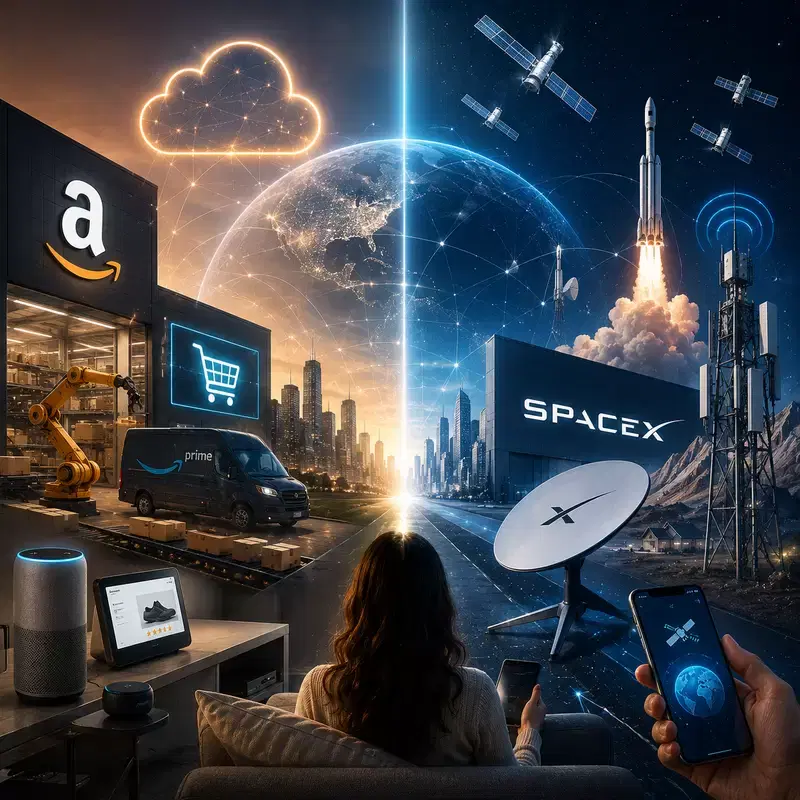
▲ Amazon (AMZN), SpaceX (SPCX)/AI Generated Image
Amazon (AMZN) and Space Exploration Technologies (SpaceX, SPCX) have entered a competition to preempt consumers' digital lives across shopping, AI, satellite internet, and mobile connectivity. However, the risk-adjusted winner is leaning towards Amazon.
According to Nasdaq on July 2 (local time), Amazon and SpaceX are aiming for a larger role in all aspects of consumers' daily lives, from shopping and content viewing to using smart home devices and connecting to the internet. Amazon has already secured consumer touchpoints in e-commerce, advertising, subscriptions, cloud, and smart home devices, while SpaceX is moving closer to the consumer telecommunications market with its Starlink satellite broadband and direct-to-cell phone connectivity technology.
In terms of scale, Amazon's dominance is overwhelming. Amazon recorded net sales of $716.9 billion in 2025, while SpaceX's revenue was only $18.7 billion. Amazon generates revenue at various points in the consumer purchase journey, earning $269.3 billion from online stores, $172.2 billion from third-party seller services, $68.6 billion from advertising, $49.6 billion from subscriptions, and $128.7 billion from AWS cloud.
Amazon's advertising and cloud are key pillars in dominating consumers' digital lives. In the first quarter, advertising revenue increased by 24% year-over-year to $17.2 billion, and AWS revenue grew by 28% to $37.6 billion, with operating profit increasing to $14.2 billion. Amazon launched Alexa for Shopping, an AI shopping assistant combining Rufus and Alexa+, and has also secured AI infrastructure demand from large clients such as OpenAI, Anthropic, and Meta Platforms (META).
Amazon has also pulled out a counterattack card in satellite internet. Amazon Leo has expanded to 367 satellites as of mid-June, securing over 100 rocket launch contracts for further deployment. The acquisition agreement with Globalstar could provide a foundation for direct-to-cell voice, data, and messaging services starting in 2028, and a multi-year contract with Delta Air Lines will install Amazon Leo satellite technology on 500 aircraft starting in 2028.
SpaceX's consumer strategy relies on Starlink Mobile. SpaceX offers direct-to-cell connectivity services with T-Mobile US in the United States, allowing compatible phones to connect via Starlink in areas where regular cell tower signals are weak or unavailable. Starlink has already secured approximately 10.3 million subscribers, and the U.S. Federal Communications Commission (FCC) approved SpaceX's plan in January to deploy an additional 7,500 second-generation Starlink satellites, expanding its authorized network to 15,000.
However, SpaceX's growth prospects come with high stock valuations and execution risks. Despite adjustments since its IPO, SpaceX is trading at approximately 82 times its trailing 12-month revenue, heavily relying on Starlink revenue to fund its rocket, AI infrastructure, spectrum expansion, and mobile businesses. Starship has not yet carried commercial payloads, and delays would burden Starlink's expansion efficiency. Nasdaq assessed that while SpaceX could grow into a more disruptive connectivity company, the risk-adjusted winner in the consumer digital lifestyle competition is Amazon.
[Article Key Summary]
-Amazon recorded net sales of $716.9 billion in 2025, securing consumer touchpoints across shopping, advertising, subscriptions, cloud, and smart homes.
-SpaceX aims to enter the mobile telecommunications market based on approximately 10.3 million Starlink subscribers and an authorized satellite network of 15,000 satellites.
-Nasdaq assessed that while SpaceX has significant growth potential, considering its high stock valuation and execution risks, Amazon is the risk-adjusted winner.
*Disclaimer: This article is for investment reference only, and we are not responsible for investment losses based on it. The content should be interpreted for informational purposes only.*
Newsletter
Get key news delivered to your email every morning
to leave a comment.