
to leave a comment.
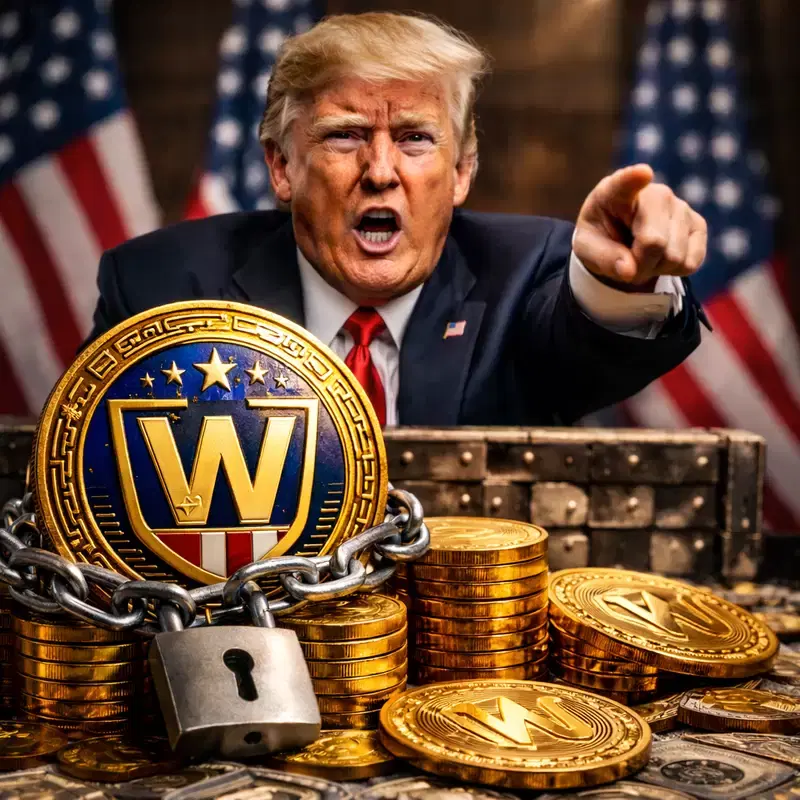
▲ Donald Trump, WLFI/ChatGPT generated image
As the cryptocurrency business profits of the family of former U.S. President Donald Trump intersect with ethical clauses in the U.S. cryptocurrency market structure bill, discussions on digital asset regulation in the U.S. are escalating beyond simple industry promotion legislation into a controversy over power-related conflicts of interest.
Cryptocurrency-focused YouTube channel Coin Bureau claimed in a video uploaded on May 13 (local time) that "Donald Trump's personal net worth has increased from approximately $2.3 billion just before his re-election to over $6 billion recently," adding that "about $3 billion of the increase is directly linked to cryptocurrency." Coin Bureau cited an analysis by Steve Ratner, based on Forbes and Bloomberg, explaining that Trump's net worth has surged in the past 16 months, unlike his first term when it remained largely stagnant.
Coin Bureau identified the structure of World Liberty Financial (WLFI) as a key issue. DT Max Defi LLC, the controlling entity of the protocol, was described as being approximately 70% owned by Trump and 30% by his immediate family. According to WLFI's internal regulations, 75% of net protocol profits and token sale revenues flow to this entity.
Coin Bureau claimed that "Trump memecoins were issued through Fight Fight Fight LLC and CIC Digital LLC," and "generated approximately $350 million in transaction fees within 48 hours of launch." Citing analyses from Nansen and Chainalysis, it was also presented that about 45 insider wallets reaped over $1.2 billion in profits, while over 2 million individual investor wallets collectively incurred $4.3 billion in losses.
Coin Bureau pointed out that legal risks have escalated with the lawsuit involving Tron (TRX) founder Justin Sun. Sun invested approximately $75 million in WLFI tokens and advisory positions starting in November 2024. The video reported that on March 5, 2026, the Securities and Exchange Commission (SEC) settled a 2023 fraud and market manipulation case against Sun and the Tron Foundation. Subsequently, on April 22, Sun filed a lawsuit in the U.S. District Court for the Northern District of California, alleging that WLFI installed a backdoor blacklist function to freeze approximately 4 billion tokens after refusing an additional $200 million investment in the USD1 stablecoin. Coin Bureau assessed this lawsuit's discovery process as the biggest legal variable for WLFI's structure, as it could reveal internal communications related to the SEC settlement, governance decisions on the blacklist function, and control over protocol operations.
Separately from the cryptocurrency controversy, the video reported that the U.S. Department of Justice and the Commodity Futures Trading Commission (CFTC) are also investigating suspicious short positions that occurred in the crude oil futures market in March and April 2026. Coin Bureau claimed, "There was a $500 million short position approximately 15 minutes before Trump's Truth Social post regarding de-escalation with Iran, a $960 million short position before the ceasefire announcement on April 7, and a $760 million short position approximately 20 minutes before the announcement of the reopening of the Strait of Hormuz on April 17." Citing a Reuters analysis, it was explained that the total suspicious pattern could amount to up to $7 billion. A $920 million short position executed approximately 70 minutes before the Axios memo leak on May 6 was presented as having yielded about $125 million in profit within a few hours.
Coin Bureau diagnosed that the U.S. cryptocurrency market structure bill directly clashes with the Trump family's cryptocurrency interests. The bill passed the House of Representatives by 294 to 134 in July 2025, and the White House wants it signed by July 4. However, Senator Kirsten Gillibrand stated at the Miami Consensus event on May 6, "Without an ethics clause, no one will vote for this bill." The provision requested by Gillibrand prohibits incumbent elected officials and their immediate families from issuing, holding, or profiting from tokens during their term in office. Coin Bureau interpreted this provision as directly targeting the current WLFI and Trump token structure. Polymarket's probability of the bill passing within 2026 has dropped from around 90% to approximately 60% recently, and the video reported that the conflict over the ethics clause has become the second largest legislative obstacle, after the stablecoin yield provision.
Coin Bureau concluded that the structural risk of the cryptocurrency industry is not regulatory hostility but rather regulatory capture, where the interests of specific political powers and legislative structures become intertwined. While Vanguard's withdrawal of its crypto ban, Morgan Stanley's launch of MSBT, and BlackRock IBIT's inflow of approximately $721 million over three trading days and total assets under management of $66.7 billion indicate continued institutional capital inflow, the video pointed out that if the perception of cryptocurrency as a separate asset class managed by neutral rules wavers, the legitimacy of institutional capital inflow could also weaken. Former U.S. President Barack Obama said on "The Stephen Colbert Show," aired on May 5, that "a U.S. president shouldn't have a bunch of side hustles that corporations and foreign entities can invest in," and Coin Bureau assessed this remark as revealing the political essence of the current cryptocurrency regulatory debate.
*Disclaimer: This article is for investment reference only, and we are not responsible for any investment losses based on it. The content should be interpreted for informational purposes only.*
Newsletter
Get key news delivered to your email every morning
to leave a comment.