
to leave a comment.
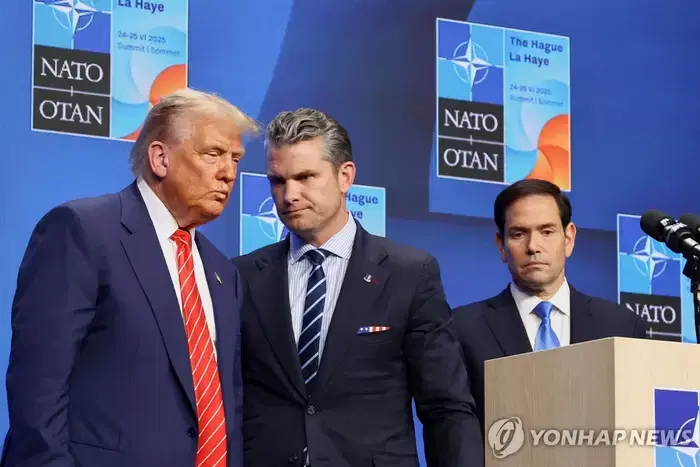
The Trump administration is seeking an exit strategy for the Iran war but has not shown a breakthrough.
More than two months after the start of the war against Iran, US President Donald Trump is facing a complex reality that is completely different from his initial boasts.
The war is costly, public support for it is low, and there is no clear plan for its conclusion.
On the 3rd (local time), the New York Times (NYT) pointed out in an analytical article that President Trump had initially boasted that the war goals could be easily achieved in a short period and that the economic impact would not be significant, but this optimism is now crumbling.
On March 1, the day after the war began, President Trump said in a phone interview with the NYT that if necessary, the US military intended to continue attacks for "four to five weeks," adding that the operation to oust Nicolas Maduro in Venezuela in early January would be a "perfect scenario."
On the 16th of last month, President Trump also claimed that "Iran has agreed to almost everything," stating that Iran had agreed to uranium removal, making it sound as if the war would soon end.
The current situation is completely different from these optimistic predictions.
Energy markets are volatile. According to the first publicly released estimate by the US Department of Defense, the war has cost $25 billion (36.8 trillion won) so far.
The $25 billion is comparable to the cost of expanding Obamacare subsidies, which was a key issue in last year's US government shutdown.
Key figures in the Republican Party, the ruling party in the US Congress, are also losing patience.
Major US allies, including Germany, are not actively supporting the US in this war, and President Trump is angry about it.
Both the US and Iran appear to be engaged in a test of endurance, continuing an uneasy ceasefire since the 8th of last month.
The US began blockading Iranian ports on the 13th of last month, and Iran is refusing US demands to remove enriched uranium.
Iran stated it would allow passage through the Strait of Hormuz on condition of collecting tolls, but the US countered by saying it would sanction vessels that comply with Iran's toll demands, thus maintaining the strait's blockade.
It is also pointed out that the continued blockade of the Strait of Hormuz could cause problems for President Trump's visit to China or lead to friction between the leaders of the two countries during their talks.
President Trump's visit to China was originally scheduled for late March to early April but was postponed and rescheduled for the 14th-15th of this month.
Chinese President Xi Jinping has strongly demanded that the US reopen the Strait of Hormuz. China imports one-third of its oil and gas through this strait.
On the 1st, President Trump spoke to supporters in a retirement community in Florida, a Republican stronghold, saying, "What I did, well, I don't know if it was foolish or brave, but it was a smart thing to do," and "If the same situation arises, I will do it again."
He emphasized that a surge in gasoline prices would be worth it if Iran's nuclear capabilities could be blocked, and he had previously made similar arguments at a state dinner with the British royal couple late last month.
According to US law, an administration must obtain congressional approval to continue a war for more than 60 days, and for the Iran war, the deadline was May 1. However, President Trump argued in a letter to Congress that day that approval was unnecessary because the ongoing ceasefire since the 8th of last month meant the war was in an "ended state."
However, just a few hours later, President Trump contradicted his "ended state of war" claim at an event in Florida, saying, "You know we are at war."
Matthew Bartlett, a Republican strategist who served in a political position at the State Department during the first Trump administration, told the NYT that the Trump administration's inconsistent messaging would not satisfy voters.
He stated, "The messaging was worse than a mess," adding, "It's worth noting that political, economic, and even diplomatic aspects have continued to worsen this week. The overall trajectory is downward, and with the war dragging on for another week, or even another month, this is by no means a good thing."
President Trump and his eldest son
Newsletter
Get key news delivered to your email every morning
to leave a comment.