
to leave a comment.
Three members dissatisfied with 'easing hint' phrase... Trump's aide suggests cut
Market reacts to 'hawkish freeze'... Mideast war-induced inflation concerns persist
The Federal Reserve (Fed), the central bank of the United States, held a Federal Open Market Committee (FOMC) meeting, its monetary policy decision-making body, on the 29th (local time) and froze the benchmark interest rate. However, this decision is interpreted as a 'hawkish (preferring monetary tightening) freeze' given that three members issued a 'dissenting opinion' to block future interest rate cut expectations.
With Kevin Warsh, the next Fed Chair nominee, expected to lead the Fed starting next month, the increasingly stark internal disagreements among Fed members, coupled with the shock of high oil prices due to the US-Iran war, are projected to be factors that increase the Fed's policy uncertainty.
Before the FOMC decision today, market experts had no disagreement that the Fed would freeze the benchmark interest rate at the current 3.50-3.75%, reflecting the sharp rise in oil prices due to the Iran war and increased economic uncertainty.
Michael Feroli, Chief Economist at JPMorgan Chase, in a policy outlook report released ahead of the April FOMC, predicted that the Fed would keep interest rates frozen for the remainder of this year. He further anticipated a 0.25 percentage point rate hike in the third quarter of next year, expecting the next policy move to be a hike, not a cut.
After freezing rates today, the FOMC stated in its policy statement that "inflation has risen, partially reflecting recent increases in global energy prices," while also assessing that "the situation in the Middle East is causing high uncertainty for the economic outlook."
Market participants noted that four dissenting opinions emerged at today's FOMC meeting, where 12 members exercised their voting rights. Reuters reported that this was the first time four dissenting opinions had been issued at an FOMC meeting since October 1992.
Steve Myron, a Fed director and former economic advisor to US President Donald Trump, opposed the rate freeze, as in previous meetings, and advocated for a 0.25 percentage point rate cut.
Separately, three members with rotating voting rights this year, including regional Federal Reserve Bank (FRB) presidents Beth Hammack (Cleveland), Neel Kashkari (Minneapolis), and Lorie Logan (Dallas), agreed to the rate freeze in today's decision but opposed the inclusion of an 'easing bias' phrase in the policy statement at this juncture.
In its policy statement today, the FOMC stated that "in assessing the appropriate stance of monetary policy, the Committee will continue to monitor the implications of incoming information for the economic outlook and will carefully evaluate the balance of risks (to price stability and maximum employment) in considering the degree and timing of additional adjustments to the target range for the federal funds rate."
Since initiating an interest rate cutting cycle in September 2024, the Fed has customarily used the phrase 'additional adjustments' in its policy statements up to today's meeting.
It is interpreted that the three members, including Governor Hammack, expressed their opposition, arguing that it was inappropriate to maintain the customary phrase implying a 'rate cut' policy signal, given that the possibility of the next policy move being a rate hike due to soaring energy prices could not be ruled out.
Chairman Powell hinted that the controversial phrase could be changed in the future.
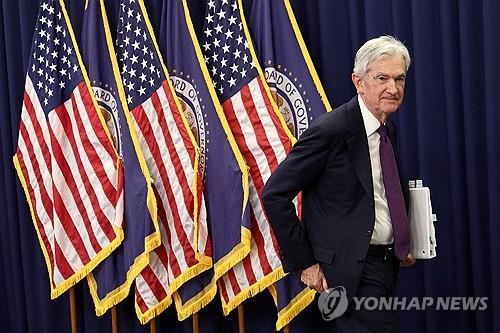
At today's press conference, Chairman Powell said, "What happens over the next 30 days, 60 days, even before the next (June) meeting, could significantly change the background circumstances around that phrase."
He added that he did not want to prejudge future meetings, but "a change could be made at a certain point, and that change could come as early as the next meeting."
Meanwhile, the dissenting opinions of the three regional Fed presidents today are seen as revealing the stark division of views within the Fed ahead of the launch of the Warsh regime next month.
Brent Schutte, Chief Investment Officer (CIO) at Northwestern Mutual, told CNBC regarding today's expression of dissenting opinions, "It highlights the likelihood of more similar situations occurring in the coming months as a new chairman focused on Fed change takes office," adding, "Furthermore, it reflects the reality that the short-term economic outlook is in a highly uncertain situation."
Ahead of today's FOMC results announcement, the US Senate Banking Committee approved the nomination of Warsh.
With the uncertainty surrounding the committee vote, which had blocked the approval, now lifted, Warsh is expected to smoothly take office after a Senate floor confirmation vote, following the end of current Fed Chair Jerome Powell's term on May 15th next month.
At today's press conference, Chairman Powell said, "Today's press conference will be my last as Chairman," and "I congratulate on the Senate Banking Committee's passage of the Warsh nomination."
However, he stated that he would retain his position as a Fed Governor even after his term as Fed Chair ends on May 15th. Powell's term as a Fed Governor, separate from his term as Chair, runs until January 2028.
Meanwhile, market participants interpreted today's Fed decision and Chairman Powell's remarks as hawkish (preferring monetary tightening).
According to CME's FedWatch, the interest rate futures market reflected an approximately 12% probability that the Fed would raise the benchmark interest rate by more than 0.25 percentage points by December. Just a day earlier, this probability was 0%.
As market participants withdrew expectations for a rate cut this year, the probability of the Fed freezing rates this year rose from 80% the previous day to 85% today.
Bond yields rose (bond prices fell) due to concerns about prolonged high oil prices and expectations of the Fed's hawkish policy stance.
According to the electronic trading platform Tradeweb, the yield on 10-year US Treasury notes was 4.42% around the close of the New York stock market, up 6 basis points (1bp=0.01 percentage point) from the previous session, reaching its highest level in a month since late March.
Newsletter
Get key news delivered to your email every morning
to leave a comment.