
to leave a comment.
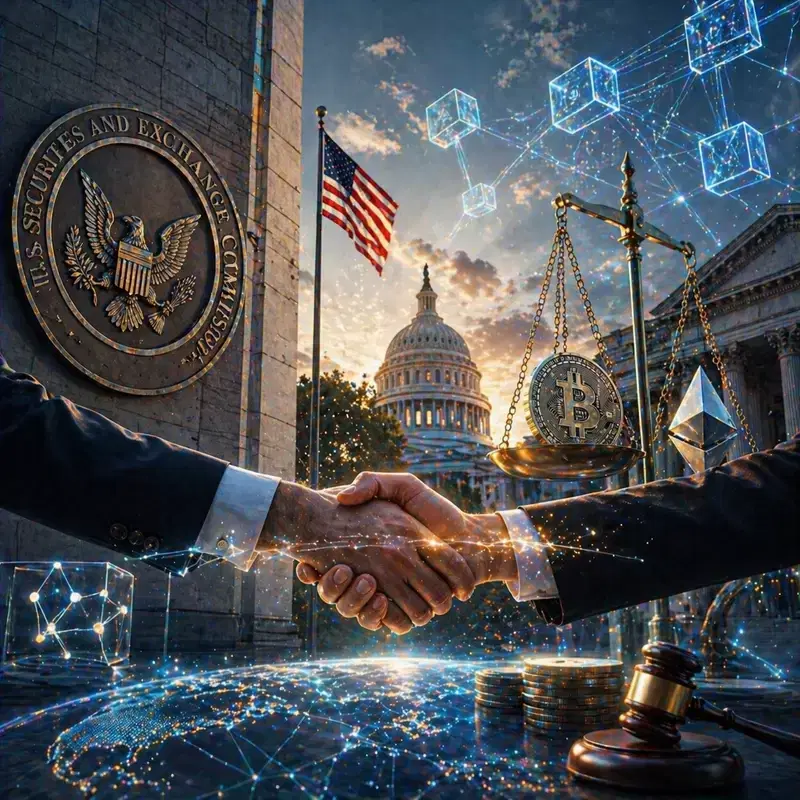
▲ U.S. Securities and Exchange Commission (SEC), Cryptocurrency Regulation, Cryptocurrency Innovation/AI Generated Image
The U.S. Securities and Exchange Commission (SEC) has declared a new era embracing innovation, moving away from enforcement-centric regulation of virtual assets, and pledging full support for the establishment of a blockchain-based financial system.
SEC Commissioner Paul Atkins declared on April 28 (local time) at Bitcoin 2026 in Las Vegas that the SEC's regulatory stance has changed 180 degrees. Atkins stated, "In the past, the SEC either ignored digital assets or relied solely on enforcement," adding, "Now, we are focused on removing obstacles that hinder innovation." He explained that this faithfully fulfills President Donald Trump's challenge to create a tech-friendly environment so that innovators in the U.S. do not leave the country to avoid complex regulatory procedures.
The SEC is establishing an unprecedented cooperative relationship with the Commodity Futures Trading Commission (CFTC) to resolve regulatory uncertainty. Atkins stated that he has been in close communication with CFTC Chairman Mike Selig, developing joint interpretive guidance for tokenized securities, thereby ending jurisdictional disputes between the agencies. Furthermore, by reinterpreting the 1946 Howey case in a modern context, it was clarified that the essence of a security is not the token itself but the promises and expectations surrounding it. This is the result of a principle-based approach that provides guidelines to exclude digital goods, collectibles, and stablecoins from the scope of securities.
The passage of the stablecoin regulation act GENIUS marked a significant leap forward for the virtual asset market. Atkins praised the act for clearly recognizing that stablecoins are not securities. However, he emphasized that institutionalization through congressional legislation is essential for favorable policies to continue under the next administration. He analyzed that only when the U.S. cryptocurrency market structure bill is passed will the legal foundation be solidified, creating a future-proof environment where innovators can confidently pursue their businesses.
The introduction of stock tokenization using distributed ledger technology and real-time settlement systems is an alternative that will fundamentally revolutionize risks in the financial market. Atkins plans to actively foster T+0 settlement, an on-chain-based instant settlement system, to minimize investor risks arising from the time lag between trading and settlement. These changes will also benefit existing financial sector participants and are expected to strengthen U.S. financial competitiveness, providing consumers with an optimal investment environment. Virtual assets, including Bitcoin (BTC), are now recognized for their asset value within a transparent institutional framework.
The SEC is expected to announce innovative exemption provisions in the coming weeks, paving the way for companies to issue and trade security tokens on-chain. As various assets, including XRP, are traded in the market according to a clear classification system, liquidity across the entire virtual asset ecosystem is expanding. Atkins is doing his best to establish legal safeguards to ensure that regulatory directions are not swayed by election results. The U.S. financial system, combined with blockchain technology, has entered a new phase, simultaneously ensuring efficiency and reliability.
*Disclaimer: This article is for investment reference only, and we are not responsible for any investment losses based on it. The content should be interpreted for informational purposes only.*
Newsletter
Get key news delivered to your email every morning
to leave a comment.