
to leave a comment.
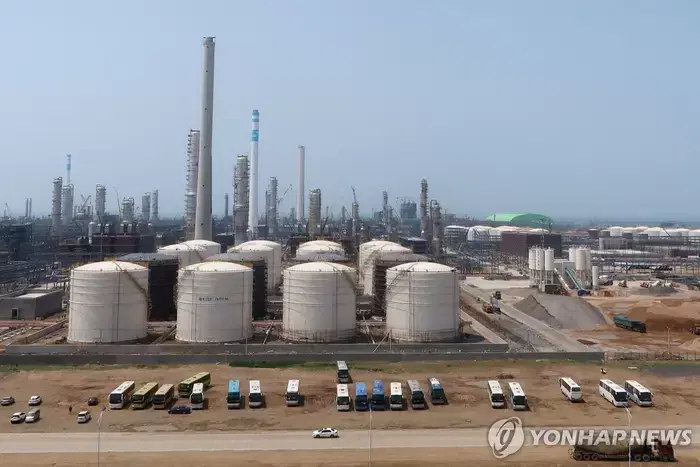
China Hengli Group refinery
The U.S. Treasury Department and State Department announced on the 24th (local time) sanctions against Hengli Group, a major Chinese refiner that imports oil from Iran.
The Office of Foreign Assets Control (OFAC) under the Treasury Department pointed out that Hengli Group is one of the 'largest customers' purchasing billions of dollars worth of Iranian oil.
The Treasury Department's assessment is that Chinese refiners, including Hengli Group, are providing economic support to Iran, including the Iranian military, by importing such sanctioned oil.
Hengli has the capacity to process approximately 400,000 barrels of crude oil per day through its refining facilities in Dalian, a port city in northeastern China, making it the largest among individual Chinese refiners, known as 'teapots'.
The Treasury Department also announced sanctions against approximately 40 shipping companies and vessels operating a 'shadow fleet' that transports Iranian oil to evade sanctions.
Companies and vessels subject to sanctions will have their assets in the U.S. frozen, and their financial interests blocked. Sanctions will also be imposed on entities in which they directly or indirectly own 50% or more equity, and on institutions that transact funds, goods, or services with them.
Along with this, the Treasury Department froze cryptocurrencies worth approximately $344 million (about 500 billion won) believed to be linked to Iran.
Treasury Secretary Scott Bessent stated on his X account that OFAC is sanctioning 'several wallets' linked to Iran, adding that it "will systematically weaken Tehran's ability to generate, move, and bring funds back home."
Secretary Bessent said, "We will track the funds Tehran is desperately trying to move abroad and target all financial lifelines connected to the regime."
CNN reported that this cryptocurrency freeze was carried out through Tether, the issuer of USDT, the world's largest stablecoin, based on information provided by the Treasury Department.
Previously, the Treasury Department had initiated an 'Economic Fury' operation to exert economic pressure on Iran, including hinting at the possibility of 'secondary boycotts' (secondary sanctions) against two Chinese banks where Iranian funds were suspected to have flowed.
Secretary Bessent said, "The 'Economic Fury' operation will help weaken Iran's aggression in the Middle East and curb its nuclear ambitions by imposing financial pressure on the Iranian regime."
Secretary Bessent added, "Under the direction of President Donald Trump, we will continue to tighten the network of vessels, intermediaries, and buyers that Iran relies on to move its oil to global markets."
Since February last year, the Treasury Department has sanctioned more than 1,000 Iran-related individuals, vessels, and aircraft through OFAC.
The Treasury Department's announcement of sanctions is interpreted as a measure to pressure both sides to accept the U.S. demands as much as possible in the second round of peace talks by targeting China, Iran's largest oil exporter, following a maritime blockade against Iran. The timing of this sanction announcement, ahead of U.S. President Trump's visit to China in mid-next month, also suggests an aspect of securing leverage against China.
Secretary Bessent explained, "China has purchased over 90% of Iranian crude oil," adding that "this accounts for about 8% of China's energy demand."
Newsletter
Get key news delivered to your email every morning
to leave a comment.