
to leave a comment.
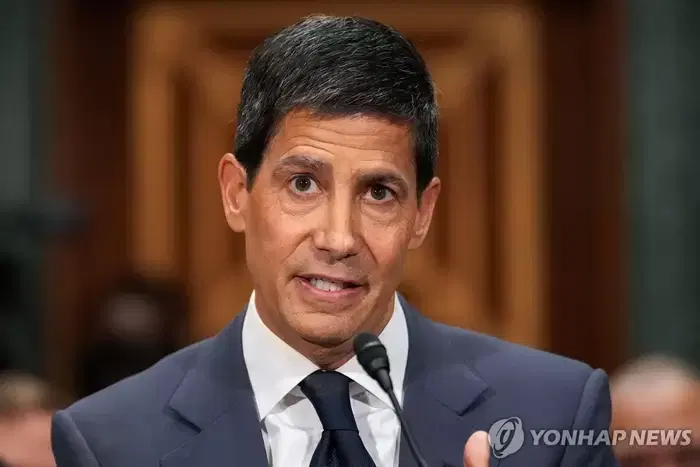
Kevin Warsh, nominee for Fed Chair, attending a Senate confirmation hearing
Kevin Warsh, nominee for Chairman of the U.S. Federal Reserve (Fed), stated on the 21st (local time) that while presidents generally prefer interest rate cuts, he has no intention of simply following suit.
During his confirmation hearing before the Senate Banking Committee today, Warsh said, "Presidents tend to prefer interest rate cuts. The difference is that President Donald Trump expresses it very openly, without proxies or prevarication."
He continued, "But the independence of the Fed rests with the Fed. The Fed leadership must decide for itself what is right," adding, "I do not believe that the independence of monetary policy is threatened simply because elected officials express their views on interest rates."
This is interpreted to mean that even if President Trump, the "elected official" who nominated him as the next Fed Chair, pressures for interest rate cuts, he will determine monetary policy based on the Fed's independent judgment.
When asked if he would become President Trump's "human puppet" if confirmed, Warsh replied, "Absolutely not." He added, "It is an honor that the President nominated me for this position, and if I am confirmed as Fed Chair, I will act independently (not as a puppet)."
He stated, "I don't know why the President chose me," and "I did not say anything to the President like, 'If you give me the position, I will cut interest rates.'"
Warsh avoided a direct answer to the question of whether a drastic interest rate cut to below 1%, as demanded by President Trump, would act as an inflationary factor, stating, "Unlike many of my colleagues (at the Fed), I do not believe in forward guidance. I don't think we should pre-announce future decisions."
Forward guidance is the practice of pre-announcing the path of monetary policy to reduce market uncertainty, and it is operated by central banks in various countries, including the Fed and the Bank of Korea.
Regarding the criticism that the Personal Consumption Expenditures (PCE) price index might exceed the target due to the Trump administration's tariff policies, he replied, "I do not agree."
Referring to the concept of the 'tyranny of the status quo' proposed by economist Milton Friedman, Warsh said, "Status quo practices and policies are particularly harmful when the world is changing so rapidly," adding, "A reform-oriented Fed can bring real change to the American people."
He emphasized, "The data used to judge inflation is quite imperfect," and "One of the tasks the Fed needs to do is to utilize new understandings. And to understand what the actual inflation in the economy is through new data sources."
He then said, "We used the core PCE index, excluding food and energy. This was to roughly estimate what the (price) situation was. Now, there is no need for such rough estimates," adding, "What I am most interested in is the 'underlying inflation rate'."
To this end, he introduced, "One of the first reform tasks I want to pursue at the Fed is to start a data project. It's about conducting an evaluation together with the public and private sectors to survey a billion prices," explaining, "The change in the 500,000,001st price among them is inflation." This is interpreted to mean that the median value from a large-scale price survey, removing extreme prices or temporary change factors, would be used as the benchmark indicator for measuring inflation.
Warsh stated, "I believe price stability is a change in prices that no one talks about," and then added, "Economics is neither physics nor mathematics," emphasizing, "In economics, we should focus on the left side of the decimal point, not the right. We should focus on the big problems."
Warsh, who was nominated as the next Fed Chair on January 30, was once considered a 'hawk' in monetary policy, advocating for tightening, as seen from his resignation as a Fed governor in 2011 in opposition to the second round of quantitative easing. However, more recently (before his nomination as Fed Chair), he has shown sympathy for President Trump's arguments for interest rate cuts.
While current Fed Chair Jerome Powell's term is until next month, Warsh must pass a Senate confirmation vote to take office.
Some quarters believe that, irrespective of today's hearing, the confirmation vote could be delayed.
As the U.S. Department of Justice continues to show its intent to investigate Chairman Powell regarding excessive spending on the renovation of the Fed building, Senator Thom Tillis (R-NC), a member of the Senate Banking Committee, has previously stated his opposition to Warsh's confirmation until the investigation issues against Chairman Powell are resolved.
The Senate Banking Committee, composed of 24 members in total, currently has a composition of 13 Republicans and 11 Democrats. If all Democratic members and at least one Republican member express opposition, the confirmation bill cannot pass the committee.
Newsletter
Get key news delivered to your email every morning
to leave a comment.