
to leave a comment.
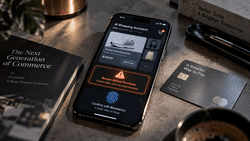
▲ Photo: AI-generated image
An AI assistant that, when online shopping, automatically compares prices, applies discount coupons, selects delivery addresses, and then says, "Payment complete." Just imagining it feels like a savior to office workers on their way home who don't want to lift a finger.
In fact, Mastercard, in partnership with Denmark's largest bank, successfully completed Europe's first demonstration test where AI directly approved payments when a consumer booked a coffee tasting with just a word. But what if an AI, holding my credit card number and account password, buys the wrong option or sends money to the wrong account, tricked by a clever shopping mall hacking scam? Who should bear that loss?
In the past 24 hours, the global financial industry's attention has turned to the 'shadow of convenience' that AI autonomous payments could bring. According to the global financial specialized media PYMNTS on the 22nd (local time), a coalition of major global banks released a joint report warning of the risks of large-scale fraud and payment disputes lurking behind the rapid growth of 'Agentic Commerce'.
A banking sector survey revealed that while AI is widely used, with 50% of US consumers using AI for shopping and 22% starting their product searches with AI, only 24% of consumers responded that they would "fully entrust AI with final payments involving money." This shows that 76% of consumers still expressed anxiety, saying they "are not confident that AI will safely protect their money on their behalf."
The biggest concern for banks is the 'gap in dispute liability.' The current credit card and bank transaction systems are designed on the premise that a person directly enters a password or recognizes a fingerprint, leaving a clear intention of approval, "I made the payment." However, if an AI agent intervenes to select products and process payments, it becomes extremely difficult to prove whether it was a simple malfunction of the AI, an erroneous payment due to a hacker's prompt manipulation (injection), or an order due to a change of mind.
The fact that some small AI commerce startups prioritize low-security payment methods or use illicit means to bypass standard financial security networks to speed up payments has also been identified as a trigger for increasing fraud crimes.
This also rings a heavy warning bell for the Web3 and digital asset ecosystems. Currently, in the decentralized finance (DeFi) and Web3 camps, micropayment networks where AI agents use stablecoins to settle data costs or API usage fees in real-time are gaining popularity. However, unlike bank credit cards, blockchain transactions inherently lack a 'chargeback' function. If an AI agent is tricked by a smart contract on a malicious on-chain phishing site and approves stablecoins in its wallet, the affected assets will permanently disappear on the spot.
Ultimately, in an era where AI assistants open our wallets for us, the best strategy for consumers is 'staged separation of control.' While delegating the tedious tasks of searching for the lowest price, summarizing reviews, and comparing value-for-money products to AI, the "final act of sending money and swiping a card" should never be entirely delegated to a machine.
Until financial institutions fully establish legal liability and safety standard specifications, payment limits per transaction should be minimized, and human final approval (Human-in-the-loop) procedures involving fingerprint or facial authentication should never be turned off.
Newsletter
Get key news delivered to your email every morning
to leave a comment.