
to leave a comment.
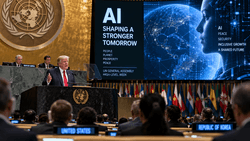
As the 81st UN General Assembly opened on the 22nd (local time) at the UN Headquarters in New York, USA, AI emerged as a key agenda item that will determine the next international order. The positions put forth by various heads of state largely split into three.
In his speech that day, U.S. President Donald Trump clearly stated his opposition to international regulations suppressing AI development and his intention to protect America's technological leadership. He said, "The United States fully rejects any attempt to control AI," and "We will not suppress the growth of technology that will be greater than the Industrial Revolution."
He also stated that if AI poses risks, the existing judicial system can address them. President Trump has consistently maintained that warnings about AI posing an existential threat to humanity are "exaggerated," and on this day, he also declared that the U.S. government documents would use the term 'super intelligence' instead of AI going forward.
▲ Photo: AI-generated image
Chinese President Xi Jinping, who is competing with the U.S. for AI hegemony, did not attend this General Assembly, and Vice President Han Zheng attended instead. In contrast, French President Emmanuel Macron proposed a 'third way' for other countries to pool computing resources and investment capabilities to jointly develop open AI models to avoid technological dependence on the two superpowers, the U.S. and China. He said, "No one wants to be a vassal state of a great power," and "We must work together to build open-source frontier models." AFP interpreted the 'great powers' he referred to as the United States and China.
UN Secretary-General António Guterres, whose term ends later this year, likened the AI hegemony competition to the danger of nuclear weapons during the Cold War and called for the establishment of international safeguards. He emphasized, "During the Cold War, rival nations recognized the need to manage shared existential risks," and "Today, AI demands the same sense of purpose and urgency." Specifically addressing leading AI nations like the U.S. and China, he proposed establishing channels for dialogue, transparency, and trust, stating, "Governments with the most powerful AI capabilities bear the greatest responsibility to humanity."
He also proposed establishing a 'multilateral AI risk management framework' with an independent oversight system, and expressed opposition to so-called 'killer robots' that autonomously select and attack targets, stating, "Decisions of life and death should not be handed over to machines."
From the U.S.'s 'rejection of regulation' to France's 'third way' and the UN's 'international cooperation,' this General Assembly shows that countries' calculations regarding AI have now moved beyond technological competition to become a formal agenda item on the diplomatic stage.
Newsletter
Get key news delivered to your email every morning
to leave a comment.