
to leave a comment.
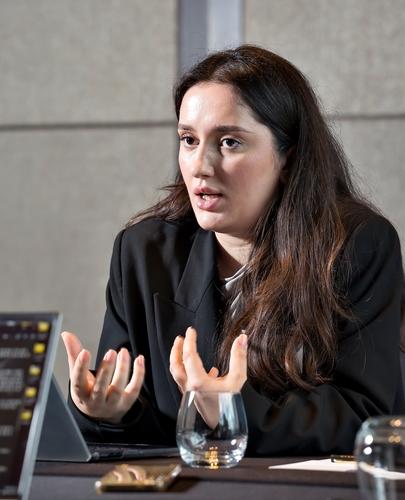
Vice Chairman Noyoftova visits Korea to attend 'The 19th Seoul ODA International Conference'
'Strengths in hydropower and young population... Actively attract Korean companies in AI, robotics, and satellite sectors'
'The core of Sovereign AI (Artificial Intelligence Sovereignty) is to build infrastructure within one's own territory, rigorously control the data produced within it, and enable local engineers to operate the systems directly.'
Najima Noyoftova (26), Vice Chairman of the Tajikistan AI Committee, met with Yonhap News at Conrad Seoul in Yeongdeungpo-gu, Seoul on the 18th and said, 'If Korea's technology and Tajikistan's clean energy combine, a new AI hub in Central Asia can be created.'
The interview with Vice Chairman Noyoftova was conducted during her recent visit to Korea to attend 'The 19th Seoul ODA International Conference,' co-hosted by the Ministry of Foreign Affairs and the Korea International Cooperation Agency (KOICA), and to discuss Korea-Central Asia cooperation.
She is the co-founder of 'Epsilon3,' an AI company that builds and deploys sovereign AI solutions. At the AI Committee under the Ministry of Industry and New Technologies of Tajikistan, she is responsible for Tajikistan's AI policy, the introduction of AI in the public sector, and international cooperation.
The Tajik government is currently pursuing 'digital transformation' and fostering private IT companies as key national tasks to leap from an agriculture-centered economy to a knowledge and information society. However, the IT infrastructure and startup ecosystem are still weak, making it necessary to lay the foundation.
Vice Chairman Noyoftova explained that while discussions on AI are active locally, its application in industry and public policy is still in its early stages. Accordingly, Tajikistan is focusing on linking AI with digital transformation to apply it to actual administration and industrial sites.
In response to this demand, KOICA is collaborating with the Agency for Innovation and Digital Technologies (AIDT) under the Office of the President of Tajikistan to promote a project to establish a 'Korea-Tajikistan IT Park' in the capital Dushanbe, investing 13.5 million dollars (approximately 18.6 billion KRW) from 2027 to 2032.
This project includes not only the construction of the IT Park but also the establishment of a master plan, AI-based learning diagnosis and performance measurement systems, AI-based startup incubation training, and events for discovering and fostering IT startups.
The IT Park will be equipped with corporate occupancy spaces, co-working spaces, meeting rooms, conference halls, as well as AI-related spaces and server, storage, and network equipment.
The Tajik government is providing the project site, electricity, high-speed internet, and water, and is reviewing administrative and financial support such as corporate tax, value-added tax, and customs duty exemptions for resident companies.
The idea is to utilize this IT Park as an innovation platform to attract AI-utilizing companies, going beyond a mere facility for telecommunications companies.
In particular, there are plans to establish a separate 'AI Free Zone' (Area AI) within the complex, where import duties and all associated fees will be fully exempt (0%), to attract a large number of excellent Korean tech companies as well as global enterprises.
The AI Free Zone, as explained by Vice Chairman Noyoftova, encompasses AI-related hardware, robotics, and more. She expressed hope for the participation of Korean companies, stating, 'The goal is to enable foreign companies to come in, produce technology, and sell it from Tajikistan to other parts of Central Asia.'
However, the AI Free Zone is not yet a physically completed area. The Tajik government formed an AI consortium involving local and international companies and government agencies in October 2025, and opened its first hub in January this year. Procedures for finalizing investment benefits, such as tax incentives, are currently underway.
She cited robotics, drones, and satellite sectors as areas of cooperation with Korea, in addition to AI infrastructure.
Vice Chairman Noyoftova said, 'Tajikistan has affordable and clean hydropower, a young population, and a government open to innovation,' adding, 'Korea possesses technology and industrial expertise, data center and energy systems, and capabilities in robotics and satellite sectors.'
She further suggested, 'Korean investment in eco-friendly AI data centers utilizing hydropower, local production and assembly of robot and drone systems, and joint training for engineers are all possible.'
In the satellite sector, they are considering cooperation with Korean companies on a project to monitor lakes in mountainous regions. The plan is to observe mountainous areas via satellite, and for relevant companies to establish satellite-related bases within Tajikistan's industrial complex to expand business into Central Asia.
The Tajik government's utilization of AI is also expanding. Vice Chairman Noyoftova explained that their government combines separate systems to allow the use of global AI tools while managing sensitive government data within internal infrastructure.
She stated, 'Governments hold sensitive information, making it difficult to simply use global AI tools.' She added, 'We educate public officials to understand how to use AI safely, its accuracy and limitations, and we provide a preliminary period for sufficient usage before full implementation.'
Vice Chairman Noyoftova is also interested in Korea's e-government experience. She evaluated Korea's e-government as a best practice and expressed a desire to learn about inter-agency information sharing, AI governance, and public-private cooperation models.
Energy and water resource management using AI are also cited as areas of cooperation between the two countries. Tajikistan is rich in hydropower and water resources but needs to address increasing electricity demand in winter and seasonal water shortages.
She emphasized, 'If AI is used to predict electricity and water demand, the efficiency of reservoir operation and water distribution can be increased,' adding that combining Korea's Green ODA with such AI models could create practical climate adaptation synergies.
In the interview, she also made it clear that to reduce the AI gap in developing countries, there is a need to move away from the existing one-sided aid approach.
Vice Chairman Noyoftova stated, 'We should not only look at what developing countries need but also what they can offer.' She added, 'Tajikistan can provide water resources, energy, and a young population, while Korea possesses advanced technology, industrial expertise, and capital.'
She further conveyed, 'Combining the resources each country possesses to build capabilities together is effective cooperation,' adding, 'I hope that the two countries will create specific joint projects to continue their cooperation.'
Newsletter
Get key news delivered to your email every morning
to leave a comment.