
to leave a comment.
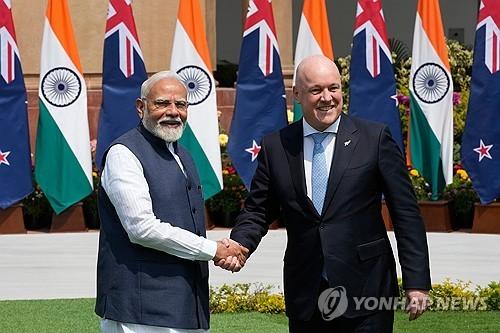
New Zealand: "Opportunity for businesses to enter India"…India: "Building an ambitious partnership"
The Free Trade Agreement (FTA) between India and New Zealand, signed last April, will take effect on the 20th of next month.
According to Reuters and Bloomberg on the 22nd (local time), New Zealand Trade Minister Todd McClay exchanged the instruments of ratification for the bilateral FTA with New Zealand High Commissioner to India, Muanpui Saiawi, in parliament the previous day.
New Zealand Prime Minister Christopher Luxon explained that following his country's parliament passing the necessary legislation to implement the FTA with India last week, the government also ratified the agreement.
The FTA between India and New Zealand is scheduled to take effect on the 20th of next month, in accordance with the prior agreement stating that it "shall enter into force 30 days after the date on which the two countries exchange written notifications confirming the completion of their domestic legal procedures."
Minister McClay expressed in a statement, "The bilateral FTA will create a level playing field and open up opportunities for New Zealand businesses to enter India, one of the fastest-growing markets in the world."
Indian Minister of Commerce and Industry Piyush Goyal also emphasized at a press conference the previous day that "(the FTA with New Zealand) is a shared commitment to building a stronger and more ambitious partnership."
Going forward, India will reduce or abolish tariffs on 95% of New Zealand goods, while New Zealand will eliminate tariffs on all Indian goods.
Minister McClay stated that "57% of New Zealand's exports to India, including lamb, wool, and coal, will be exempt from tariffs from the first day of entry into force."
He added that over 95% of forestry products and timber exports will also be exempt from tariffs from the first day of entry into force, and exporters will receive a second round of tariff reductions on January 1st next year.
However, sensitive agricultural sectors for India, such as dairy products, coffee, sugar, and spices, were excluded from liberalization to protect domestic producers.
India expects New Zealand's exports of textiles, leather, footwear, seafood, and automobiles to be boosted.
New Zealand has decided to invest 20 billion dollars (approximately 27.2 trillion won) in India over the next 15 years.
Furthermore, both countries have pledged to double their trade volume, currently 2.3 billion dollars (approximately 3.13 trillion won) annually as of June this year, by 2030.
India is working to reduce its dependence on the US and China and diversify its export markets, having signed an FTA with the UK in July last year and with the European Union (EU) in January this year.
Newsletter
Get key news delivered to your email every morning
to leave a comment.