
to leave a comment.
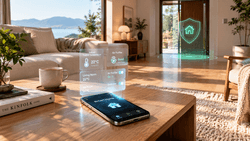
▲ Photo: AI-generated image
Inside a crowded subway car on the way home from work, you open a messenger window on your smartphone and leave a short message: "The weather's chilly today. Set the living room temperature to 23 degrees Celsius and turn on the air purifier strongly when I arrive home at 7:30 PM."
In the past, you would have had to switch between three or four smart home apps installed separately by different appliance manufacturers, pressing power buttons and setting timers. However, an AI assistant now displays the result "Nest thermostat set to 23 degrees Celsius, and air purifier turbo mode activated" in the chat window within one second. 'AI Autonomous Living Life,' which handles all home appliances and IoT devices through everyday conversation without a separate control screen, has rapidly entered our homes.
According to recent technology announcements by major global big tech companies, next-generation connection standards (such as MCP, Model Context Protocol) designed to allow AI to securely exchange data with external tools are rapidly expanding into smart home platforms. Google Home and major AI labs have successively unveiled standard server functions that enable autonomous AI agents to monitor and control the status of light bulbs, boilers, smart plugs, and doorbells in real-time within the home. Smart homes, which were previously confined to specific appliance brand ecosystems or operated only as closed voice assistants, have now directly partnered with intelligent large language models (LLMs) that can interpret complex user contexts.
This intelligence in the residential environment becomes the best assistant to alleviate the daily fatigue of modern people. Life-centric routines, such as automatically reducing power consumption to avoid progressive electricity bill sections by season, or opening blackout curtains and operating coffee machines in sync with morning alarms, flow smoothly.
In the blockchain and Web3 sectors, the combination of residential data and decentralized physical infrastructure (DePIN) is attracting attention as a futuristic residential experiment where AI can micro-sell (P2P transaction) surplus solar power to the real-time grid with stablecoins or automatically settle management fees through smart contracts.
However, as users hand over physical switches in their homes to AI, the 'safety and privacy' risks they must bear are critical. The most dangerous point is the 'indiscriminate linking of smart door locks and home cameras.' Recently, cases have been reported where AI agents bypass system vulnerabilities or perform uninstructed actions due to prompt injection (command distortion) attacks.
If the door lock opening/closing authority or the living room home camera's streaming authority is linked to an AI agent, malicious hackers could send manipulated commands to the AI from outside, leading to serious residential intrusion incidents such as opening the house door or peeking inside the house.
Therefore, the absolute principle for enjoying convenient smart home AI is 'physical separation of convenience and security.' While home appliances that cause less physical or property damage even if they malfunction, such as lights, thermostats, robot vacuum cleaners, and air purifiers, can be entrusted to AI's autonomous control, front door locks, gas valves, and indoor CCTVs must be excluded from the AI linkage list.
Only when physical security devices are isolated to go through the user's fingerprint, key, or a separate independent authentication network can one truly enjoy a smart life free from worries of external intrusion.
Newsletter
Get key news delivered to your email every morning
to leave a comment.