
to leave a comment.
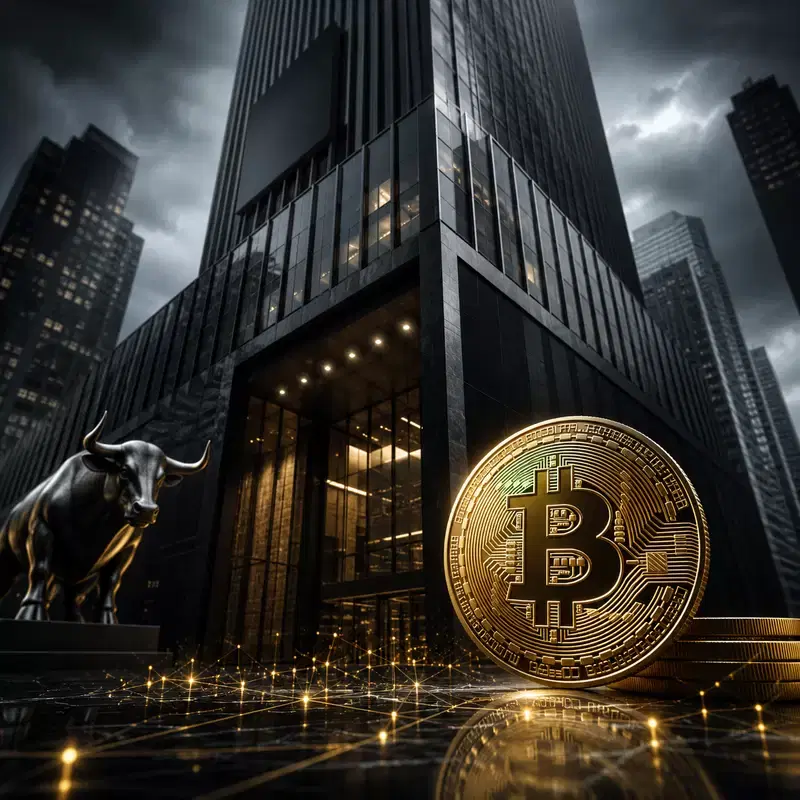
▲ Bitcoin (BTC), Wall Street/AI-generated image
Bitcoin (BTC), which started with the aim of dismantling Wall Street's financial system, has, after 15 years, completely transformed into a core global reserve financial asset, taking over Wall Street, the heart of traditional finance.
Crypto-focused YouTube channel Coin Bureau analyzed in a video uploaded on September 17 (local time) that Bitcoin has transitioned from a niche asset to a core portfolio holding for global institutional investors, following the entry of major financial institutions into the custody business and the approval of spot exchange-traded funds. In 2020, during the COVID-19 pandemic, as the Federal Reserve (Fed) supplied unlimited liquidity, including purchasing approximately $2.36 trillion in Treasury bonds and mortgage-backed securities, Bitcoin, with its limited supply of 21 million BTC, began to gain attention as an inflation hedge asset. Legendary macro investor Paul Tudor Jones officially announced his purchase, and British asset manager Ruffer allocated 2.5% of its assets to Bitcoin, recognizing it as a store of value.
The undisputed leader of the wave of corporate Bitcoin treasury adoption was Strategy. As the real value of cash assets declined, CEO Michael Saylor invested $250 million to acquire 21,454 BTC in August 2020, and then issued convertible bonds, securing 70,469 BTC with an investment of $1.1 billion by the end of the same year. Major corporations followed suit, including Square's $50 million purchase, conservative insurer MassMutual's $100 million acquisition, and Tesla (TSLA)'s $1.5 billion investment. Fidelity, Coinbase (COIN), and BNY Mellon (BK), among others, rapidly built institutional custody and trading infrastructure.
Crises that tested market confidence also followed. Starting with the Terra and Luna collapse in 2022, Three Arrows Capital, Celsius, and Voyager went bankrupt in a chain reaction, and even giant exchange FTX collapsed due to a liquidity crisis, causing Bitcoin's price to plummet below the $16,000 mark. While numerous centralized crypto asset companies collapsed due to leverage failures, the Bitcoin network itself continued to process on-chain transactions normally without interruption, demonstrating the reliability of decentralized protocols to the market.
The biggest turning point for institutional adoption came after a legal battle. After Grayscale won its lawsuit against the U.S. Securities and Exchange Commission (SEC), 11 Bitcoin spot ETFs, including BlackRock (BLK) and Fidelity, were approved simultaneously on January 10, 2024. BlackRock's IBIT surpassed $20 billion in net assets in just five months, then exceeded $51 billion by year-end, attracting sovereign capital as well, with not only Goldman Sachs (GS) and Morgan Stanley (MS) but also Abu Dhabi sovereign wealth fund Mubadala disclosing investments of $437 million.
Bitcoin, once ostracized outside the financial system, has now been elevated to an official reserve asset for major Wall Street asset managers, banks, and national institutions. Bitcoin, emerging as a key variable in macroeconomics, monetary policy, and geopolitical dynamics, is fundamentally reshaping the landscape of global capital markets.
[Article Key Summary]
-Driven by COVID-19 liquidity injections and inflation concerns, global corporations like Strategy began actively purchasing Bitcoin (BTC) as a reserve asset.
-Despite the Terra and FTX bankruptcies in 2022, Bitcoin proved its network stability and found its place within Wall Street's institutional framework with the approval of spot ETFs in January 2024.
-With BlackRock's (BLK) fund surpassing $51 billion and the participation of the Abu Dhabi sovereign wealth fund, Bitcoin's status has been elevated to a core global financial asset.
*Disclaimer: This article is for investment reference only, and we are not responsible for any investment losses based on it. The content should be interpreted for informational purposes only.*
Newsletter
Get key news delivered to your email every morning
to leave a comment.