
to leave a comment.
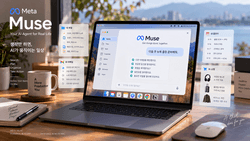
▲ Photo: AI-generated image
Artificial intelligence (AI) is moving beyond smartphones and into personal computers. As Meta expands its personal AI agent ‘Muse’ to Mac, the era where AI searches users' files, emails, and calendars, and handles tasks across multiple apps, is drawing near.
As AI evolves from 'chatbots' that answer questions to 'agents' that act on behalf of users, the way we work and shop is also changing. Users are now expected to explain their goals to AI and verify the results, instead of directly finding files and manually organizing emails.
Meta Launches Muse for Mac
On the 18th, Meta unveiled the Mac app for its personal AI agent, Muse. While Muse has previously been available mainly on mobile, web, and WhatsApp, the Mac app extends its utility to the desktop environment, including files, mail, calendars, and messages stored on the user's computer.
Muse doesn't just answer questions; it performs tasks by navigating various applications. If a user requests, “Find last month's meeting materials, summarize the key points, and add the next meeting schedule to the calendar,” Muse can search relevant files and emails, summarize them, and even register the schedule.
Complex tasks such as “Find the quotation sent by the client last week and draft a reply” are also possible. Even if the user doesn't accurately remember the file name or storage location, they can describe the desired task in natural language, and the AI will find and process the relevant data.
Meta's expansion of Muse to Mac demonstrates that the scope of personal AI agents is extending beyond mobile apps to work computers. However, the actual accessible files, apps, and executable tasks may vary depending on the user's permission settings and the service provider's scope.
Difference Between Chatbots and Agents
Traditional chatbots provided answers when users entered questions. It was up to the user to send emails or organize files after receiving an answer.
AI agents directly intervene in this process. After receiving a goal, they search for necessary information, manipulate various apps, and create results within a defined scope.
Ultimately, the competitiveness of an AI agent lies not in how naturally it can write sentences, but in what actions it can actually perform within the user's digital environment.
Online Shopping Also Moving Towards 'Agent-to-Agent Transactions'
The spread of AI agents is changing not only desktop work but also the structure of online shopping.
Recently, 'agent-to-agent transactions,' where a consumer-side AI agent and a seller-side AI system directly exchange information, are gaining attention. This method allows AI to compare prices, inventory, and delivery conditions and place orders without the consumer directly visiting a shopping mall.
For example, if a consumer requests, “Find a laptop under 1.5 million won with 32GB or more memory,” the consumer's AI requests product information from the seller's system. Subsequently, it compares prices, specifications, compatibility, and delivery dates to recommend suitable products.
In this process, it becomes more important whether product information is organized in an AI-readable format than the design of the product page. This is because if price, inventory, specifications, shipping costs, return conditions, and certification information are not structured, it is difficult for AI to accurately compare products.
Sellers will need to deal with both people and AI as customers in the future. This means building systems that not only provide attractive product pages for humans but also reliable information for AI agents.
Will AI Reduce Smartphone Usage?
Ericsson ConsumerLab surveyed over 43,000 smartphone users in 27 markets and predicted that the number of agentic AI users, currently around 4%, will significantly increase by 2030. Respondents anticipated using AI agents for schedule management, product comparison, repetitive purchases, and health monitoring.
Among the respondents, 38% expected to use agentic AI by 2030, and about two-thirds predicted daily interaction with AI. Some respondents also stated that AI agents could reduce the time spent directly operating smartphone screens by up to one hour per day.
However, a reduction in direct smartphone viewing time does not mean a decrease in digital activity itself. While AI processing searches, bookings, and comparison tasks in the background may reduce user screen interaction, the data and network activity used by AI could increase.
Ericsson analyzed that agentic AI will change the demand for mobile communication networks, increasing the importance of not only network speed but also latency, stability, and security.
The Authority Problem Behind Convenience
If AI reads files, emails, and even manages schedules, users' repetitive tasks will decrease. However, if AI reads the wrong files or sends emails to the wrong people, the scale of damage could also increase.
Therefore, AI agents need a function to separate permissions by task. For example, allowing only read access to files but prohibiting deletion, or only allowing email draft creation and requiring user approval for sending.
CoinReaders' Perspective: Digital Rights Management for AI
When AI agents go beyond reading files and sending emails to ordering and paying for goods, AI becomes the user's digital proxy.
What's important here is not AI's intelligence, but permission management.
-Which AI agent requested the transaction?
-What conditions did the user approve?
-What is the amount and scope AI can use?
-Was the actual transaction executed within the approved scope?
-Who is responsible if a problem occurs?
Blockchain-based identity and access management technologies can be used to verifiably record permissions and transaction histories for each AI agent. However, it is difficult to conclude that blockchain has been established as an essential foundation for AI agents. Existing authentication and payment systems and various access management technologies are currently competing and integrating in the market.
Changes Likely to Appear First in Korean Daily Life
In Korea, AI agents are highly likely to be utilized first in the following areas:
Searching and organizing work files and emails.
Summarizing meeting materials and registering schedules.
Repetitive grocery shopping and regular deliveries.
Travel itinerary and accommodation/transportation booking.
Comparing price, inventory, and delivery conditions.
Automated purchase of data and APIs between companies.
Especially if domestic platforms connect their search, map, shopping, and payment data with AI agents, the number of times users directly navigate between various services could decrease. On the other hand, discussions are also needed on who will manage the data and permissions concentrated on these platforms.
Meta's launch of Muse for Mac shows that AI agents are moving beyond mobile and into personal work computers. AI is now evolving from a tool that answers questions to an agent that finds files, organizes emails, and manages schedules.
At the same time, in online shopping, agent-to-agent transactions are emerging, where consumer AI and seller AI directly exchange information. The structure where people visited webpages to search and pay is increasingly likely to be reorganized around AI.
The next competitive edge in AI life is not in automating everything. The key is to clearly control what AI can see, what it can do, and to what extent it has received user approval.
What is needed in the era of personal AI is not an AI that does everything. It is an AI that remembers and acts only within the scope permitted by the user, and returns the final decision to a human.
Newsletter
Get key news delivered to your email every morning
to leave a comment.