
to leave a comment.
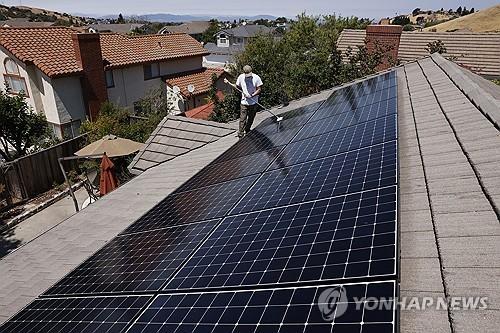
Reuters and Bloomberg report… "US government discusses at least 15% tariffs and minimum price system"
Relief measures to protect US companies also being prepared… "Decision based on scale of capital investment in the US"
Hanwha Qcells with 'Georgia factory' and OCI with 'Texas production facility' may be affected
The US Donald Trump administration could announce measures to restrict imports by imposing tariffs on foreign polysilicon as early as the 6th (local time), Reuters and Bloomberg reported on the 5th.
Polysilicon is a key material for solar products and semiconductors, and attention is focused on how Korean companies will be affected by this measure.
Reuters reported today, citing sources, that "the Trump administration plans to announce the results of the polysilicon investigation under Section 232 of the Trade Expansion Act as early as the 6th."
According to the wire service, a 15% tariff will be imposed on polysilicon derivatives imported into the United States.
Bloomberg, in an article titled 'Trump prepares tariffs and minimum price system to support US-made polysilicon,' stated, "This measure could be announced as early as the 6th," adding, "In recent days, Trump administration officials have been discussing a minimum 15% tariff and a minimum import price to be applied to various solar equipment using polysilicon, including raw material polysilicon and wafers, solar cells, and solar modules."
The Trump administration is also preparing to implement a temporary offset program to protect US manufacturers currently relying on imported raw materials from the adverse effects of tariffs.
However, such relief is expected to be determined by the scale of capital investment by companies within the United States.
According to Bloomberg, the US government has intermittently imposed tariffs or implemented incentive policies for domestic companies for over a decade to undermine China's dominance in polysilicon and its derivative products, where China controls the global market.
The US Department of Commerce's initiation of a Section 232 investigation into polysilicon in July last year was also part of these efforts.
Section 232 of the Trade Expansion Act grants the President the authority to restrict imports through appropriate measures, such as tariffs, if the import of a specific item is deemed to threaten national security.
During the Commerce Department's Section 232 investigation, domestic polysilicon advocates have urged focusing on solutions for Chinese-made or China-linked polysilicon.
Their argument is that tariffs should be imposed high enough to offset China's overproduction capacity and below-cost pricing.
They also argued that, given the limited polysilicon production in the US, if the administration does not provide some trade support, it would be difficult for US solar production to be profitable at current price levels.
Details such as how tariffs and the minimum price system will be implemented and what specific relief measures will be provided to domestic companies are expected to be announced through a presidential proclamation.
Accordingly, attention is focused on how Korean companies will be affected.
Previously, in an opinion submitted to the US Department of Commerce in August last year after the initiation of the Section 232 investigation, the Korean government requested special consideration to allow flexible application to Korean companies if imports of polysilicon and its derivative products were to be restricted.
It also emphasized that broadly imposing tariffs on polysilicon when Korean companies are investing in solar and semiconductor production in the US could risk disrupting the economies and supply chains of both countries.
In particular, the Korean government mentioned Hanwha Qcells' investment in a solar panel production facility in Georgia and OCI's investment in a solar cell production facility in Texas, urging that these companies be excluded from import restriction measures such as tariffs.
Hanwha Qcells also argued in its opinion that US polysilicon producers should be protected from unfair practices by Chinese companies, proposing a tariff of $10 per kg on imported polysilicon and allowing duty-free imports of 20,000 tons of solar-grade polysilicon annually from Germany and Malaysia.
Hanwha Qcells sources all polysilicon used in its US factories from Malaysia, and imports solar cells made from Malaysian polysilicon from Korea and Malaysia into the US for manufacturing into solar modules.
OCI, which produces polysilicon for semiconductors, stated that it has completely excluded forced labor and Foreign Entities of Concern (FEOC) from its supply chain, and requested that polysilicon for semiconductors not manufactured by FEOC and adhering to fair trade practices be excluded from the investigation.
Newsletter
Get key news delivered to your email every morning
to leave a comment.