
to leave a comment.
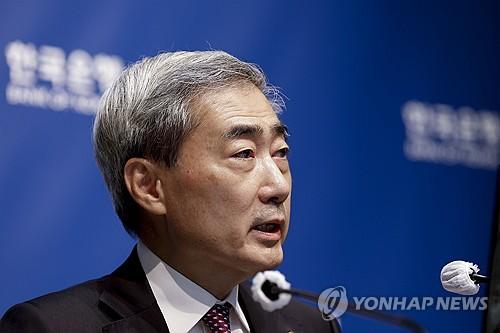
3 members for hike, September hike possibility↑..."2% inflation target"
Due to strong Korean growth, consecutive hikes in July and August also possible...Attention on this month's inflation indicators
As the US Federal Reserve (Fed) decided on a 'hawkish (preferring monetary tightening) base rate freeze,' the possibility of the Bank of Korea (BOK) accelerating monetary tightening has increased.
Amid escalating concerns over Middle East-driven inflation, the BOK entered a monetary tightening cycle on the 16th, ahead of the US.
As the US also has an increasing possibility of raising interest rates one or more times within the year, there are observations that the BOK might raise the base rate in August, following July.
◇ Fed: "9 for freeze vs. 3 for hike...will achieve price stability"
The Fed froze the base rate at 3.50-3.75% per annum at the regular Federal Open Market Committee (FOMC) meeting held on the 28th-29th (local time).
The US base rate has been frozen for five consecutive times this year in January, March, April, June, and July. This is the second consecutive freeze since Kevin Warsh took office as Fed Chair.
However, unlike in June, three members within the Fed advocated for an interest rate hike, leading to the atmosphere being interpreted as 'hawkish.'
The Fed stated that this rate freeze was decided by a vote of 9 in favor and 3 against among the 12 FOMC members.
Three members, including Beth Hammack (Cleveland), Neel Kashkari (Minneapolis), and Lorie Logan (Dallas), opposed the freeze decision, arguing for a 0.25 percentage point interest rate hike.
The Fed's policy statement was almost identical to the one released at last month's meeting. Following last month, the Fed stated, "Inflation remains elevated relative to the FOMC's 2 percent objective," and "The Committee is strongly committed to returning inflation to its 2 percent objective."
Chair Warsh later reiterated in a press conference, "There is only one goal, and that is 2% (inflation rate)."
He said, "For some households, businesses, and market participants, the high inflation over the past five years has left a hard-to-shake mistaken impression that the Fed's implicit inflation target is higher than 2%," adding, "There is no relaxed inflation target."
In the market, expectations are growing that the Fed will raise interest rates in September.
Fed members indicated in the dot plot of future base rate level forecasts released last month that they expect one rate hike within the year based on the median.
According to CME's FedWatch, the interest rate futures market reflected an approximate 72% probability of the Fed raising rates in September immediately after the rate decision announcement.
◇ BOK entered tightening ahead of US...1-2 additional hikes within the year likely
The BOK's Monetary Policy Board entered monetary tightening for the first time in 3 years and 6 months by raising the base rate by 0.25%p to 2.75% per annum at its monetary policy direction meeting on the 16th.
In the market, there is no disagreement on the forecast that the BOK will raise interest rates at least one more time within the year.
However, regarding the timing of the hike, there are conflicting views: some expect consecutive rate hikes in August following July, while others anticipate a freeze in August followed by a hike in October or November.
BOK Governor Shin Hyun-song stated in a parliamentary business report the day before, "It is reasonable to curb core inflation by maintaining the base rate hike stance," but regarding the timing of the hike, he only gave a general statement, saying, "We will monitor incoming data and economic conditions."
At a press conference on the 16th, Governor Shin, when asked about the 'consecutive August hike theory,' said, "We will keep all possibilities open for policy," not ruling out the possibility of consecutive hikes.
He also stated that he would carefully watch the second-quarter GDP growth rate and the inflation rate to be released in early August in this regard.
The second-quarter growth indicators announced last week continued strong growth, supporting the possibility of a consecutive rate hike in August.
Korea's real gross domestic product (GDP) growth rate (quarter-on-quarter, preliminary) for the second quarter recorded 0.6%, continuing its solid growth after 1.8% in the first quarter.
This performance significantly exceeded the BOK's forecast of 0.2% in May.
Accordingly, the possibility of the BOK raising its annual growth forecast to the 3% range has also increased.
In a business report submitted to the National Assembly the day before, the BOK stated, "The domestic economy is expected to expand significantly more this year than last year," and "It is also expected to be significantly higher than the May forecast (2.6%)."
Amidst this, it appears that whether the BOK will immediately proceed with consecutive rate hikes at the monetary policy direction meeting on the 28th of next month will be determined by the July inflation rate, which will be announced early next month.
In July, international oil prices remained high, and the recovery in domestic demand and consumption also increased, so inflation (price increase) pressure is generally assessed to be high.
Not only exports, centered on semiconductors, but also domestic demand and private consumption are showing solid improvement, increasing the likelihood of demand-side price pressure.
Governor Shin stated in a parliamentary business report the day before, "We are paying more attention to core inflation, and the core inflation rate rose to 2.5% in May," adding, "There is also continuous demand-side (price increase) pressure due to the economic boom."
If the BOK implements consecutive base rate hikes in August, there is room for three hikes within the year, totaling 0.75%p.
Kim Jin-wook, an economist at Citibank, projected in a recent report that the BOK's Monetary Policy Board would raise the base rate by 0.25%p next month, as the second-quarter GDP growth rate exceeded expectations.
He predicted that the BOK would raise the base rate by 0.25%p each in August, November, and February of next year, bringing the final rate level to 3.5% per annum.
However, there is also a view that the possibility of consecutive rate hikes in August is low, considering the recent exchange rate situation and inflation outlook.
Ahn Ye-ha, a senior research fellow at Kiwoom Securities, said, "I see a higher possibility of a hike in October after a freeze in August," citing as reasons that "the inflation rate is expected to peak in the third quarter and then slow down, and the rising trend of the exchange rate is also easing in terms of supply and demand."
She added, "The inflation indicators coming out next month are more important, and if core inflation rises significantly, there could be room for an August hike."
◇ Exchange rate falls below 1,450 won due to improved supply/demand...concerns about housing prices and household debt remain
As the BOK raised the base rate faster than the US, the interest rate gap between the two countries narrowed, and the concentration of dollar supply and demand eased, leading to a somewhat stable exchange rate.
The won/dollar exchange rate the day before dropped by 15.8 won to 1,446.7 won as of 3:30 PM, reaching its lowest level since February 27 (1,439.7 won), just before the outbreak of the Middle East war.
Funds raised by SK Hynix through its American Depositary Receipt (ADR) listing flowed into the foreign exchange market, and dollar selling by exporters also emerged, increasing downward pressure on the exchange rate.
Since July, the won has shown the strongest performance among major currencies.
In a business report submitted to the National Assembly the day before, the BOK assessed, "Since July, the won has shown significant strength compared to the US dollar and other currencies, reversing its previous weakening trend," and "The exchange rate has fallen to the mid-to-upper 1,400 won range due to improvements in foreign exchange supply and demand, such as the easing of net selling of foreign stocks due to domestic stock market adjustments."
In the future, if Korea raises its base rate faster than the US, the downward pressure on the exchange rate is likely to increase further.
As Korea raised its base rate to 2.75% per annum on the 16th, the interest rate gap between the two countries narrowed from 1.25%p to 1.00%p based on the upper bound.
Even if the US raises interest rates once more within the year, if Korea raises rates further as expected, the gap could remain at 1.00%p or, in some cases, narrow to 0.75%p.
Theoretically, a narrowing of the interest rate gap between Korea and the US reduces the relative investment attractiveness of dollar assets, thus exerting downward pressure on the exchange rate.
The renewed rise in housing prices, particularly in the Seoul metropolitan area, and the increasing household debt, including 'debt-fueled investment' and 'borrowing to the max,' are also factors supporting the BOK's outlook for additional rate hikes.
In a business report submitted to the National Assembly the day before, the BOK assessed, "As housing prices are again rising, especially in the Seoul metropolitan area, and investment utilizing leverage is increasing, concerns about the accumulation of financial imbalances are growing."
Newsletter
Get key news delivered to your email every morning
to leave a comment.