
to leave a comment.
'Forced Labor Tariff' Likely to Replace 'Overproduction Tariff' Due to Investigation Delay
Government Adheres to '15% Cap' Even if Overproduction Tariff is Introduced Later
If the Donald Trump administration's 'global 10% tariff' expires as scheduled in about two weeks, Korean products are expected to face new tariffs of up to 12.5%.
The overproduction tariff, which was initially expected to be introduced along with the forced labor tariff, has not yet even produced an investigation report, so the forced labor tariff, which is nearing its final stage, is likely to fill the gap first.
According to trade authorities on the 8th, the Office of the United States Trade Representative (USTR) received opinions from trading partners until the 6th regarding tariffs related to forced labor based on Section 301 of the Trade Act.
The process for imposing tariffs of 10-12.5% on 60 economies, including South Korea, is almost complete, and the USTR plans to determine the final tariff rate after a public hearing on the 9th.
The government and the Korea International Trade Association (KITA) argued in their opinion letter that "the additional 12.5% tariff on Korean products lacks grounds and should be reconsidered." They have requested that if a tariff imposition is unavoidable, it should be lowered to 10%.
Cho Sung-dae, head of KITA's Trade Research Department, said, "We included such content in the opinion letter with the expectation that a slightly lower tariff would be applied," but added, "However, realistically, the possibility of the U.S. accepting and lowering it does not seem very high."
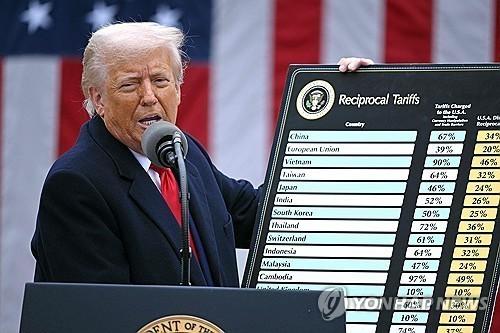
Since the Federal Supreme Court's ruling against reciprocal tariffs in February, the Trump administration has imposed a 10% global tariff on all trading partners worldwide based on Section 122 of the Trade Act.
However, since the period for imposing global tariffs is 150 days, ending on the 24th, the Trump administration is rushing to introduce alternative tariffs under Section 301 of the Trade Act before then.
But the investigation into overproduction, which the USTR began in March under Section 301 of the Trade Act along with forced labor, is still in the dark.
Initially, the USTR had presented a timeline to complete both investigations within the global tariff expiration deadline.
However, even then, the dominant view was that it would be physically difficult to complete all investigations within five months. Past cases show that it usually took more than a year just to investigate a specific issue of a single country under Section 301 of the Trade Act.
For example, when the USTR targeted only China for intellectual property infringement and other reasons under Section 301 of the Trade Act in August 2017, during the first Trump administration, actual tariffs were only imposed 11 months later, in July 2018.
Unlike the forced labor sector, which was easier to judge based on legal and institutional deficiencies of trading partners, the overproduction sector inevitably takes a long time because country-specific and industry-specific data must be meticulously analyzed and verified.
The USTR has initiated a Section 301 investigation into overproduction issues targeting 16 economies, including South Korea.
Even if the results of the overproduction investigation were to come out immediately, it would require essential procedures such as collecting opinions and holding public hearings, so the dominant analysis is that its introduction before the global tariff deadline expires is virtually impossible.
For the time being, it is highly likely that the forced labor tariff will continue to replace the global tariff.
However, concerns are also being raised that if the forced labor tariff rate is set high at 12.5%, and additional tariff measures based on the USTR's future overproduction investigation results are added, the tariff burden on Korean products to the US could exceed 15%.
Accordingly, the government plans to do its best to ensure that tariffs imposed on South Korea do not exceed the 15% agreed upon last year, even if the US continues to pressure with additional tariffs, such as future overproduction-related measures.
An official from the Ministry of Trade, Industry and Energy emphasized, "Our government's consistent position is that even if the U.S. takes action under Section 301 of the Trade Act, it should be within the scope of the tariff level previously agreed upon by both sides," adding, "As we uphold what we agreed to do, they (the U.S.) should also uphold it."
Last year, South Korea promised a total of $350 billion in investment in the U.S. through tariff negotiations, and in return, the U.S. lowered its announced 25% reciprocal tariff to 15%.
Newsletter
Get key news delivered to your email every morning
to leave a comment.