
to leave a comment.
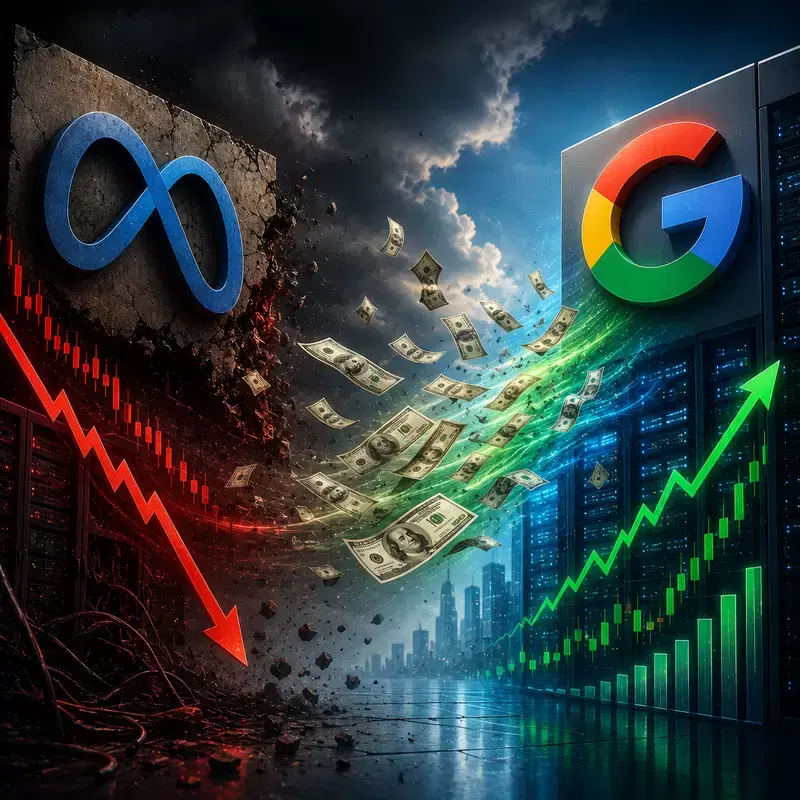
▲ Meta (META), Google, Artificial Intelligence (AI), US Tech Stocks/AI Generated Image
While Meta Platforms (META) pours up to $145 billion into AI by 2026, Wall Street's big money is quietly shifting towards Google. Meta's Chaikin Money Flow (CMF) slipped to -0.209, but Google recorded +0.177, indicating that the ability to convert AI investment into actual revenue has distinguished the two stocks.
According to financial media outlet BeinCrypto on July 6 (local time), Meta's stock price fell by about 10% in 2026, and the company plans to spend $125 billion to $145 billion this year. Most of this will be invested in AI data centers. However, approximately 98% of Meta's 2025 revenue of $200.97 billion still came from advertising, and unlike Google, Amazon (AMZN), and Microsoft (MSFT), it does not operate a cloud business that leases computing resources.
The disparity is even clearer in institutional fund flows. Chaikin Money Flow, which shows the buy and sell trends of major investors, indicated a consistent sell signal for Meta at -0.209, while Google showed buying interest at +0.177. Meta's relative strength against its peers was only 95.8, but Google led with 123. BeinCrypto analyzed that investors are selling Meta and buying Google within the same AI hyperscaler group.
The key difference is the ability to recoup AI investments. Google is already converting its AI spending into revenue through its large-scale cloud business, while Meta is just preparing for the same business model. According to Bloomberg, Meta is pushing to build an internally named "Meta Compute" to sell its excess AI computing capacity, but the plan is in its early stages. JPMorgan lowered its investment rating for Meta to neutral in April and cut its price target from $825 to $725, warning that free cash flow could turn negative for the first time in years.
The overall strength of AI-related stocks has also weakened. Only 32% of AI-linked stocks were trading above their 50-day moving average, and all five major hyperscalers were below their 50-day moving average. Meta's put-call ratio rose from 0.37 on July 2 to 0.58, indicating increased hedging demand ahead of its earnings announcement. However, the proportion of call options was still higher, which was interpreted as a strengthening of caution rather than fear.
Wall Street analysts, contrary to institutional fund flows, maintained their bullish stance on Meta. Citi, Wells Fargo, and Wolfe Research maintained their buy ratings, with price targets ranging from $767 to $850. Meta will announce its Q2 earnings on July 29, and analysts expect approximately $60 billion in revenue. With major investor selling, increased option hedging, and Wall Street's maximum price target of $850 clashing, the July 29 earnings report is set as the next test for Meta's AI spending debate.
[Article Key Summary]
-Meta plans to spend $125 billion to $145 billion on AI by 2026, but approximately 98% of its 2025 revenue came from advertising.
-Meta's Chaikin Money Flow recorded -0.209, while Google's recorded +0.177, indicating diverging fund flows from major investors.
-Meta's put-call ratio rose from 0.37 to 0.58, but Wall Street maintained its buy rating with price targets of $767 to $850.
*Disclaimer: This article is for investment reference only, and we are not responsible for any investment losses based on it. The content should be interpreted for informational purposes only.*
Newsletter
Get key news delivered to your email every morning
to leave a comment.