
to leave a comment.
Up to 13 trillion won invested every 5 years... up to 512 low-orbit satellites under consideration
Reduce dependence on foreign networks and secure core infrastructure for security and disaster response
As Starlink, operated by Elon Musk's SpaceX, preempts the global low-earth orbit satellite communication market, securing space communication networks is emerging as a new arena for national competition.
The government's move to build its own low-earth orbit satellite communication network of several hundred satellites by 2035 is also based on the judgment that it must secure core infrastructure to support national security and industrial competitiveness without relying on foreign services for future communication infrastructure.
As the scope of satellite communication utilization expands to include 6th generation mobile communication (6G), artificial intelligence (AI), and disaster response, the government plans to foster the domestic space ecosystem, which leads to satellite production, launch, and services, through large-scale investment.
◇ Up to 512 satellite network to be built by 2035... 3 scenarios under review
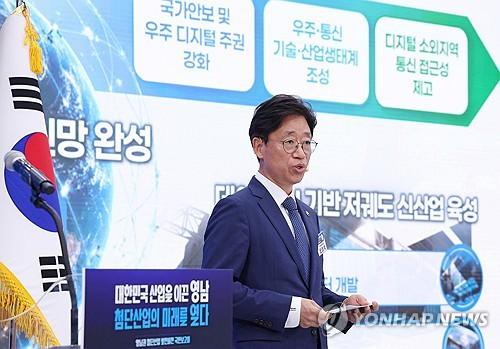
According to the low-earth orbit satellite communication network construction scenarios contained in the 'Yeongnam Advanced Industry Development Vision Public Briefing' unveiled by the Space Agency on the 3rd, the government is considering three options to operate from a minimum of 128 satellites to a maximum of 512.
Option 1 involves raising the satellite altitude to 1,280 km to reduce network construction costs and the number of satellites, which is estimated to cost 3.9982 trillion won every five years, considering the satellite's lifespan.
Option 2 prioritizes the use of domestic launch vehicles and sends 256 satellites to an altitude of 888 km, the existing technology development altitude, costing 7.4184 trillion won every five years.
Option 3 considers a very large increase in demand for private low-earth orbit satellite communication, sending 512 satellites to an altitude of 1,280 km, which is estimated to cost 14.2586 trillion won every five years.
These scenarios were reviewed through a multi-agency task force (TF) led by the Ministry of Science and ICT.
Lee Hyun-ho, director general of the Radio Policy Bureau at the Ministry of Science and ICT, said at a briefing held at the Government Complex Seoul that day, "This is an estimate that includes satellite manufacturing costs, launch costs, ground station terminal manufacturing costs, and operating costs. We currently plan to launch two low-earth orbit satellites in the first quarter of 2030, and the goal is to mass-produce them by 2035 by linking the technologies developed from there."
◇ Reduce Starlink dependence and secure space sovereignty... Foster public-private ecosystem
This plan is interpreted as being based on the judgment that if dependence on overseas services deepens while commercial low-earth orbit satellite communication services like SpaceX's Starlink are already being provided, domestic communication sovereignty could be weakened.
It also appears to include a strategy to solve these problems at once through a super-large project, given that the low-earth orbit satellite communication technology base and large-scale satellite mass production system are not yet established, and there is a lack of launch vehicles to launch them.
The government's large-scale infrastructure investment can serve as a pump-priming fund for the private sector to build and lead the space industry ecosystem.
Furthermore, as Starlink has recently been used in the Russia-Ukraine war and has a close impact on the defense environment, the situation where communication network access rights are becoming important from a security perspective also appears to be reflected.
The Ministry of National Defense and the Defense Acquisition Program Administration also submitted their opinions on the security sector to this TF.
◇ As core infrastructure for security, 6G, and disaster response... Long-term investment sustainability is key
Along with this, there is a prospect that securing a large-scale satellite constellation, which can become 6G and artificial intelligence (AI) infrastructure, could be a new driving force in the communication sector, which has been struggling to find new industries.
Noh Kyung-won, Deputy Administrator of the Space Agency, said, "Low-earth orbit communication satellites or satellite communication have various purposes such as national security, 6G communication, and disaster response. In the case of SpaceX, they divide their services into four categories, and we also need to consider which services to prioritize sequentially."
However, since massive investments ranging from at least 800 billion won to 2.8 trillion won annually are required, alleviating concerns about whether the policy can be consistently pursued thereafter is considered a challenge.
To establish an inter-agency cooperation system and ensure policy consistency, the government decided to establish a pan-ministerial promotion team under the Ministry of Science and ICT to carry out project planning, industrial base creation, international cooperation response, and development of satellite communication utilization plans in the defense sector.
Newsletter
Get key news delivered to your email every morning
to leave a comment.