
to leave a comment.
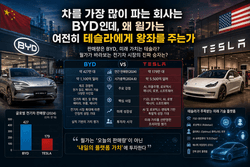
The competition for hegemony in the electric vehicle (EV) market is transforming from a simple battle for 'vehicle sales volume' into a high-order equation encompassing 'ecosystem dominance' (spanning infrastructure, energy, and artificial intelligence (AI)) and 'financial viability'.
The EV market, once dominated by Tesla, has now taken on the perfect form of a "Three Kingdoms" era with the fierce global road conquest by China's BYD and the emergence of Rivian in the premium pickup truck market. However, from the cold perspective of the capital market—that is, the question of 'which stock deserves to claim the EV throne in 2026'—Wall Street still favors Tesla.
Behind Tesla's ability to maintain its throne even after losing the top spot in shipments lies a deeper context that is changing the paradigm of automobile manufacturing.
▲Photo: AI-generated image
The huge wall BYD's volume couldn't overcome: the 'missing link' of the US market
If the success or failure of the EV market were solely judged by 'production and sales volume,' the clear winner would be China's BYD. In 2025 alone, BYD sold a staggering 4.6 million battery electric vehicles (BEVs) and plug-in hybrids (PHEVs) combined, achieving a 7.7% growth in external scale compared to the previous year.
Behind this explosive growth is a perfect 'vertical integration,' where BYD directly manufactures core components such as batteries, semiconductors, and electric motors. This has allowed BYD to gain overwhelming cost control, which it has leveraged to expand its territory into Europe, South America, and Southeast Asia, establishing itself as a global automotive powerhouse.
However, behind these impressive figures lies a fatal limitation: the inability to enter the world's second-largest and highest-margin 'US automotive market.' Being blocked by America's strong trade and protectionist barriers from even glimpsing a massive market of 16.4 million units annually is a weakness that cannot be lightly dismissed when evaluating long-term growth metrics.
As long as trade barriers cannot be penetrated, BYD's external growth is at high risk of devolving into price wars in limited territories, which is a decisive factor allowing Tesla to maintain its dominance in its home market (the US) and secure financial flexibility.
The EV Tragedy Resembling a 'SaaS-pocalypse': Rivian's Profit Transition and the Seesaw Game of Cash Burn
American nascent EV startup Rivian is also writing a commendable and significant narrative. After years of severe losses, it finally achieved its first annual gross profit in 2025, proving its manufacturing efficiency. Annual revenue reached approximately $5.38 billion, and Rivian is currently sharpening its sword, preparing for the launch of its mass-produced, low-cost SUV, the 'R2,' which could change its fate.
However, a cold look at the books reveals that Rivian's estimated deliveries for this year are merely between 62,000 and 67,000 units. This is a tiny fraction of Tesla's production volume. Most importantly, Rivian has still not escaped a net loss (deficit) structure at the company-wide level.
In a macro environment of prolonged high interest rates and a shrinking capital market, survival itself is a huge gamble for nascent EV companies that must burn massive amounts of cash every quarter. Ultimately, Rivian's position, where it must bet solely on future execution, stands in stark contrast to Tesla's overwhelming financial viability.
Tesla's 'Ecosystem' to Defend Against the Era of Zero Hardware Margins: 80,000 Charging Stations and the Megapack Empire
Tesla's true formidable strength does not lie in simple 'car sales.' Fierce price-cutting competition has made margin compression an unavoidable reality across the EV industry, and Tesla is also experiencing a slowdown in delivery growth. However, Tesla has already built a robust platform ecosystem to defend itself even if a downturn arrives where hardware sales margins approach zero.
First is its global infrastructure dominance. Tesla operates a network of over 80,000 'Supercharger' fast-charging stations worldwide, holding the fueling station hegemony in the EV era. Second is the rise of its energy empire. The 'Megapack' large-scale energy storage device business, which penetrates the grid utility market, has become a new core revenue source for Tesla, riding the wave of massive power infrastructure investments. Furthermore, astronomical investments in Full Self-Driving (FSD), humanoid robotics, artificial intelligence (AI), and manufacturing automation create future pipelines that other companies dare not imitate.
Its financial ammunition is also incomparable. Even amidst price wars, Tesla generated $6.2 billion in free cash flow (FCF) in 2025 alone, and as of the end of Q1 2026, it holds over $44 billion (approximately 60 trillion KRW) in cash and short-term investments on its books. This overwhelming financial firepower provides the flexibility to continuously invest in securing future technologies, even during an EV downturn.
The Victory of a Platform Company Beyond Car Manufacturing
The paradigm of EV competition has completely shifted. The race is no longer a pre-modern manufacturing battle of 'who can churn out more cars.' It's a battle over who can more tightly dominate the AI software ecosystem surrounding those cars, including charging infrastructure, energy storage, and extending to autonomous driving and robotics.
If BYD is the leader in quantitative growth, Rivian is a promising challenger. However, only one company has overcome all these waves and completed an 'ecosystem' that generates independent cash flow: Tesla. This is why Wall Street allows Tesla to retain the EV crown, even after it ceded the shipment throne.
*Disclaimer: This article is for investment reference only, and we are not responsible for any investment losses based on it. The content should be interpreted for informational purposes only.*
Newsletter
Get key news delivered to your email every morning
to leave a comment.