
to leave a comment.
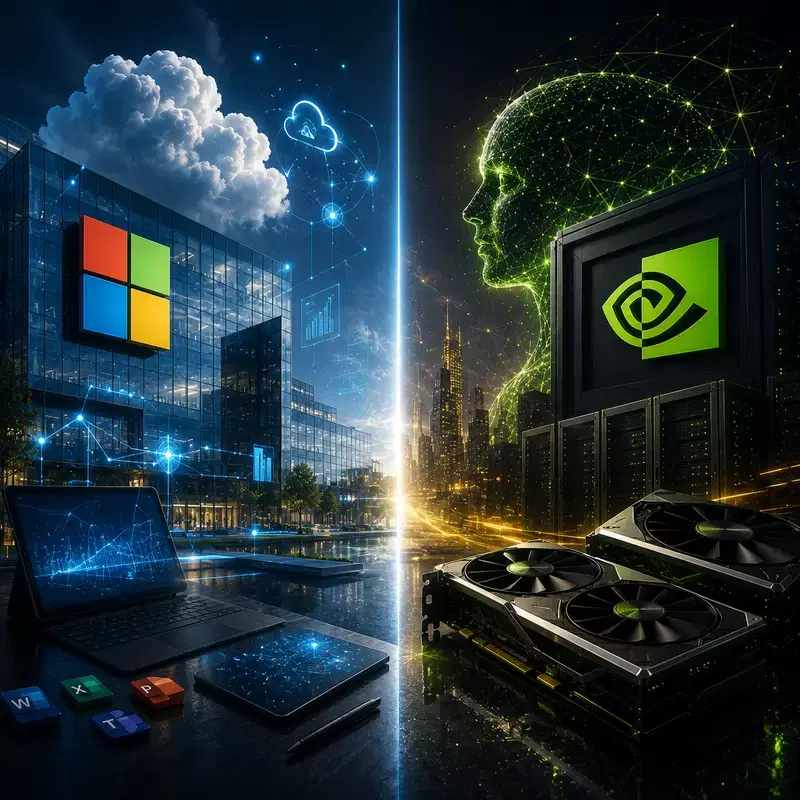
▲ Microsoft (MSFT), NVIDIA (NVDA), US Tech Stocks/AI Generated Image
The artificial intelligence (AI) investment frenzy has simultaneously propelled Microsoft (MSFT) and NVIDIA (NVDA). However, an analysis suggests that over the next three years, the competition might hinge more on resilience than growth speed. While NVIDIA represents the explosive power of the AI chip market, Microsoft is considered closer to a defensive growth stock, holding cloud, enterprise software, and AI services together.
According to Nasdaq on July 2 (local time), Justin Pope of The Motley Fool compared Microsoft and NVIDIA, stating a slight preference for Microsoft as a holding for the next three years. Pope acknowledged NVIDIA as a prime beneficiary, dominating the AI data center graphics processing unit (GPU) market. However, he pointed out that since market expectations are already largely reflected in the stock price, future considerations must include not only earnings growth but also stock price burden and business stability.
NVIDIA's growth drivers remain strong. Its next-generation AI chip platform, Vera Rubin, has entered full production, with shipments potentially starting by the end of this year. Jensen Huang, NVIDIA's CEO, projected that orders for Vera Rubin and Grace Blackwell chips could reach $1 trillion by 2027. Wall Street expects NVIDIA's revenue to increase from $253 billion in the trailing 12 months to $392 billion in the current fiscal year and $554 billion in the next fiscal year. The price-to-sales ratio (PSR) has also fallen below 19x, leading to an assessment that the burden has decreased compared to the past.
Microsoft is not a company solely dependent on a single hardware cycle like NVIDIA. Pope analyzed that while Microsoft rose to a central position in the AI market with its investment in OpenAI, a strategic adjustment became necessary as some enterprise customers began using other AI models, such as Anthropic's Claude. Consequently, Microsoft is moving towards embracing various AI models based on its Azure, enterprise software, and Copilot ecosystems. Notably, its $627 billion in remaining performance obligations provides a strong foundation supporting future revenue visibility.
The difference between the two companies is clearer in their downside protection than in their upside potential. NVIDIA stands to benefit most if AI data center investments continue to surge, but revenue expectations and stock prices could waver simultaneously the moment big tech's AI infrastructure spending slows down. In contrast, Microsoft has diverse revenue streams, holding cloud, Office, Windows, and enterprise AI services together. Pope explained that Microsoft has historically been valued at an average of nearly 33 times its trailing 12-month earnings over the past decade, but it is currently trading at around 22 times. Wall Street expects Microsoft's earnings to grow at an average annual rate of 16-17% over the next 3-5 years.
The conclusion is not to deny NVIDIA's growth potential, but rather that if one had to choose a stock to hold for three years at current prices, Microsoft would be the more comfortable choice. NVIDIA is a high-growth play, boasting a $1 trillion AI chip order forecast, but the impact is also significant when investor expectations falter. While Microsoft may not outperform NVIDIA in growth speed, it is evaluated as a stock with a $627 billion contract base, a 22x earnings multiple, and an average annual earnings growth forecast of 16-17%.
[Article Key Summary]
-The Motley Fool expressed a slight preference for Microsoft over NVIDIA in a comparison of AI stocks for the next three years.
-NVIDIA's Vera Rubin and Grace Blackwell orders could reach $1 trillion by 2027, with revenue projected to increase to $554 billion in the next fiscal year.
-Microsoft was evaluated as a more stable AI investment, based on its $627 billion in remaining performance obligations, a 22x earnings multiple, and an average annual earnings growth forecast of 16-17%.
*Disclaimer: This article is for investment reference only, and we are not responsible for any investment losses based on it. The content should be interpreted for informational purposes only.*
Newsletter
Get key news delivered to your email every morning
to leave a comment.