
to leave a comment.
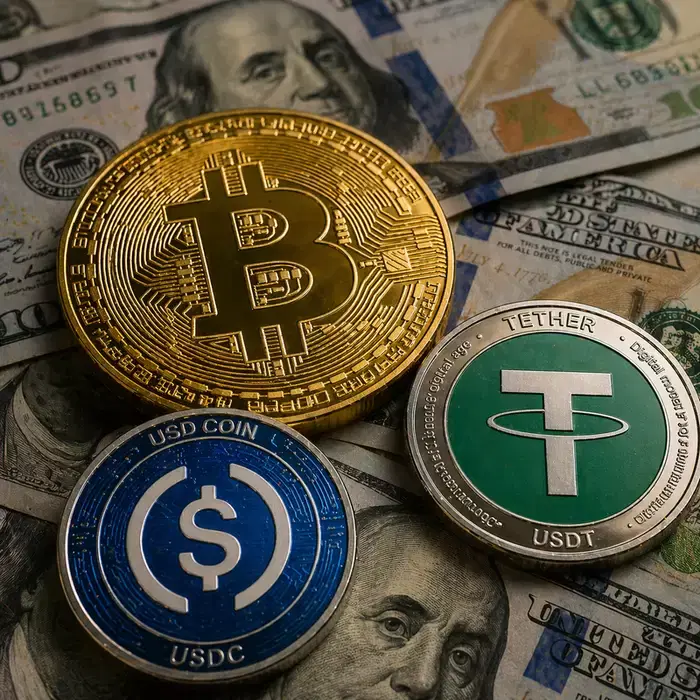
▲ Bitcoin (BTC), Tether (USDT), USDC, Dollar (USD)/AI-generated image ©
It is once again drawing attention that although it may seem like holding the US dollar directly, it can actually be an entirely different asset. Tether's stablecoin Tether (USDT) has grown to a market capitalization of $189.6 billion, but analysis suggests it carries structurally different risks compared to the US dollar.
According to investment media FXStreet on May 21 (local time), USDT is not a fiat currency issued by a government, but a digital token issued by the private company Tether based on its reserve assets. Launched in 2014 under the name 'Realcoin,' it has since grown to become the largest stablecoin, accounting for 59% of the total stablecoin market, which is approximately $322 billion. The media explained, 'While USDT is a blockchain-based means of dollar transfer, it is not the same asset as the actual US dollar.'
Tether currently holds approximately $191.8 billion in assets and $183.5 billion in liabilities, with an excess reserve of about $8.2 billion. Among its reserve assets, approximately $141 billion consists of US Treasury bills (T-Bills), $20 billion in gold, and $7 billion in Bitcoin (BTC). However, the media pointed out that the US Commodity Futures Trading Commission (CFTC) previously fined Tether $41 million in 2021 for making false and misleading statements regarding USDT reserves. Although Tether currently publishes quarterly reports, the market reportedly remains concerned that these are not full external audits.
The utilization of USDT varies by country. In the United States and Europe, it largely serves as a waiting fund for cryptocurrency transactions, but in countries with severe currency depreciation and capital controls, such as Nigeria and Turkey, it functions virtually as a 'digital dollar savings tool,' according to analysis. Its scope of use is also expanding to include freelancer salary payments, international remittances, inter-company settlements, and peer-to-peer transfers. However, it was also pointed out as a risk factor that users must manage wallet addresses and networks themselves, and selecting the wrong network can result in the permanent loss of assets.
The media cited 'issuer risk' as the biggest difference between USDT and the actual US dollar. While the US dollar has government backing and a deposit insurance system, USDT directly depends on Tether's financial health and legal status. In particular, under the Stablecoin Regulation Act (GENIUS), starting in 2028, US citizens will only be able to hold stablecoins from licensed issuers, and Tether has not yet secured a US license, it was explained. Furthermore, USDT holders do not share in the interest income from US Treasury bills, and in times of market instability, a cryptocurrency exchange or intermediary process is required for conversion to cash, which was noted as another difference.
The media predicted that competition in the stablecoin market will intensify further in the future. Circle's USD Coin (USDC) boasts higher reserve transparency and regulatory friendliness, and PayPal's PYUSD and tokenized bank deposit products are also expanding into the market, it was explained. The Bank for International Settlements (BIS) warned that if the stablecoin market grows rapidly, the shock could spill over to the Treasury and repurchase agreement (repo) markets. However, the media assessed that 'USDT still holds a strong advantage in terms of global exchange liquidity and network effects,' and regulatory adaptation will be a key variable determining future market share.
*Disclaimer: This article is for investment reference only, and we are not responsible for any investment losses based on it. The content should be interpreted for informational purposes only.*
Newsletter
Get key news delivered to your email every morning
to leave a comment.