
to leave a comment.
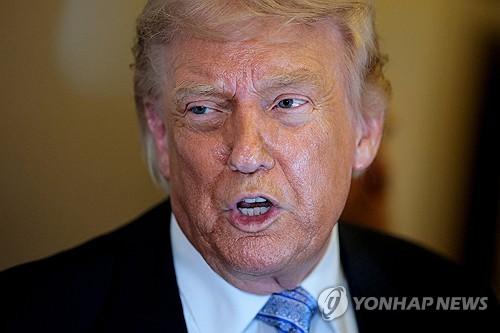
Concerns about conflicts of interest in transactions worth up to 1 trillion won... "Looks like an algorithmic trading hedge fund" with an average of 40 transactions per day
Trump, the first U.S. president not to dispose of assets with potential conflicts of interest or use a blind trust
It has been revealed that U.S. President Donald Trump engaged in hundreds of millions of dollars worth of transactions related to U.S. corporate securities in the first quarter of this year.
According to data released by the U.S. Office of Government Ethics (OGE), cited by Bloomberg and Reuters on the 15th (local time), President Trump conducted over 3,700 transactions in major corporate securities that were entangled with the administration's interests in the first quarter.
During this period, corporate securities purchased for at least $1 million (approximately 1.5 billion KRW) each included Nvidia, Apple, Oracle, Microsoft, Boeing, and Costco.
Furthermore, in February, he disposed of securities from three technology companies – Microsoft, Meta, and Amazon – for amounts ranging between $5 million and $20 million each (approximately 7.5 billion KRW to 30 billion KRW).
In addition, securities linked to various companies such as Broadcom, Bank of America, Goldman Sachs, eBay, Abbott Laboratories, Uber Technologies, AT&T, and Dollar Tree were included in the transaction history.
The OGE data did not specify whether the corporate securities traded by President Trump were stocks or corporate bonds.
Transaction values were specified as ranges instead of exact amounts. Based on this, President Trump's cumulative transaction amount for the first quarter is estimated to be at least $220 million (approximately 329.8 billion KRW) and up to $750 million (1.1243 trillion KRW).
Bloomberg explained that while it is difficult to calculate the exact transaction value, the daily average of over 40 transactions over three months is noteworthy.
Matthew Tuttle, CEO of asset management firm Tuttle Capital Management, described President Trump's securities trading as an "insane amount of trading," adding, "It looks like a hedge fund doing massive algorithmic trading."
The disclosure of these securities transactions has reignited concerns about conflicts of interest that have consistently followed President Trump.
The U.S. Federal Ethics Act, enacted in 1978, did not impose an obligation on presidents to 'dispose of assets that could lead to conflicts of interest'.
However, past U.S. presidents voluntarily disposed of assets with potential conflicts of interest or placed them in blind trusts. President Trump is the first president since the enactment of the law not to follow this tradition.
President Trump's assets are held in a family trust managed by his children.
President Trump has taken various policy measures affecting companies he has traded, such as Nvidia and Boeing, and regularly interacts with the executives of these companies.
He recently took a large number of leaders from companies he invested in, including Nvidia CEO Jensen Huang, Apple CEO Tim Cook, and Boeing CEO Kelly Otberg, on his trip to China.
In particular, Jensen Huang, who was not initially included in the list of business leaders for the China trip, reportedly joined late at the layover in Alaska at President Trump's request.
For this reason, criticisms have consistently been raised that President Trump is confusing public duties with personal business interests and using the presidency to gain financial benefits.
In response, a spokesperson for the Trump Group, President Trump's family business, stated, "President Trump's investment assets are maintained through a full-time asset management account independently managed by a third-party financial institution with exclusive and full authority over all investment decisions."
The spokesperson added, "Neither President Trump, his family, nor the Trump Group plays any role in the selection, direction, or approval of specific investments."
According to the Federal Ethics Act, U.S. presidents are obligated to report financial transactions for themselves, their spouses, and dependent children. Accordingly, President Trump has been disclosing his transaction history since taking office for his second term early last year.
Meanwhile, the law stipulates that public officials must report transactions within 45 days of their occurrence.
This time, two of President Trump's reports were overdue, but the fine was only $200 (approximately 300,000 KRW) per disclosed item. OGE data shows that Trump paid all these fines.
Newsletter
Get key news delivered to your email every morning
to leave a comment.