
to leave a comment.
"Musk argued, 'I should have control because I'm famous'"..."Attempted to acquire OpenAI 6 months after the lawsuit"
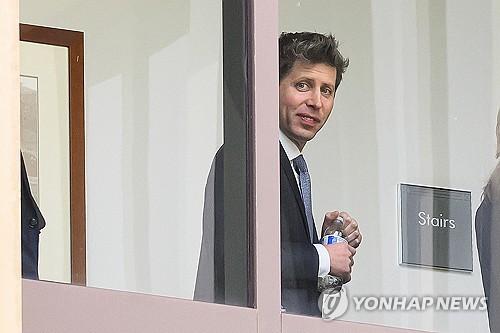
Sam Altman, CEO of OpenAI, testified that Elon Musk, CEO of Tesla, supported OpenAI's commercialization and demanded a stake and management rights.
Altman CEO appeared as a witness at the trial held on the 12th (local time) at the Oakland Division of the U.S. District Court for the Northern District of California, initiated by Musk's lawsuit. When asked if Musk opposed the commercialization plan, Altman replied, "It was the exact opposite," as reported by major foreign media including AP, Reuters, and the Wall Street Journal (WSJ).
He stated that he and other co-founders believed at the time that the organization needed to be converted into a for-profit company to raise the necessary funds to secure computing resources essential for AI development, and Musk shared the same view.
He revealed that Musk participated in discussions regarding the establishment of OpenAI as a for-profit entity and demanded at the time that he should have 90% of the stake.
Altman claimed that Musk cited "I am the most famous" as the reason he should have control, and said, "If I just post one tweet, OpenAI's value will skyrocket instantly."
Altman particularly described it as a chilling moment when other co-founders asked Musk, 'What happens to that control if you die?' and he replied, "It should go to my children."
He further claimed that between late 2018 and early 2019, when a for-profit subsidiary was being established, they inquired about Musk's interest in investing, but "he refused, saying he would not invest in a startup he did not control."
He also criticized Musk for harming the organization by introducing a factory-style corporate culture into the AI research lab.
Musk allegedly forced methods unsuitable for an AI research lab, which requires psychological stability, such as demanding engineers and scientists be ranked and low-performers be fired.
He added that the morale of the members improved after Musk left the organization.
Altman also depreciated Musk's contribution by presenting OpenAI's fundraising list between 2015 and 2020, stating that the $38 million invested by Musk accounted for only 28% of the total investment raised during that period.
He refuted Musk's claim of 'stealing a public benefit organization,' saying, "Such a framework is difficult to even understand."
He also clarified that the incident in 2023, where he was temporarily dismissed from the board, stemmed from a misunderstanding, stating, "I never tried to deceive the board."
Before Altman, Bret Taylor, Chairman of the OpenAI Board of Directors, testified that an xAI consortium led by Musk made an acquisition offer for OpenAI in February of last year, just six months after Musk filed a lawsuit against OpenAI.
Chairman Taylor expressed "surprise" at the offer at the time, pointing out that "the proposal was for a group of for-profit investors to acquire a non-profit organization, which seemed to contradict the spirit of this lawsuit." He added that the board unanimously rejected the offer at the time.
He also praised Altman, saying, "Sam did an excellent job as CEO," and "He was honest with me and the other board members."
Musk filed a lawsuit claiming damages because OpenAI allegedly broke its promise to operate as a non-profit and converted into a for-profit entity, demanding Altman's dismissal and the return of his unjust gains.
Newsletter
Get key news delivered to your email every morning
to leave a comment.