
to leave a comment.
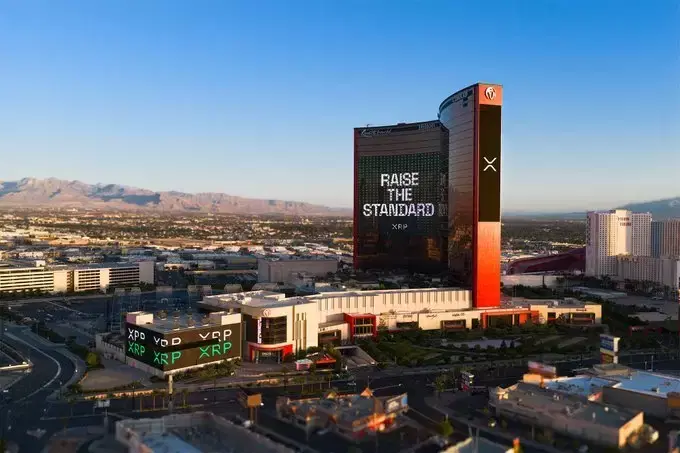
▲ Source: Ripple X ©
Although XRP (Ripple) has regained $1.40, the real challenge lies not in the price, but in whether the U.S. cryptocurrency market structure bill, the Clarity Act, will be processed on May 21.
According to the investment media TradingNews on May 1 (local time), XRP traded around $1.40, up approximately 2% that day, once again tapping the upper end of the $1.30-$1.45 box range. In April, $83.9 million flowed into XRP spot ETFs, and Goldman Sachs was found to hold positions totaling $153.8 million in XRP spot ETFs related to Bitwise, Franklin Templeton, Grayscale, and 21Shares.
The biggest variable for this rise is the schedule for the U.S. cryptocurrency market structure bill, the Clarity Act, to be reviewed by the Senate Banking Committee, expected around May 21. TradingNews suggested that if the bill passes, XRP would be classified as a digital commodity, reducing obstacles to institutional capital inflow. If the bill review progresses before May 21, XRP could open up to $1.65-$1.70, and if Bitcoin (BTC) breaks $80,000, it could reach $1.80. However, if the schedule is delayed, there is a possibility of retesting the $1.30 support level and a drop to $1.20.
Ripple's Las Vegas conference also attracted investor attention. The event, attended by Brad Garlinghouse, David Schwartz, Matt Hogan, and John Deaton, focused on the XRP Ledger, real-world asset tokenization, and regulatory-compliant decentralized finance as key agenda items. However, the media noted that despite the flashy marketing, the price reaction was limited, and questions remain about whether Ripple's institutional partnerships actually lead to real XRP demand.
In particular, Ripple's stablecoin RLUSD emerged as a structural issue. It was pointed out as a burden that major partnerships such as Convera, Deutsche Bank, and Société Générale are settling transactions primarily with RLUSD rather than XRP, and about 82% of RLUSD is on the Ethereum (ETH) blockchain, not the XRP Ledger. While a $59 million RLUSD settlement on April 29 processed with a $0.000188 fee demonstrated infrastructure capabilities, experts believed this did not directly imply demand for XRP itself.
The expansion of institutional infrastructure was presented as a clear positive. Coinbase introduced settlement at a fixed price (TAS) for XRP futures starting May 1, and GraniteShares' 3x long/short XRP ETF is set to be listed on Nasdaq on May 7. In Japan, Rakuten Wallet users can now convert Rakuten points to XRP and use them at over 5 million affiliated stores. Santiment analyzed that social media optimism related to XRP reached its second-highest level in two years after this news.
Technically, XRP is forming a cup-and-handle pattern with a neckline at $1.50. For the target prices of $1.65-$1.70 to be valid, it needs to break above $1.45 with significant volume. Conversely, if $1.30 breaks, downward pressure could increase to $1.28 and even $1.20. The Relative Strength Index shows potential for further upside in some timeframes, but the Average Directional Index indicates a lack of a clear trend. Ultimately, XRP's direction in May depends not on the recovery of $1.40 itself, but on the Clarity Act schedule, ETF demand, and whether institutional derivatives infrastructure translates into actual trading volume.
*Disclaimer: This article is for investment reference only, and we are not responsible for any investment losses based on it. The content should be interpreted for informational purposes only.*
Newsletter
Get key news delivered to your email every morning
to leave a comment.