

to leave a comment.
This is Jinhyuk Seo, a macro strategist from Wall Street. As of April 14, 2026, the market is showing a chaotic trend with major cryptocurrencies attempting a rebound even amidst extreme fear. While geopolitical risks from the Middle East continue to weigh on the market, Bitcoin has broken above $74,000, demonstrating strong resilience.
However, a thorough analysis is needed to determine whether this rebound is the start of a sustainable rally or merely a short-term technical bounce. I will clearly present the market's current focus, its direction, through key macroeconomic indicators and crypto market data.
| Indicator | Current Price | 24h Change | 7d Change |
|---|---|---|---|
| Bitcoin (BTC) | $74515.0 | +5.31% | +7.19% |
| Ethereum (ETH) | $2371.86 | +8.20% | +10.85% |
| Ripple (XRP) | $1.38 | +3.87% | +3.08% |
| Solana (SOL) | $86.6 | +6.22% | +6.30% |
| Dogecoin (DOGE) | $0.094183 | +3.68% | +3.05% |
| Fear & Greed Index | 21 (Extreme Fear) | ||
| NASDAQ 100 (QQQ) | $617.39 | +1.03% | |
| S&P 500 (SPY) | N/A | N/A | |
| VIX Fear Index | 28.62 | ||
| US 10-year Treasury Yield | 4.31% | ||
| BTC Funding Rate | N/A | -0.01% | |
| ETH Funding Rate | N/A | +0.01% |
Recent geopolitical tensions in the Middle East have amplified instability across global financial markets. Concerns over a potential blockade of the Strait of Hormuz and soaring oil prices exerted significant downward pressure on risk assets, including Bitcoin. However, news of renewed negotiations between the U.S. and Iran provided relief to the market, leading to a temporary rebound.
The U.S. 10-year Treasury yield remains high at 4.31%, but the spread with the 2-year Treasury yield (0.50%) shows a relatively stable trend. This can be interpreted as a sign that the market does not anticipate aggressive tightening, even though expectations for Fed rate cuts have somewhat receded. However, the VIX Fear Index maintaining a high level of 28.62 indicates that the market's underlying unease has not fully dissipated.
Among the three major U.S. stock indices, the NASDAQ 100 (QQQ) closed +1.03% higher, showing a tech-led rebound. This is believed to reflect positive outlooks for the corporate earnings season, along with hopes for easing Middle East risks. However, with SPY data not provided, further confirmation is needed regarding the broader market's upward potential.
Bitcoin rose +5.31% over the past 24 hours, reaching $74,515.0 and breaking the $74,000 mark. On a weekly basis, it also showed a +7.19% increase, demonstrating strong resilience by quickly recovering from the Middle East-induced downturn.
This rebound in Bitcoin is closely linked to the continuous accumulation by institutional investors, including BlackRock. Institutions like BlackRock and Strategy continue to inject funds through Bitcoin spot ETFs, acting as a major factor in strengthening the market's downside rigidity.
However, it is crucial to note that the BTC funding rate in the futures market remains in negative territory at -0.01%. This indicates that despite the price increase, a premium exists for short positions, suggesting that market participants remain cautious about further declines. Furthermore, analyses indicate that tens of millions of dollars in profit-taking orders are triggered every hour when the price exceeds $70,000, making the breakthrough of the upper $70,000 and $80,000 resistance levels a critical turning point for Bitcoin's future direction.
Ethereum rose +8.20% over the past 24 hours, reaching $2,371.86, showing a higher growth rate than Bitcoin. Its weekly growth rate also stands at a robust +10.85%.
The movement of institutional investors like Bitmain buying and staking large amounts of Ethereum demonstrates confidence in Ethereum's long-term value. Specifically, Bitmain purchased an additional $150 million worth of ETH last week, marking its largest weekly purchase ever.
On the other hand, a concerning point is that the number of active addresses for USDT and USDC based on the Ethereum network has recorded its lowest figures since 2026. This phenomenon typically occurs during a prolonged sideways market, suggesting a slight slowdown in activity within the Ethereum ecosystem.
XRP rose +3.87% over the past 24 hours, but recently faced the risk of collapsing below $1.30, suffering from severe investor sentiment deterioration and selling pressure. Open interest also plummeted to a 14-month low, indicating a loss of investor confidence in the derivatives market.
Nevertheless, some analysts argue that XRP's extreme fear sentiment could paradoxically present a contrarian buying opportunity and signal the start of a major bull run. In particular, news of institutional funds re-entering XRP ETFs can be interpreted as a positive sign.
Solana (SOL) rose +6.22% over 24 hours, showing a co-movement with Bitcoin's rally. However, it relies on Bitcoin's rally without significant independent catalysts, and some financial strategy firms have reportedly suffered losses after heavily betting on Solana, suggesting a loss of momentum and stumbling performance.
In today's Binance USDT-M futures market, some altcoins recorded explosive gains, with BLESSUSDT up +243.99% and ONUSDT up +98.73%. This indicates that market liquidity is flowing into specific themes or small-cap altcoins, leading to short-term pumps. However, such sharp increases involve extremely high volatility, requiring extreme caution for investors.
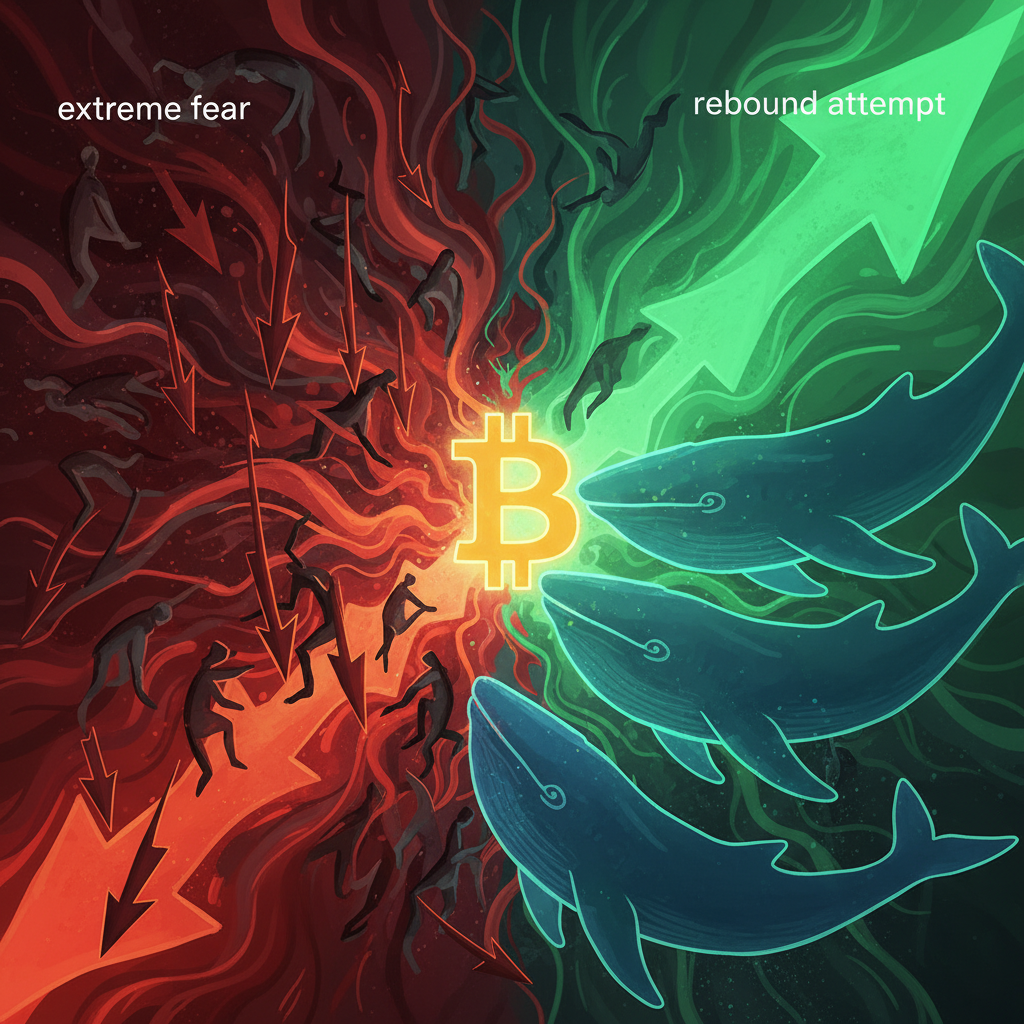
Currently, the Fear & Greed Index stands at 21, indicating 'Extreme Fear'. Although it has slightly risen from 12 the previous day, it still suggests that overall market investor sentiment is highly subdued.
This implies that despite Bitcoin's price rebound, individual investors' sentiment remains frozen. Fears of war, inflation concerns, and news of sharp declines in some altcoins are collectively stimulating market fear.
Paradoxically, however, such extreme fear has often been interpreted as a signal for the beginning of past major bull runs. As the market adage goes, 'When retail investors leave, whales accumulate,' current Bitcoin on-chain data shows evidence of large whales continuing to buy at low prices.
The U.S. Securities and Exchange Commission (SEC) has urged a revamp of existing regulations that classify crypto wallets as broker-dealers and has issued guidelines exempting DeFi and non-custodial wallets meeting certain conditions from broker-dealer registration requirements. This can be interpreted as a positive move to resolve regulatory uncertainty.
Discussions on stablecoins are also active. Jamie Dimon, CEO of JPMorgan, mentioned that blockchain is becoming faster and cheaper than traditional financial systems, and HSBC is piloting deposit token services on the Canton Network, indicating growing interest in tokenization within traditional finance.
Meanwhile, in South Korea, the Financial Intelligence Unit (FIU) notified Coinone of a three-month partial business suspension and a fine of 5.2 billion won, signaling strengthening regulations for domestic exchanges. Additionally, Upbit has partnered with Circle, the issuer of USDC, for virtual asset market innovation and education, foreshadowing changes in the domestic stablecoin market landscape.
Amidst extreme fear, Bitcoin and Ethereum are showing signs of recovery driven by institutional capital inflow, while the altcoin market is expected to undergo intensified differentiation.
to leave a comment.
바람237
·와 진짜 어렵네.. 이게 다 무슨 뜻인거지
fierce_turtle
·지금이 바로 기회야. 존버만이 승리한다!
LuxWalker
·와, 비트코인 7만 4천 달러 돌파 실화냐?
quiet곰
·공포 속 반등, 지표들이 엇갈리는 신호를 보내고 있네
noah45
·우와, 시장 분석 정말 대단해요! 👍