

to leave a comment.
This is Jinhyuk Seo, a macro strategist from Wall Street. On September 5, 2026, today the market entered a deep correction phase, dampened by hawkish tightening concerns triggered by unexpectedly strong US employment figures. Major cryptocurrencies, including Bitcoin, could not escape the downturn, and notably, the probability of a Fed rate hike in September exceeded 60%, with fears of liquidity contraction once again dominating the market. What is the market looking at now? It's interest rate hikes, the resulting liquidity reduction, and increased risk aversion.
However, even amidst these macroeconomic pressures, some altcoins have shown strong upward trends based on individual momentum, exacerbating market polarization. Through data and figures, we will clearly analyze today's market trends and present future market directions.
| Indicator | Current Value | 24h Change Rate | 7d Change Rate |
|---|---|---|---|
| Bitcoin (BTC) | $79667.0 | -1.97% | +3.00% |
| Ethereum (ETH) | $2456.1 | -2.07% | +1.10% |
| Ripple (XRP) | $1.4 | -3.63% | +1.80% |
| Solana (SOL) | $101.94 | -1.96% | -1.60% |
| Dogecoin (DOGE) | $0.084812 | -3.41% | +0.00% |
| Fear & Greed Index | 73 (Greed) | Previous Day: 74 (Greed) | - |
| Nasdaq 100 (QQQ) | $718.96 | +0.18% | - |
| S&P 500 (SPY) | $770.19 | -0.39% | - |
| VIX Fear Index | 17.0 | - | - |
| US 10-year Treasury Yield | 4.77% | - | - |
| BTC Funding Rate | 0.000010 | +0.00% | - |
| ETH Funding Rate | 0.000020 | +0.00% | - |

The biggest factor hitting the cryptocurrency market today was the stronger-than-expected US employment figures. US non-farm payrolls increased by 162,000 in August, significantly exceeding market expectations of 55,000. This was interpreted as a signal that a robust job market would dampen expectations for a Federal Reserve (Fed) rate cut and lead to the maintenance of hawkish tightening policies.
Indeed, the probability of a Fed rate hike in September, based on the swap market, exceeded 60%. These rate hike concerns pushed the US 10-year Treasury yield up to 4.77%, and the long-short spread recorded 0.43%, still showing the strength of long-term yields. High interest rates mean liquidity absorption, which acts as direct downward pressure on the cryptocurrency market, a risky asset.
As analyzed by Bloomberg strategist Mike McGlone, Bitcoin is dependent on stock market movements, and the current outlook for interest rate hikes inevitably places a significant burden on BTC. Former President Trump's explicit pressure on the Fed to cut rates adds a political variable to this tightening stance, but the market is currently reacting more sensitively to data.
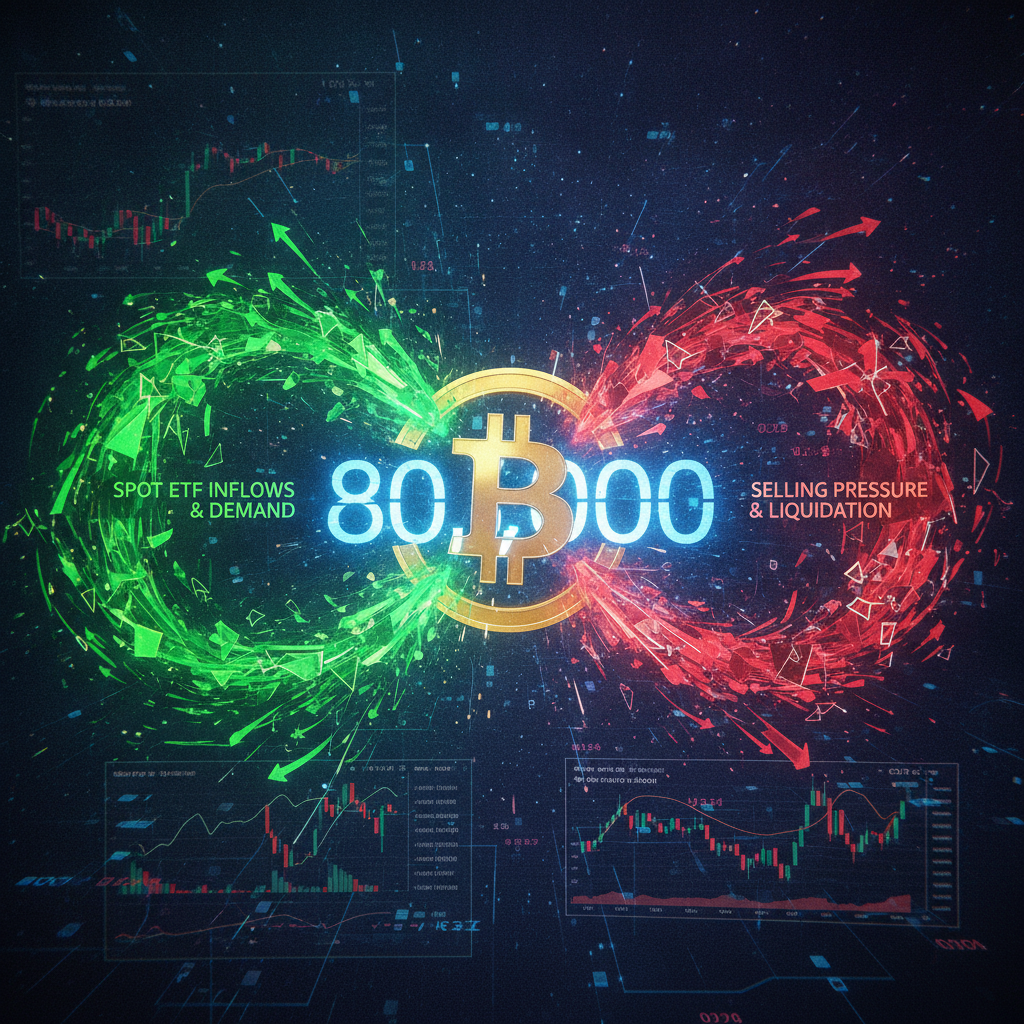
Bitcoin fell by -1.97% over the past 24 hours, recording $79667.0, pushing it back below $80,000. This is attributed to renewed risk aversion sentiment following the strong US employment data release and the re-ignition of interest rate hike fears.
Interestingly, on the 3rd (local time), approximately $276 million (375.4 billion KRW) flowed into US Bitcoin spot ETFs, marking two consecutive days of net inflows. However, in the first three trading days of September, about $46 million was net outflowed. This suggests that sustained net inflows are necessary for institutional capital inflows through spot ETFs to act as a continuous upward driving force.
CryptoQuant analyzed that Bitcoin short-term holders (STH) have shifted from a 'capitulation' phase to a 'profit-taking' phase. Since August 17, short-term holders have transferred 467,000 BTC (approximately $35.4 billion) to exchanges, and the fact that most of the inflows to exchanges are Bitcoins in profit zones could increase short-term selling pressure.
In the futures market, $200 million worth of futures positions were forcibly liquidated in the last hour, and $749 million over 24 hours. Specifically, if BTC breaks above $83,032, $1.589 billion worth of short positions could be forcibly liquidated, whereas if it falls below $80,057, $896 million worth of long positions could be liquidated, indicating extreme two-way movements are expected. The current BTC funding rate remains neutral at 0.000010, but rapidly fluctuating open interest (OI) suggests the potential for increased market volatility.
Major altcoins also showed a downturn along with Bitcoin. Ethereum (ETH) fell by -2.07% over the past 24 hours to $2456.1, Ripple (XRP) by -3.63%, Solana (SOL) by -1.96%, and Dogecoin (DOGE) by -3.41%.
However, even amidst this overall bearish market, altcoins with individual positive news and narratives showed strength. Tron (TRX) showed strength in network fund size, surpassing $28 billion in Total Value Locked (TVL), and Cardano (ADA) surged by +17% weekly amid whale accumulation and strong derivative signals.
Notably, Robinhood Chain-related coins attracted attention. As Robinhood Markets (HOOD) stock surged and Robinhood Chain's trading volume exploded, Uniswap (UNI) also jumped by +8%. Although there was a transaction batch delay issue on Robinhood Chain, an Ethereum Layer 2, Arbitrum stated that it was operating normally.
Meanwhile, changes in the regulatory environment in various countries will continue to impact the altcoin market, such as the delisting of six assets including TRUMP, BNB, and PEPE from the Japanese exchange Bitpoint.
The current Fear & Greed Index stands at 73, maintaining the 'Greed' stage, but it has slightly decreased from 74 the previous day. This indicates that while overall market sentiment remains optimistic, risk aversion has begun to be partially reflected after the US employment data release.
The total market capitalization of the cryptocurrency market is $2696.8B, and the 24-hour trading volume is $98.6B, still attracting high interest. However, the downturn in Bitcoin and major altcoins is amplifying short-term anxiety, and the fact that the volume of forced long position liquidations has exceeded $200 million indicates that investors' positions are rapidly fluctuating.
The market's attention is now focused on the intersection of AI and cryptocurrency. Bitwise CEO Hunter Horsley noted that loans collateralized by GPUs are moving into on-chain financial products, and Bitcoin mining company Argo Blockchain is moving to expand its operations into AI and High-Performance Computing (HPC) infrastructure. This suggests that AI can create new financial and infrastructure demands beyond mere technological innovation, providing a new narrative for the cryptocurrency market.
The regulatory environment is also a critical variable. The G7 urged a transition to Post-Quantum Cryptography (PQC) to prepare for quantum computing threats, sparking discussions about the future of public-key cryptography used in blockchain wallets and transaction signatures. While there were concerns about a potential delay in the September vote for the US crypto bill, the Clarity Act, there are also positive signs, such as the National Sheriffs' Association withdrawing its opposition.
The controversy surrounding Robinhood's stock tokens is also noteworthy. The AMC CEO strongly criticized Robinhood's trading of AMC stock tokens and threatened legal action. This case highlights the growth potential of the tokenized real-world assets (RWA) market, along with the need for clear guidelines from regulatory authorities.
Amidst dominant liquidity contraction and risk aversion sentiment stemming from US employment data-driven tightening concerns, Bitcoin is battling for the $80,000 mark, and the altcoin market is showing a polarized trend based on individual momentum and regulatory risks.
to leave a comment.
ella달빛
·이런 분석은 진짜 참교육이네
noah달빛
·아이고, 이럴 때마다 어떻게 해야 할지 너무 걱정돼요.
겨울잠pearl
·글쎄, 이번엔 또 얼마나 가려나.
느긋한고슴도치
·오묘한 데이터 속에서도 감성이 느껴지네요.