
to leave a comment.
Guidance provided via homepage... Cause and scale still undetermined after two months
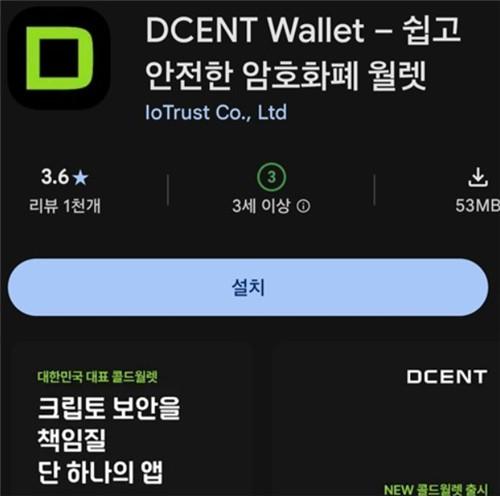
The app wallet service of the virtual asset wallet D'CENT, which suffered hacking damage, will eventually be terminated.
According to the virtual asset industry on the 22nd, D'CENT's operator, IoTrust, announced on its website that the app wallet service is in the process of being terminated and is advising users to transfer their assets to other wallets.
The service being terminated is a standalone app software wallet that allows users to create a wallet and approve transactions using only a smartphone, without a separate hardware wallet.
The function of storing private keys in a hardware wallet and managing assets by connecting it with the D'CENT app will continue to be provided.
The D'CENT hacking incident became known on September 16th of this year when cases of unauthorized asset transfers from app wallets were reported in the early morning, and the operator immediately issued an urgent notice to users about asset transfers that day.
Since then, various virtual asset damage cases, including Bitcoin, Ethereum, Ripple (XRP), Tron, and Tether (USDT), have successively occurred both domestically and internationally, escalating into a large-scale hacking incident.
XRPL.to, an XRP Ledger (XRPL) data and analysis platform, analyzed that approximately 12.728 million XRP (worth about 15.4 billion KRW) were stolen between September 15th and October 7th. The scale of damage is expected to be larger if other virtual assets besides XRP are included.
However, more than two months after the hacking occurred, the exact cause and scale of the damage are still unknown.
The operator suspects that vulnerabilities in the random number generation module installed in older Android and iOS operating systems may have been exploited in the attack. However, the exact attack path, cause, and scope have not yet been determined.
The fact that D'CENT is a non-custodial wallet that does not directly store user assets makes it difficult to ascertain the scale of the damage. This is because the operator has limitations in verifying the status of all users or their held assets.
The operator is cooperating with relevant agencies, including submitting technical data to the Korea Internet & Security Agency (KISA), to investigate the cause of the incident. Requests for asset freezes have been made to over 110 domestic and international exchanges and virtual asset swap services.
While the operator has not stated its position regarding compensation for damages, some domestic victims filed a complaint against the operator around mid-last month. Additionally, about 20 other victims are receiving legal advice for a joint response.
According to a lawyer representing victims whose total losses exceed 1 billion KRW, relevant technical data has been submitted to investigative agencies, and the cases have been transferred to the Cyber Terror Investigation Unit of the National Police Agency.
The lawyer stated, "Since users directly manage their recovery phrases for personal wallets, it needs to be determined whether the hacking cause was a technical issue with the operator or something that occurred during the user's management process." He added, "It's not easy to prove that the operator's fault was the sole cause, so we are approaching civil lawsuits cautiously."
Newsletter
Get key news delivered to your email every morning
to leave a comment.