
to leave a comment.
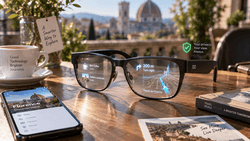
Walking down an unfamiliar alley in a foreign city, I look at the menu board in front of a restaurant. Instead of taking out my smartphone from my pocket and opening a translation app, I lightly tap the side temple of my glasses, and Korean translation appears on the lens before my eyes, accompanied by a voice briefing in my ear: "The signature dish is handmade mushroom pasta, with a rating of 4.8 points."
This is daily life where essential information is instantly displayed without obstructing vision, even when carrying a lot of luggage in both hands or cycling. The era of 'AI Smart Glasses,' where artificial intelligence, once confined to smartphone screens, steps out into real space through eyeglass lenses, is unfolding before our eyes.
Recently, major global big tech companies have been aggressively expanding the next-generation AI eyewear ecosystem, combining ultra-lightweight displays with real-time visual multimodal models. The core technology lies in reducing weight and thickness to the point where they are hard to distinguish from regular fashion glasses, while built-in miniature cameras and microphones analyze the context of objects the user is looking at without delay. They effectively act as a person's 'second pair of eyes,' guiding transfer exits when looking at a subway map, and verbally informing about the nutritional content and expiration date of processed foods picked up from a supermarket shelf.
The widespread adoption of such wearable AI significantly changes mobility, leisure, and consumption patterns. In particular, it allows users to safely obtain information without worrying about dropping their smartphones when checking recipes while cooking with hands full or checking navigation during outdoor leisure activities. The blockchain and fintech industries are also paying attention to its connection with next-generation hands-free interfaces, such as instantly processing micropayments by simply looking at a QR code or Web3 payment tag at a specific offline store with smart glasses, or entering a concert venue unmanned by scanning DID (Decentralized Identifier)-based tickets with the lens.
However, as these devices constantly record and analyze the world before our eyes, the accompanying privacy and safety risks are by no means light. The most sensitive issue is the 'controversy over constant surveillance in public places.' If cameras are constantly on in spaces where others' portrait rights and privacy should be protected, such as cafes, public transportation, and public restrooms, it can lead to unnecessary disputes with those around. In fact, many countries have begun to regulate actions such as arbitrarily turning off or covering the shooting notification LED on smart glasses.
New caution is also required concerning financial assets and personal information protection. If one enters a password at an ATM or inputs a virtual asset wallet's private key or a financial account's OTP on a smartphone while wearing smart glasses, such sensitive information can be entirely transmitted as video frames to the AI cloud server analyzing the wearer's field of vision.
Ultimately, the standard for wisely living in the era of AI smart glasses is 'situational vision separation.' While actively utilizing the visual analysis of AI glasses for exploring unfamiliar travel destinations or in hands-on work environments, one must develop 'digital etiquette' and asset protection habits, such as physically closing the camera shutter or turning off the power of the glasses when entering sensitive spaces like banking, password entry, public changing rooms, or meeting rooms.
Newsletter
Get key news delivered to your email every morning
to leave a comment.