
to leave a comment.
All 12 FOMC members agree...Strong reaffirmation of commitment to price stability
Dot plot suggests one more hike this year...Will high interest rates continue until next year?
With inflation proving stubbornly persistent and the added shock of soaring international oil prices, the U.S. Federal Reserve (Fed) has shifted its policy towards tightening for the first time in 3 years and 2 months.
While this interest rate hike itself was largely anticipated by financial markets, market attention quickly shifted to how many more times the Fed would raise rates. Fed officials, through the dot plot, hinted at the possibility of one more additional hike this year, leaving the door open for a continued tightening stance.
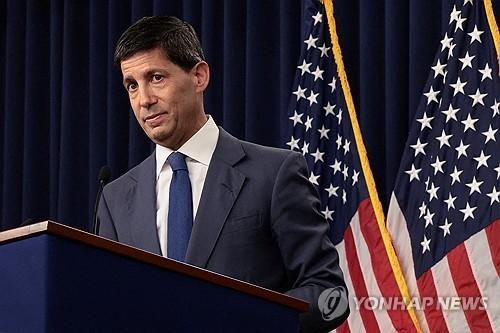
Most notably, despite President Donald Trump's overt pressure for interest rate cuts, the Fed, led by Chairman Kevin Warsh, showed a strong commitment to price stability and made a unanimous decision to raise interest rates.
◇ Confidence in inflation slowdown shaken, compounded by oil price shock
On this day, the Fed, following a two-day Federal Open Market Committee (FOMC) meeting in Washington D.C., raised the benchmark interest rate by 0.25 percentage points (p) to 3.75-4.00% annually.
This is the first monetary tightening measure in 3 years and 2 months since July 2023, and all 12 FOMC members voted in favor of the hike.
At the previous meeting, only 3 members advocated for an interest rate hike, but in just one meeting, all FOMC members turned towards an increase.
The biggest reason the Fed shifted towards tightening is the assessment that the risk of inflation rising again has increased in a situation where inflation has not sufficiently slowed to the target level.
In its statement today, the Fed diagnosed that "inflation remains elevated" and newly added the phrase "will support a timely return to the Committee's 2 percent objective."
It also emphasized, "The Committee is strongly committed to returning inflation to its 2 percent objective."
Conversely, regarding the economic situation, it assessed that "economic activity is expanding at a solid pace." It also newly included the assessment that domestic consumption is resilient, productivity growth is strong, and capital investment is active.
Employment growth was also assessed to be in line with the size of the labor market, with no significant change in the unemployment rate.
As the economy and labor market continue their robust performance, the Fed has more room to prioritize price stability in its policy rather than being burdened by concerns about an economic slowdown.
Recently released inflation indicators also swayed the Fed's decision towards a hike.
The August CPI, announced on the 11th, showed a 3.4% increase year-over-year, and core CPI, excluding volatile energy and food, rose by 2.4%, indicating that inflationary pressures are proving stubborn.
In addition, fears grew that rising energy prices could spread to overall inflation as international oil prices exceeded $100 per barrel due to the prolonged Iran war.
Consequently, the probability of a 0.25 percentage point hike reflected in the interest rate futures market surged from around 60% to over 90% within a week.
For Chairman Kevin Warsh, who usually values signals embedded in financial market prices, it would have been difficult to ignore the market's assumption of a rate hike after the inflation data release.
◇ One hike already priced in by the market...Dot plot suggests additional hike this year
Since this 0.25 percentage point interest rate hike was largely anticipated by the market with a high probability before the meeting, attention is now shifting to the number and timing of further hikes.
Fed officials, in the dot plot released today, presented a median forecast of 4.1% for the benchmark interest rate at the end of this year.
This is a 0.3 percentage point increase from the previous forecast of 3.8%.
Considering that the target range for the benchmark interest rate became 3.75-4.00% after today's hike, this suggests that Fed officials anticipate one more additional 0.25 percentage point hike this year.
Of the 18 members who submitted interest rate forecasts, 16 expected an additional hike, while only 2 expected rates to remain at the current level.
In particular, as the next FOMC will be held before the November midterm elections, the key question is whether the Fed will proceed with consecutive hikes immediately or freeze rates once before an additional hike in December.
Former New York Fed President Bill Dudley previously explained that "a 0.25 percentage point rate hike alone is too small to have a significant impact on economic activity," and that as monetary policy takes a considerable time to affect the real economy, the Fed tends to make a significant policy adjustment and then move in the same direction until changes appear in the economic outlook.
However, it is uncertain whether this tightening will lead to steep consecutive hikes like in 2022-2023.
Given that the U.S. economy is not in a general overheating phase as it was then, and high interest rates have already been maintained for a considerable period, the Fed may space out hikes while monitoring future inflation and employment data.
The median dot plot also showed rates remaining at 4.1% at the end of 2027, suggesting a path where the Fed freezes rates until next year after an additional hike this year.
Newsletter
Get key news delivered to your email every morning
to leave a comment.