
to leave a comment.
CLARITY Act's 'Vote of Destiny' Imminent…Passage Hopes Revived, But 60-Vote Threshold Still Unclear
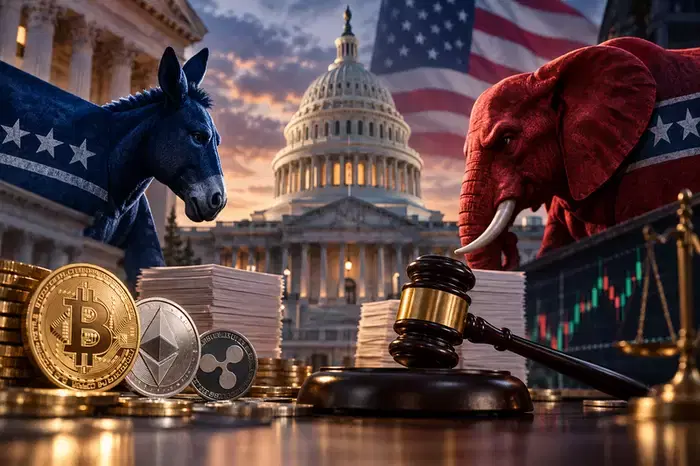
▲ Will the CLARITY Act truly pass? The crypto market holds its breath for the '60 votes of destiny'/AI generated image
The CLARITY Act, poised to reshape the regulatory landscape of the US cryptocurrency market, is effectively at a crossroads. The possibility of the bill's advancement has increased compared to just a few days ago, as Republicans introduced a final amendment largely reflecting Democratic demands, and President Donald Trump also accepted a significant portion of the core ethical regulations. However, it remains unclear whether the necessary 60 votes have actually been secured for the Senate vote scheduled for September 15 (local time). Market observers suggest that the 'unexpected passage of the procedural vote' itself, rather than 'confirmed passage,' could be a variable that moves short-term cryptocurrency prices.
The first point to distinguish in this vote is that the September 15th vote is not the one that will determine the final passage of the CLARITY Act. The Senate will proceed with a cloture vote, a procedural vote to decide whether to formally debate the bill on the floor, and 60 votes are required for its passage. Currently, Republicans hold 53 seats, so even assuming all Republicans vote in favor, support from at least 7 Democratic or independent senators is needed. Even if the vote passes, there will still be floor debate, amendment processing, a final vote, and subsequent procedures in the House of Representatives. With the legislative calendar tight before the midterm elections, this is why 'passage on the 15th = CLARITY Act confirmed' should not be assumed.
Last-Minute Compromise Is Progress…But the '7 Votes' Remain Elusive
The biggest variable that has boosted the chances of passage is the Republicans' last-minute concession. Senate Republicans unveiled a final proposal incorporating 126 substantive changes, reflecting Democratic demands. President Trump also accepted a significant portion of the ethical regulations limiting cryptocurrency interests for politicians and their spouses, and the amendment also included enforcement powers for state attorneys general and mechanisms to address large-scale deposit outflows from regional banks to stablecoins. Reuters also assessed this amendment as a last-ditch effort to address the Democrats' ethical and financial stability concerns.
In addition, there are movements within the Democratic Party to garner 'yes' votes. Reports indicate that Democratic Senator Kirsten Gillibrand, who has been involved in bipartisan cryptocurrency legislation, is persuading her colleagues to vote in favor. Conversely, Republican Senator Cynthia Lummis, who has led the CLARITY Act negotiations, stated that the current proposal is virtually the limit of what can be conceded, citing ongoing demands from Democrats for further amendments. The Democratic Party is even holding separate strategy meetings to discuss their response ahead of the vote. Ultimately, the bill's fate hinges not on how much more the Republicans concede, but on whether the already proposed amendment can secure the necessary votes from Democrats and independents.
The problem is that the remaining issues are not trivial. The banking industry is protesting that stablecoin rewards could accelerate the outflow of bank deposits, and that the amended safeguards are insufficient. Some Democratic senators believe that ethical regulations surrounding cryptocurrency businesses involving politicians and the Trump family are still inadequate, and 18 state attorneys general have urged opposition, citing the weakening of investor protection powers. There are also internal complaints within the cryptocurrency industry regarding the reduction of blockchain developer protection clauses. In other words, it's not a simple confrontation between 'the crypto industry versus the anti-crypto camp,' but a structure where banking, consumer protection, political ethics, and developer protection clash within a single bill.
Year-End Passage Probability 25-30%…But Why Is the Market Optimistic?
Based solely on current figures, it is difficult to be optimistic about final passage by the end of the year. TD Cowen put the probability of the CLARITY Act passing this year at 25%. On the decentralized prediction market Polymarket, the probability of passage by year-end surged from 12% in early September to 30%, reaching its highest level since early August, but still falls significantly short of half. Conversely, Kalshi showed the probability of passage before October 1, 2027, soaring to 64% at one point before settling at around 53%. This indicates that the market is evaluating 'the possibility of immediate enactment' differently from 'the possibility of eventual legislation, even if it takes time.'
Rather, what's important in the short-term cryptocurrency market is the difference between expectations and actual results, more so than the absolute probability of passage. Bernstein analyzed that the market has recently leaned bearish ahead of the CLARITY Act vote, and the possibility of the bill advancing more than expected due to Republican's last-minute concessions has not been fully priced in. It also mentioned the possibility that some Democratic senators might be reluctant to be perceived as 'anti-crypto' ahead of the midterm elections. Therefore, if the bill secures 60 votes and passes the first hurdle, even if it's not the final passage of the bill itself, there's room for it to be perceived by the market as an unexpected regulatory boon.
Passage: Bullish Factor; Failure: Shock…But the Fed Awaits Immediately After
The scenario is relatively clear. If the CLARITY Act secures 60 votes, the possibility of Congress establishing a legal framework for digital asset regulation, including the roles of the US Securities and Exchange Commission (SEC) and the Commodity Futures Trading Commission (CFTC), increases by one step. Jon Medel of Injective Labs assessed that the CLARITY Act could provide 'sustainability' to the cryptocurrency policies pursued by regulatory agencies. This means that expectations could form that policies would not be easily overturned even with a change in administration.
Conversely, if it fails to secure 60 votes, there is a risk of sell-offs due to disappointment in the short term. Bernstein specifically warned of the possibility of a significant decline in the cryptocurrency market if the CLARITY Act fails and the Fed takes a hawkish stance simultaneously. This is why the market cannot focus solely on the CLARITY Act this week. With the Fed's interest rate decision scheduled for September 16, immediately after the Senate vote, the difference in outcomes between 'bill passage + dovish Fed' and 'bill failure + hawkish Fed' could widen. Bitcoin futures open interest has also decreased by 13.5% since September 3, indicating that deleveraging has already occurred ahead of major events.
However, if the CLARITY Act founders in this vote, it does not mean that the overhaul of US cryptocurrency regulation itself will halt. Bernstein suggested that if congressional legislation fails, it could actually accelerate the SEC's and CFTC's own rulemaking. The industry shares this view. If the bill passes, the sustainability and predictability of regulatory policy will significantly increase, but even if it fails, institutionalization through regulatory bodies can continue under the current administration. Ultimately, the September 15th vote is less about determining the survival or demise of the cryptocurrency industry and more about testing whether the US can move towards a 'long-term regulatory framework through congressional legislation' as a first hurdle.
*Disclaimer: This article is for investment reference only, and we are not responsible for any investment losses based on it. The content should be interpreted for informational purposes only.*
Newsletter
Get key news delivered to your email every morning
to leave a comment.