
to leave a comment.
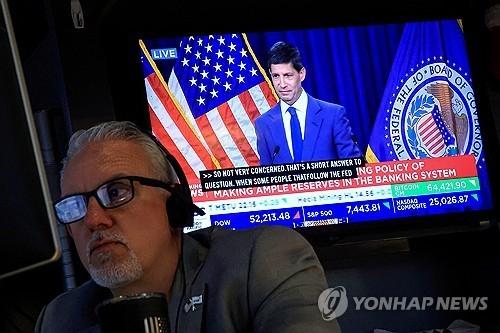
First hike in 3 years and 2 months if it happens... Trump reiterates demand for "world's lowest interest rates"
Wall Street also predicts two hikes within the year... Freezing rates would damage Fed's credibility
As the possibility of the U.S. Federal Reserve (Fed) raising interest rates again after more than three years grows, there are predictions that Fed Chairman Kevin Wash could clash with President Donald Trump, who has repeatedly called for rate cuts.
According to CME FedWatch on the Chicago Mercantile Exchange (CME) on the 14th (local time), the interest rate futures market reflected a 92% probability that the Fed would raise its benchmark interest rate by 0.25 percentage points at the Federal Open Market Committee (FOMC) meeting on the 15th-16th.
This is a significant increase from about 70% before the recent inflation data was released.
The probability of the benchmark interest rate being higher than its current level by December was 98.7%.
If the Fed raises the benchmark interest rate by 0.25 percentage points at this meeting, the target range for the policy rate will increase from the current 3.50-3.75% to 3.75-4.00%.
If the Fed raises rates, it would be the first rate hike in 3 years and 2 months since July 2023, marking a shift back to tightening after a period of freezes that followed three consecutive rate cuts in the second half of last year.
As the possibility of further Fed tightening emerged, U.S. Treasury yields also surged.
On this day, the yield on the U.S. 10-year Treasury note rose to 5.012% during trading, surpassing 5% for the first time since October 2023.
The market's outlook has sharply turned hawkish (preferring monetary tightening) because recent inflation data was stronger than expected, and the aftermath of armed conflict in the Middle East pushed international oil prices well over $100 per barrel, increasing concerns about a resurgence of inflation.
The U.S. August Consumer Price Index (CPI), which drew attention as the last inflation indicator before this FOMC, also remained at a high level.
The August CPI rose 3.4% year-over-year, and the core CPI, excluding energy and food, rose 2.4%.
As the likelihood of a rate hike increases, attention is also drawn to the possibility of Chairman Wash clashing with President Trump, who nominated him as the head of the Fed, over monetary policy.
President Trump reiterated his pressure for rate cuts the previous day, stating, "The U.S. economy is so strong that regardless of their (Fed's) formulas, we should have the lowest interest rates in the world."
Conversely, Chairman Wash has emphasized price stability and left open the possibility of a rate hike. If he proceeds with a hike as the market expects, a conflict with President Trump could arise.
Some in the market also suggest that if Chairman Wash, conscious of the White House's demands, freezes rates, it could raise questions about his commitment to tackling inflation and the Fed's credibility, narrowing his options.
Michael Feroli, an economist at JPMorgan, pointed out, "Ultimately, if Chairman Wash's repeated strong warnings against tolerating inflation are not backed by policy action, the Fed's institutional credibility could be undermined."
Meanwhile, major investment banks (IBs) on Wall Street have increasingly joined the rate hike forecast.
Goldman Sachs, JPMorgan, and HSBC all predicted that the Fed would raise the benchmark interest rate by 0.25 percentage points at this FOMC.
Ryan Wang, an economist at HSBC, stated, "The lack of progress in disinflation has finally tipped the balance," predicting a September rate hike.
JPMorgan also stated that recent inflation data has raised doubts about whether inflation will continue to slow, predicting a rate hike this week followed by one more hike later this year.
However, while Goldman Sachs anticipated a rate hike this week, it offered a different perspective on the subsequent rate path.
Goldman Sachs maintained its forecast for two rate cuts in 2027 but expected the timing of these cuts to be later than previously anticipated.
It also assessed that this week's expected rate hike was more influenced by financial markets already largely pricing in the possibility of a rate hike rather than the fundamental trend of prices.
Newsletter
Get key news delivered to your email every morning
to leave a comment.