
to leave a comment.
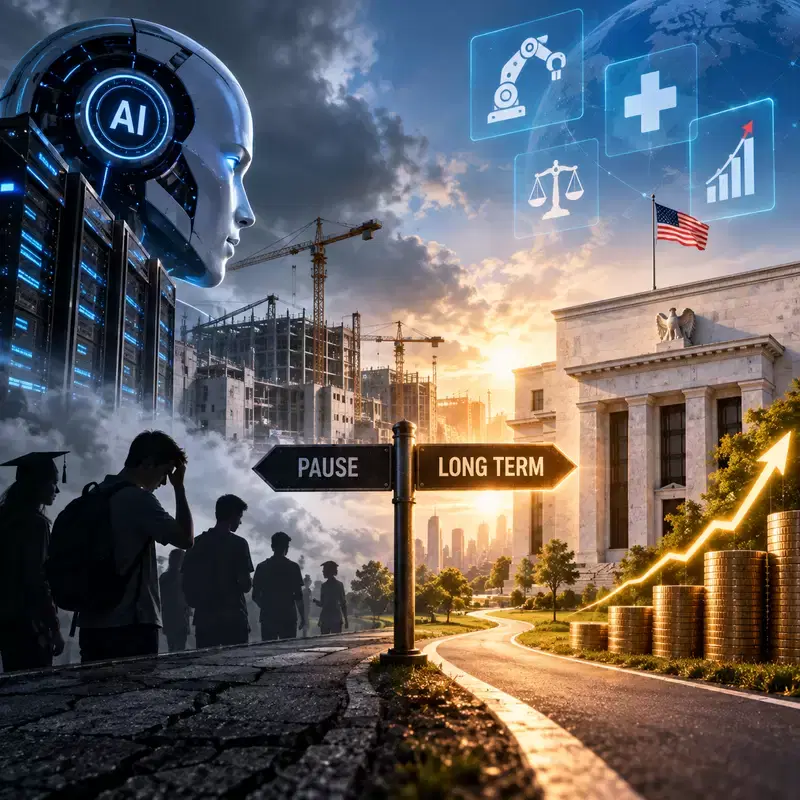
▲ Artificial Intelligence (AI) / AI-generated image
Although the AI industry has started to catch its breath, it has been diagnosed that the long-term investment trend has not been broken.
Jennifer Lee, Senior Economist at asset management firm BMO Capital Markets, stated in an interview with Bloomberg on September 13 (local time) that it is too early to interpret the recent slowdown in the AI industry as a sign of an economic recession. She said, “Now is the stage to wait and see how things unfold.” She explained that while employment and economic concerns surrounding data center construction and the pace of AI adoption have grown, the long-term direction of investment itself has not changed.
The impact on the job market was cited as a key variable slowing down AI investment. She explained that from university graduates to existing workers, there are concerns about the impact AI will have on jobs, and in some regions, there have been movements to slow down data center construction. She also saw that there could be short-term effects on consumption and financial markets. However, she distinguished between short-term adjustments and structural growth, stating, “AI infrastructure is already being built and is a long-term trend looking ahead 20 years.”
Rather, in the long term, she placed more weight on the possibility of stronger demand for automation. This is because the global birth rate and fertility rate are close to their lowest levels ever, slowing the growth of the labor supply. Lee predicted that labor shortages would continue to drive investment in AI, robotics, and automation. This is the background for evaluating the current slowdown as a temporary retreat in the process of long-term growth.
The profitability issue of AI companies also came to the forefront. The interview pointed out that AI performing specific tasks has a higher potential for generating profits than general-purpose AI. Lee acknowledged this possibility but did not conclude on companies' intentions. She emphasized that it remains unchanged that AI is a technology that will change the way work is done in almost every industry, including healthcare, law, and economics.
The market's next focus shifted to the Federal Reserve (Fed) meeting. Lee predicted a rate hike at the September meeting based on recent inflation data and hawkish remarks from the Fed chair. However, she explained that what the market would pay more attention to was the remarks at the press conference rather than the decision itself. She expected the Fed to continue its method of checking economic indicators at each meeting, stating, “I see at least two rate hikes by the end of the year.”
[Article Key Summary]
-An analysis suggests that the recent slowdown in the AI industry is not a sign of an economic recession but rather a process of reviewing employment and economic impacts.
-Declining birth rates and slowing labor force growth were identified as factors that will continue to stimulate long-term investment in AI, robotics, and automation.
-BMO Capital Markets anticipates a rate hike in September and suggests the possibility of at least two additional rate hikes by the end of the year.
*Disclaimer: This article is for investment reference only, and we are not responsible for investment losses based on it. The content should be interpreted for informational purposes only.*
Newsletter
Get key news delivered to your email every morning
to leave a comment.