
to leave a comment.
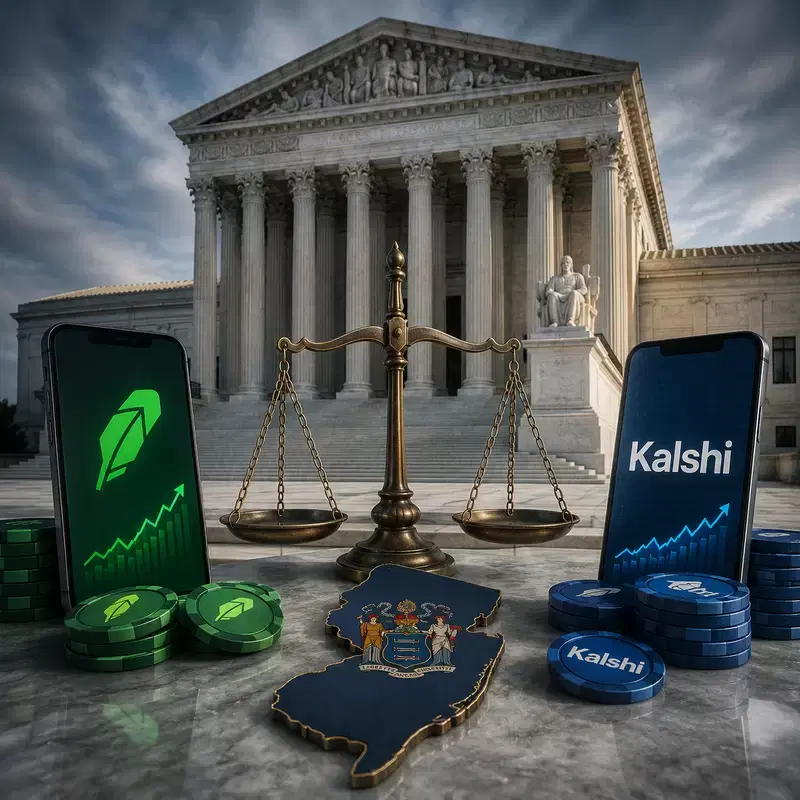
▲ Robinhood (HOOD), Kalshi, lawsuit/AI generated image
Robinhood Markets (HOOD)'s fast-growing prediction market business is increasingly likely to come before the U.S. Supreme Court.
According to U.S. economic media Benzinga on September 3 (local time), New Jersey has asked the U.S. Supreme Court to hear the lawsuit with Kalshi. The key issue is whether sports prediction market contracts should be viewed as financial derivatives or gambling. Depending on the direction of the ruling, the regulatory framework for prediction market operators such as Robinhood could also change.
Court decisions have already diverged. In April, the U.S. Third Circuit Court of Appeals ruled that New Jersey could not apply state gambling laws to Kalshi's sports event contracts. This decision recognized the federal regulatory authority of the U.S. Commodity Futures Trading Commission (CFTC). Conversely, on August 28, the Ninth Circuit Court of Appeals unanimously ruled that Nevada could regulate Kalshi, determining that sports event contracts cannot be considered swaps.
New Jersey argued that if Kalshi's claims were accepted, state-by-state sports gambling regulations could effectively be nullified. The logic is that simply by registering with the CFTC, operators could circumvent state licensing and gambling regulations. Kalshi and Robinhood have maintained that event contracts are derivatives subject to federal law.
For Robinhood, this is not a minor business issue. Vlad Tenev, CEO of Robinhood, described the prediction market as the fastest-growing business in the company's history. He previously stated that even if the Supreme Court sided with the state governments, “it would not result in the disappearance of the prediction market.” However, he added that if the court defines regulatory boundaries, Robinhood would also have to adjust its business practices to meet those standards.
This lawsuit is a battle over who will hold the regulatory initiative for prediction markets: the federal government or state governments. With the Third and Ninth Circuit Courts of Appeals issuing conflicting rulings on the same law, the possibility of Supreme Court intervention has increased. If the Supreme Court takes the case, the regulatory framework for the U.S. sports prediction market could be redefined nationwide.
[Article Summary]
-New Jersey has asked the U.S. Supreme Court to hear the lawsuit concerning Kalshi's regulatory authority over sports prediction markets.
-The Third Circuit Court of Appeals recognized federal regulation, while the Ninth Circuit Court of Appeals recognized state governments' gambling regulatory authority, leading to directly conflicting rulings.
-Robinhood, which is growing its prediction market as a core growth business, may have to adjust its business structure depending on the Supreme Court's decision.
*Disclaimer: This article is for investment reference only and we are not responsible for any investment losses based on it. The content should be interpreted for informational purposes only.*
Newsletter
Get key news delivered to your email every morning
to leave a comment.