
to leave a comment.
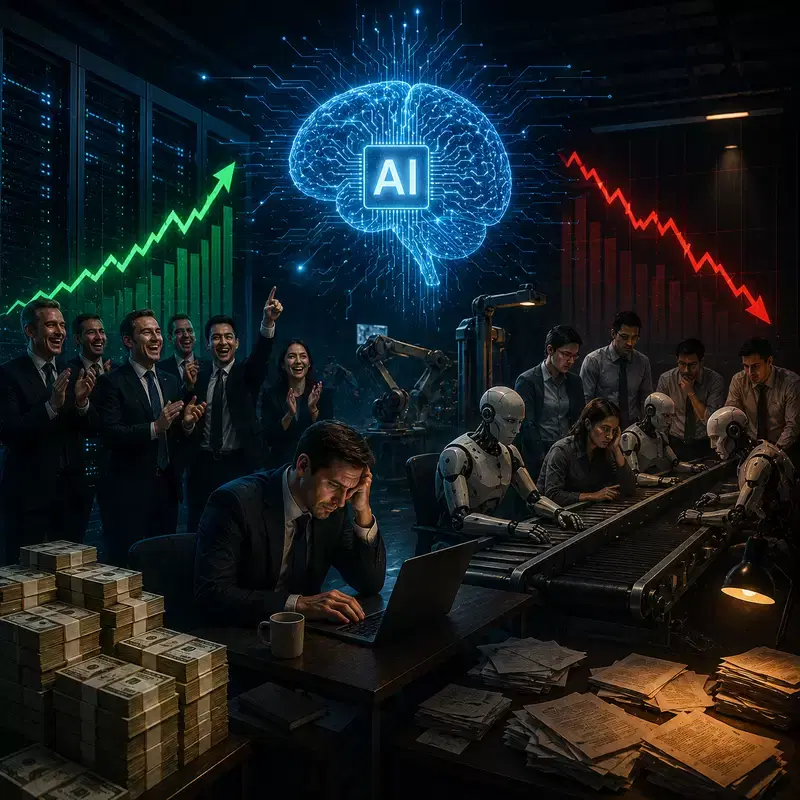
▲ Artificial Intelligence (AI)/AI Generated Image
A warning has emerged that while companies are pouring astronomical sums into AI, actual productivity improvements and return on investment are not keeping pace with expectations. The diagnosis is that if the pace of AI investment recovery continues to slow down while expectations for tech stock performance have run too far ahead of reality, the market could face a "painful re-evaluation."
According to Fortune, a U.S. economic media outlet, on July 6 (local time), Torsten Slok, Chief Economist at Apollo Global Management, pointed out that AI productivity improvements are evident in technology companies but have not spread to most of the Fortune 500 companies. He explained that while the software and technology sectors can relatively easily apply AI to their operations, the broader economy is hampered by issues such as regulation, data protection, and the integration of existing work systems. Slok stated, "The core problem is how long it will take to realize the return on AI investment outside the technology sector." He added, "The mismatch between current profit expectations and the time required for companies to actually generate returns from AI investments could significantly impact the valuation of many AI companies."
The gap in corporate profit margins has already widened. According to data from Bloomberg and Macrobond, the profit margin of the Magnificent Seven rose from approximately 15% in Q1 2023 to 25% in Q1 2026, while the profit margin for the remaining S&P 493 companies remained at around 10%. The profit margin for companies comprising the Bloomberg 500 index also stagnated at around 12% during the same period. An MIT study published last year showed that only 5% of companies reported significant returns on investment from generative AI pilot projects. Slok warned that "if companies do not quickly see a return on their investment, they will reduce AI spending," and that the larger the gap between market prices and actual profits, the higher the likelihood of a "painful re-evaluation."
On the ground, there have been a series of cases demonstrating the difficulty of boosting productivity with AI automation alone. Ford rehired 350 veteran engineers to train new employees and redesign ineffective AI tools. The company deployed AI vision systems in 33 factories worldwide and performed millions of assembly line inspections with over 1,000 cameras, but concluded that the technology's effectiveness was limited without human supervision. Charles Poon, Vice President of Vehicle Hardware Engineering at Ford, stated, "AI is a great tool, but it's only as good as the information it learns from."
An analysis also suggested that companies' excessive expansion of AI use only increases costs. A survey by Boston Consulting Group of approximately 12,000 field employees found that 42% of respondents who regularly used AI reported saving 8 hours per week. However, many respondents reported receiving little guidance on how to utilize the saved time, and half did not use the freed-up time for more strategic tasks. Ricoh, a digital services company, incurred approximately $500,000 in external consulting fees and $200,000 per month in AI costs while processing insurance claims administrative tasks with AI. Initial costs were three times higher than when employees processed tasks directly, and the workforce only decreased from 44 to 39 people.
Ricoh eventually tripled the productivity of that department but had to bear massive initial costs and a long implementation period. Peter Cappelli, a professor of management at the Wharton School, pointed out the practical burden of AI adoption, stating that "what is possible is different from what is realistically achievable." Regarding Ricoh's productivity improvement, Cappelli said, "There were results. But it wasn't cheap, and it took an awfully long time." The speed at which companies recover their investments, rather than AI productivity improvement itself, was presented as a key variable that will determine market valuations.
[Article Key Summary]
-AI productivity improvements were concentrated in technology companies, while the profit margins of the remaining S&P 493 companies stagnated at around 10%.
-An MIT study found that only 5% of companies identified significant returns on investment in generative AI pilot projects.
-Torsten Slok warned that if the recovery of AI investment returns is delayed, it could lead to reduced corporate spending and a "painful re-evaluation" of the market.
*Disclaimer: This article is for investment reference only, and we are not responsible for investment losses based on it. The content should be interpreted for informational purposes only.*
Newsletter
Get key news delivered to your email every morning
to leave a comment.