
to leave a comment.
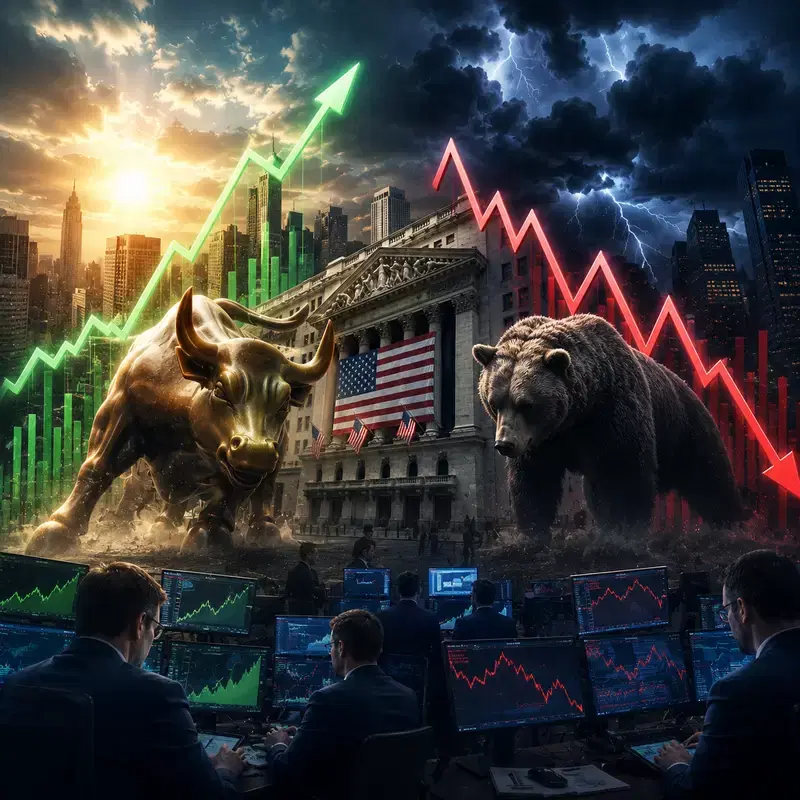
▲ US Stock Market, Nasdaq, Dow Jones, Bull Market, Bear Market, Mixed Trend/AI Generated Image
A warning has emerged that the 'buying the dip' strategy of purchasing the S&P 500 every time stock prices fall could become a fatal trap for individual investors in 2026. While the index continued its historic high streak, an analysis suggests that a long-term slump, similar to what was seen in the 2000s, could recur, due to a surge in long-term losing stocks internally, coupled with overvaluation and an over-reliance on big tech.
According to Yahoo Finance, a US financial news outlet, on July 5 (local time), Rob Isbitts, a columnist for Barchart, pointed out that the long-term rise of the S&P 500 Index (SPX) instilled in investors the belief to 'buy on dips and never sell'. However, from March 1, 2000, to June 30, 2011, as the dot-com bubble burst and the global financial crisis successively hit, the S&P 500 recorded a 25% loss during that period. Isbitts expressed concern about a trend similar to 2000-2011, stating, "Broad market rallies are masking the internal weakness of the stocks dominating the index."
Internal cracks within the index were also presented as a basis for the warning. Approximately one-third of the S&P 500 constituent stocks have recorded negative returns over several years, and about half have not even surpassed US short-term Treasury yields since early 2022. In contrast, the S&P 500 hit all-time highs 24 times in the first half of 2026. Since 1955, there have been 16 instances, including this year, where all-time highs were recorded more than 20 times in the first half of the year; all previous 15 instances ended with annual gains, and the average return exceeded 20%.
Isbitts countered that a strategy of blindly relying on impressive past statistics and rushing into buying the dip is risky. He pointed out that while past bull markets had a relatively balanced market composition, the current market-cap-weighted S&P 500 has an excessively large proportion of a few mega-cap tech stocks. He analyzed that even if passive funds flock to just 2-3 large tech stocks, the index can hit all-time highs, while the remaining stocks could quietly collapse. Currently, the Shiller Price-to-Earnings Ratio (CAPE) is 41x, placing it in the 98th percentile of historically overvalued periods.
Short-term technical trends also sent warning signals. Isbitts noted that on the S&P 500's 2-hour chart, the Percentage Price Oscillator (PPO) showed a bearish crossover, indicating a short-term sell signal on rallies. He warned against strategies that determine risk exposure solely based on calendars and past average returns, stating, "The stock market goes up by stairs and comes down by elevator." He argued that the habit of mechanically buying the S&P 500 on every dip, relying solely on all-time high statistics, could once again turn into a long-term losing strategy.
[Article Key Summary]
-The S&P 500 hit all-time highs 24 times in the first half of 2026, but approximately one-third of its constituent stocks showed negative returns over several years.
-Rob Isbitts warned against a buying-the-dip strategy that relies solely on past bullish statistics, citing the concentration in a few mega-cap tech stocks and a Shiller CAPE of 41x.
-An analysis suggests that unconditional buying-the-dip could lead to long-term losses, similar to the S&P 500's 25% loss from March 2000 to June 2011.
*Disclaimer: This article is for investment reference only, and we are not responsible for any investment losses based on it. The content should be interpreted for informational purposes only.*
Newsletter
Get key news delivered to your email every morning
to leave a comment.