
to leave a comment.
Special meeting on China on the 29th... Chinese Foreign Ministry: "Will take necessary measures to protect rights and interests"
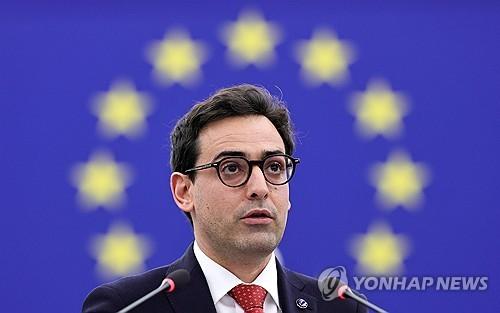
The European Union (EU) plans to expand the use of safeguard clauses (emergency import restriction measures) to protect its entire industrial sector from Chinese imports, said Stéphane Séjourné, EU Commissioner for Prosperity and Industrial Strategy.
The UK daily Financial Times (FT) reported in an article published on the 28th (local time) that Commissioner Séjourné expressed this position during interviews with the newspaper and other European media outlets.
Commissioner Séjourné emphasized the need to use trade defense instruments, stating that Chinese imports pose an "existential" threat in some industrial sectors.
He stated that European industries such as chemicals, metals, and clean technologies are at risk of being destroyed by unfair Chinese competition, and that the EU will more systematically deploy measures such as import quotas and tariffs.
He said, "We will use safeguard clauses in a more general way for sectors, not limited to companies or specific raw materials," adding that such measures would be a "less fragmented approach" that would help overcome challenges across entire sectors.
He explained the background, saying, "Because realistically, we cannot rescue the sector with an 8 or 9-month investigation."
Commissioner Séjourné stated, "Our goal is not to decouple from China, but to achieve a genuine rebalancing and take concrete measures to make that possible."
He pointed out that the EU's trade deficit with China amounts to 1 billion euros (1.7044 trillion won) per day, and 29 million jobs are at risk due to China's overproduction.
He said that while there is no sector where China relies on Europe as much as Europe relies on China, the EU could leverage the attractiveness of its single market, adding, "That's where China might have a weakness."
Commissioner Séjourné said that the expanded use of safeguards would be accompanied by proposals "to compel companies to diversify (supply chains)."
The EU's safeguard procedures, which can be triggered by a sudden surge in imports, affect all trading partners and can last for up to five years.
Exporting countries are protesting the EU's decision on steel safeguard measures, which cut quotas by half and impose a 50% tariff.
Five EU member states, including France, Italy, Spain, the Netherlands, and Lithuania, recently called for countermeasures against "an increase in unfair trade practices," stating that "some countries are causing systemic structural industrial overproduction." However, they did not explicitly name China.
Among the countermeasures proposed in their informal opinion paper is the development of a 'resilience' tool that would allow for quotas or additional tariffs to be imposed on supplier companies whose import concentration exceeds a certain level.
EU commissioners are expected to discuss these proposals at a special meeting on China to be held on the 29th.
Commissioner Séjourné stated that if the EU does not take stronger measures against unfair trade competition involving dumping and state subsidies, it could provoke backlash from member states, potentially leading them to reclaim control over trade policy from the EU.
He expressed concern, saying, "In three or four years, member states will say, 'You failed to protect us, so we will reclaim trade control and implement safeguards, protective measures, and border control measures ourselves'," and that this would fragment the single market and further weaken EU member states.
He also pointed out that some member states, such as Spain and Germany, tend to be reluctant to send negative signals to China.
Mao Ning, spokesperson for the Chinese Foreign Ministry, criticized at a briefing today, "International trade is a mutual choice; there is no forced buying or selling, and China does not deliberately pursue a trade surplus with Europe." She added, "Whether it's 'de-risking' (meaning excluding China from critical technology supply chains), reducing dependence, or so-called trade balance, in reality, all are protectionist, and such measures will weaken the long-term competitiveness of European industries."
Mao added, "The EU should view China-EU trade relations comprehensively and objectively and adhere to its free trade commitments." She further stated, "China will also closely monitor EU developments and take necessary measures to safeguard its legitimate rights and interests."
Newsletter
Get key news delivered to your email every morning
to leave a comment.