
to leave a comment.
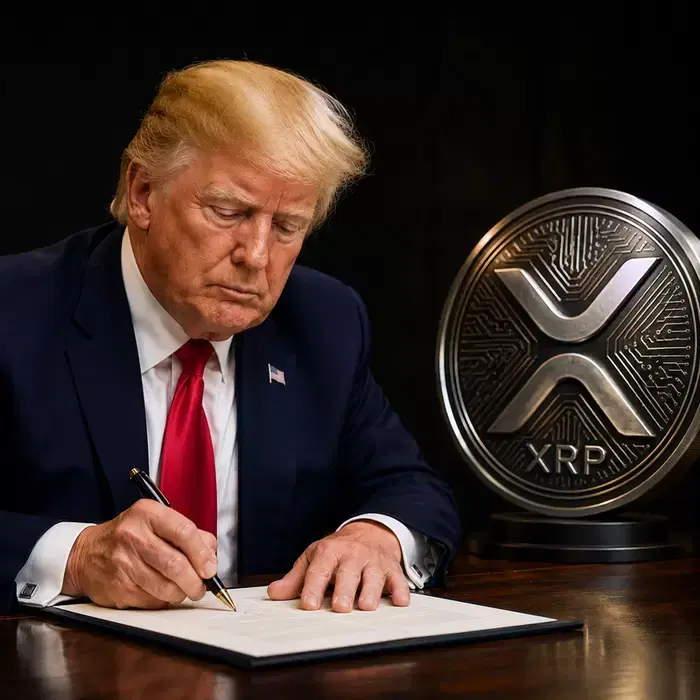
▲ Donald Trump, XRP/AI Generated Image ©
As geopolitical tensions in the Middle East escalate once again, the XRP (Ripple) market has reached a strong horizontal support line and entered a consolidation phase. However, due to frozen investor sentiment and stagnation of funds in the derivatives market, the journey towards a decisive upward breakout remains heavily suppressed. The U.S. military's surprise airstrike on southern Iran near the Strait of Hormuz has sent an immediate sense of crisis through asset markets, causing capital that had hoped for a peace agreement to shrink significantly, thereby fueling the sideways trend across virtual assets. Experts unanimously state that a strong accumulation of buying power cannot be expected as long as geopolitical risks are not resolved, emphasizing the need to focus on thoroughly defending the lower support levels for the time being.
According to the investment media FXStreet on May 26 (local time), peace negotiations between the U.S. and Iran encountered a major stumbling block just as a final agreement was within reach. After the U.S. military launched a surprise attack on Monday in the vicinity of the Strait of Hormuz, citing self-defense, the Iranian Revolutionary Guard Corps (IRGC) also strongly protested on Tuesday in a statement, asserting their legitimate right to defense. This military clash erupted just before the finalization of a Memorandum of Understanding (MoU) between the two countries in Doha, Qatar, adding to the shock. However, U.S. Secretary of State Marco Rubio mentioned that the possibility of a peace agreement is still open, leading the market to keenly watch for any slim chance of a diplomatic resolution.
As the clouds of war thicken, individual investors' demand to enter risk assets, including XRP, has noticeably cooled. CoinGlass data analysis shows that as of Tuesday, XRP futures Open Interest (OI) slightly increased from $2.83 billion the previous day to approximately $2.85 billion. This level is significantly lower than the $3 billion recorded in mid-May, let alone the all-time high of $10.94 billion in July of the past year. Derivative traders lack strong conviction in short-term bullish prospects and are hesitant to build new positions, significantly weakening the overall market strength.
From a technical perspective, XRP's spot price, as reported by the media, is fighting a fierce battle above the short-term support line of $1.35, struggling to secure downside rigidity. Above the current price, the 50-day Exponential Moving Average (EMA) at $1.40, followed by the 100-day EMA at $1.47 and the 200-day EMA at $1.68, form a tight supply wall, repeatedly thwarting rebound attempts. While the Relative Strength Index (RSI) on the daily chart remains stagnant around 43, indicating no visible influx of buying power, the gradual contraction of the declining part of the Moving Average Convergence Divergence (MACD) histogram suggests that selling pressure is not increasing explosively.
The media predicts that XRP's future fate hinges on whether it can decisively reclaim the short-term supply zone of $1.40 on a daily closing basis. Only by clearing this 50-day EMA resistance wall can downward pressure subside, paving the way for a full recovery rally towards the $1.47 and $1.68 highs, respectively. Conversely, if the support line breaks due to a lack of buying power, the $1.33 level, where the technical indicator SuperTrend is located, will act as the final defense line. If even this zone is hit by a selling onslaught and broken downwards, the existing structural bearish trend could intensify uncontrollably, with a high risk of falling into a deep correction.
Consequently, in the current situation, where fears of a geopolitical flash crash from the Middle East coincide with a loss of momentum in the derivatives market, thorough risk management is required rather than aggressive upward chasing. Until a clear major catalyst, such as a diplomatic peace agreement, emerges, price volatility will inevitably be extremely limited. Therefore, investors should closely monitor the specific clause adjustments emerging from the U.S.-Iran negotiation table in Doha, along with the breakout direction from the clear short-term turning points of $1.33 and $1.40, and adhere to a meticulous phased response strategy.
*Disclaimer: This article is for investment reference only, and we are not responsible for any investment losses based on it. The content should be interpreted for informational purposes only.*
Newsletter
Get key news delivered to your email every morning
to leave a comment.