

to leave a comment.
Where is the market looking now? On July 30, 2026, we are witnessing the shockwave of the Federal Reserve's (Fed) 'hawkish pause' hitting global financial markets. U.S. stock and bond markets have plummeted together, with the fear index soaring, and the crypto market is also experiencing overall weakness. However, even amidst this chaos, changes in institutional investor fund flows and the movements of specific altcoins are providing important clues.
Data and figures are sending a clear message. The Fed's tough stance on inflation, coupled with geopolitical tensions in the Middle East, has maximized risk-off sentiment. In particular, the sharp decline in the AI semiconductor sector indicates a rapid shift in market leadership, which is directly impacting the crypto market. From now on, we will clearly analyze the current market direction through key indicators.
| Indicator | Current Value | 24-hour Change |
|---|---|---|
| Bitcoin (BTC) | $63924.0 | +0.00% |
| Ethereum (ETH) | $1909.36 | -0.90% |
| Ripple (XRP) | $1.073 | +0.50% |
| Solana (SOL) | $73.63 | -0.60% |
| Dogecoin (DOGE) | $0.070086 | -1.50% |
| Fear & Greed Index | 28 (Fear) | Previous Day 29 (Fear) |
| NASDAQ 100 (QQQ) | $661.73 | -2.04% |
| S&P 500 (SPY) | $729.46 | -1.54% |
| VIX Fear Index | 22.53 | |
| US 10-year Treasury Yield | 4.61% | |
| BTC Funding Rate | 0.000085 | +0.01% |
| ETH Funding Rate | 0.000039 | +0.00% |
The U.S. Federal Reserve (Fed) froze its benchmark interest rate at 3.50%~3.75% for the fifth consecutive time, as expected by the market. However, this pause was by no means dovish. Three members of the Federal Open Market Committee (FOMC) dissenting against a rate hike for the first time since 2016 clearly demonstrates the Fed's firm hawkish stance. Chairman Wash stated, "If inflation remains high, a rate hike could be part of the solution," keeping the possibility of further tightening open.
The Fed's 'hawkish pause' immediately shocked the bond market. The yield on the U.S. 30-year Treasury bond surged, breaking above 5.2%. This reflects market anxiety about future rate hikes and will likely increase corporate borrowing costs and concerns about an economic slowdown. Adding to this, the escalation of inflation pressure with international oil prices surging over 7% during trading due to the US-Iran conflict, with WTI hitting $84 and Brent crude reaching $87.69, is expected to deepen the Fed's dilemma.
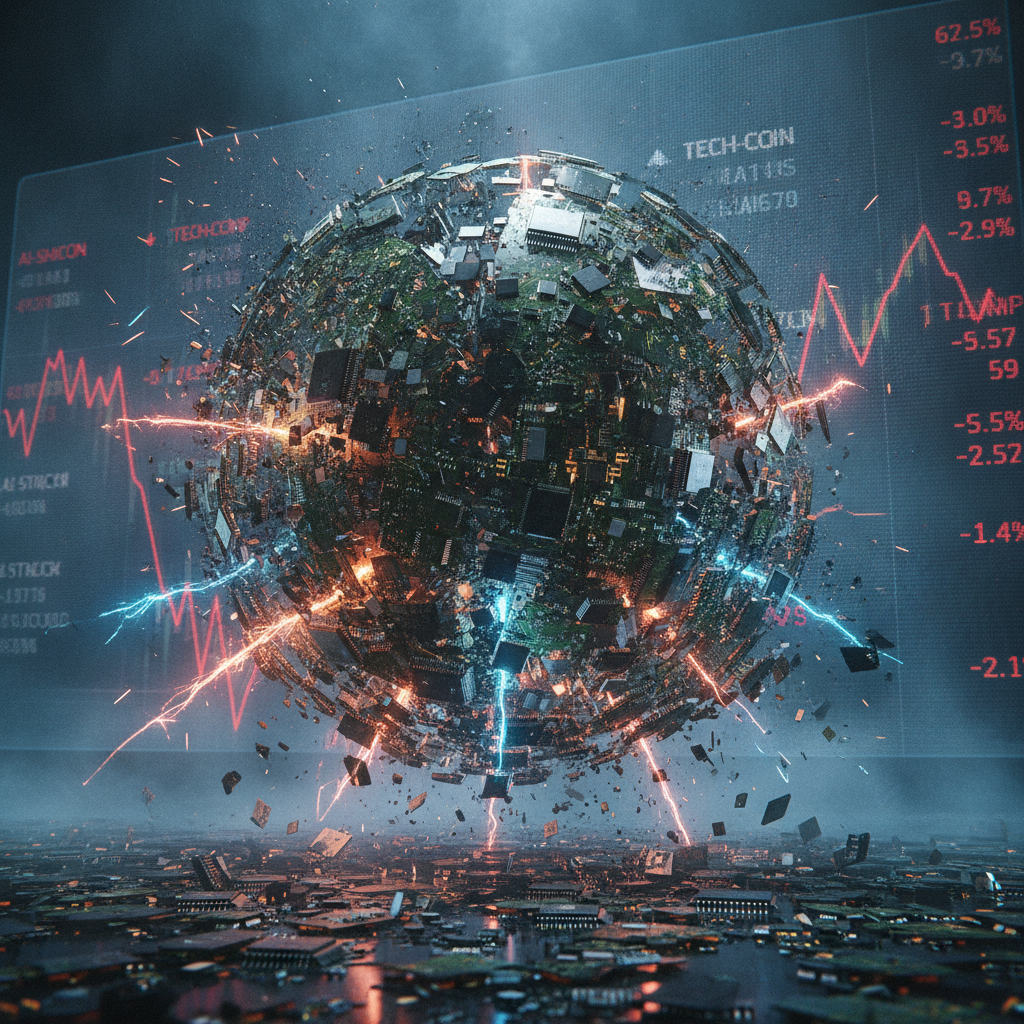
Following the Fed's rate freeze announcement, U.S. stocks fell sharply. The S&P 500 plunged -1.54%, NASDAQ 100 -2.04%, and the Dow Jones -2.18%, showing broad selling pressure. The decline in AI semiconductor-related stocks was particularly noticeable. SK Hynix and Micron Technology (MU) plummeted amid gloomy earnings forecasts, while Nvidia (NVDA) and Oracle (ORCL) also saw their stock prices falter due to AI investment burdens.
This aligns with Jim Cramer's warning that the rotation in AI stocks resembles the dot-com bubble collapse of 2000, and Peter Schiff's comments on AI bubble collapse signals. Market fear is further heightened, with the VIX fear index reaching 22.53. Amidst this risk-off sentiment, funds are observed moving towards Warren Buffett-style value investing and stable large-cap stocks like Apple (AAPL).
Despite macroeconomic uncertainty and the sharp decline in U.S. stocks, Bitcoin (BTC) maintained a relatively solid sideways trend in the $63,000 range, showing a +0.00% change over 24 hours. However, it fell -3.30% over the past 7 days, and Bitcoin spot ETFs experienced net outflows for four consecutive trading days, with a total of $49.7 million evaporating. Bitcoin trading volume also shrank to its lowest level since 2023, indicating a strong wait-and-see attitude in the market.
In contrast, Ethereum (ETH) fell -0.90% over 24 hours, but Ethereum spot ETFs saw net inflows for two consecutive trading days, with $9.4 million flowing in. This suggests a potential shift of institutional funds from Bitcoin to Ethereum. Solana (SOL) fell -0.60% over 24 hours, but technical development continues with a governance proposal for transaction throughput improvement applied to the mainnet.
Meanwhile, discussions on U.S. crypto market structure bills like the CLARITY Act are active, but uncertainty is growing due to differences with the White House's stance and the probability of passage within the year falling to the 30% range. However, the consistent expansion of traditional financial institutions' participation in the blockchain and tokenization market, such as BNY Mellon's $8.6 trillion fund tokenization, Morgan Stanley's positive outlook on tokenized assets, and Tether's entry into the Kenyan securities market, indicates that long-term industry growth drivers remain valid.
Dogecoin (DOGE) fell -1.50% over 24 hours, while XRP showed a +0.50% increase over 24 hours. While there are positive factors such as news of an XRP Ledger security system upgrade and the possibility of breaking $1.35 if the CLARITY Act passes, short-term volatility is expected to be high due to spot ETF supply and demand uncertainty. In the futures market, COTI surged +59.29% over 24 hours, showing strong buying interest, and UAI and BEAT also recorded double-digit gains, indicating active speculative trading on specific market themes.
Current market investor sentiment remains in the 'Fear' stage. The Fear & Greed Index further declined from 29 to 28, indicating increased investor anxiety. News that Bitcoin open interest has accumulated to $47.9 billion suggests the possibility of a volatility explosion accompanied by large-scale liquidations. Although funding rates remain slightly positive for BTC at +0.01% and ETH at +0.00%, the risk of long position liquidations persists amidst overall market pessimism.
The sharp decline in the AI semiconductor sector and the Fed's hawkish stance are dampening investor sentiment across all risk assets. In this situation, the market is engaged in an intense waiting game, searching for its next direction. In the short term, market volatility may further expand depending on macroeconomic indicators and policy decisions, making a cautious approach necessary.
The market is gripped by deep fear due to the Fed's hawkish pause and AI bubble collapse concerns, but the shift of institutional funds to Ethereum and the growth of the tokenization market offer new opportunities.