

to leave a comment.
Hello, I'm Jinhyuk Seo, a macro strategist from Wall Street. On July 29, 2026, the market today is experiencing extreme risk aversion amid a double whammy of fear of interest rate hikes by the U.S. Federal Reserve (Fed) and a sell-off in artificial intelligence (AI) semiconductor stocks. Yesterday, the U.S. stock market closed mixed, but Asian markets plunged due to fears of China's self-sufficiency in semiconductor equipment, triggering circuit breakers in South Korea's KOSPI and KOSDAQ markets, casting a shadow over the entire global market. The cryptocurrency market is also reacting sensitively to these macroeconomic indicators, continuing its volatile trend.
Currently, the market is experiencing growing concerns about liquidity contraction amidst interest rate uncertainty, which is acting as downward pressure on major cryptocurrencies, including Bitcoin (BTC). However, even in this chaos, some altcoins are showing strength and a differentiated trend, with analyses suggesting that they have entered a 'Capitulation' phase from a long-term investment perspective. Let's closely analyze where the market is looking through key indicators.
| Indicator | Current Value | 24h Change |
|---|---|---|
| Bitcoin (BTC) | $64,007.41 | -1.50% |
| Ethereum (ETH) | $1,884.00 | +0.50% |
| ONUSDT | $0.34196 | +80.07% |
| BULLAUSDT | $0.018984 | +35.12% |
| BEATUSDT | $3.383 | +28.97% |
| Fear & Greed Index | 29 (Fear) | - |
| S&P 500 (SPY) | $740.86 | +0.24% |
| NASDAQ 100 (QQQ) | $675.49 | -0.97% |
| VIX Fear Index | 21.24 | - |
| US 10-Year Treasury Yield | 4.65% | - |
| BTC Funding Rate | +0.000100 | +0.01% |
| ETH Funding Rate | +0.000057 | +0.01% |
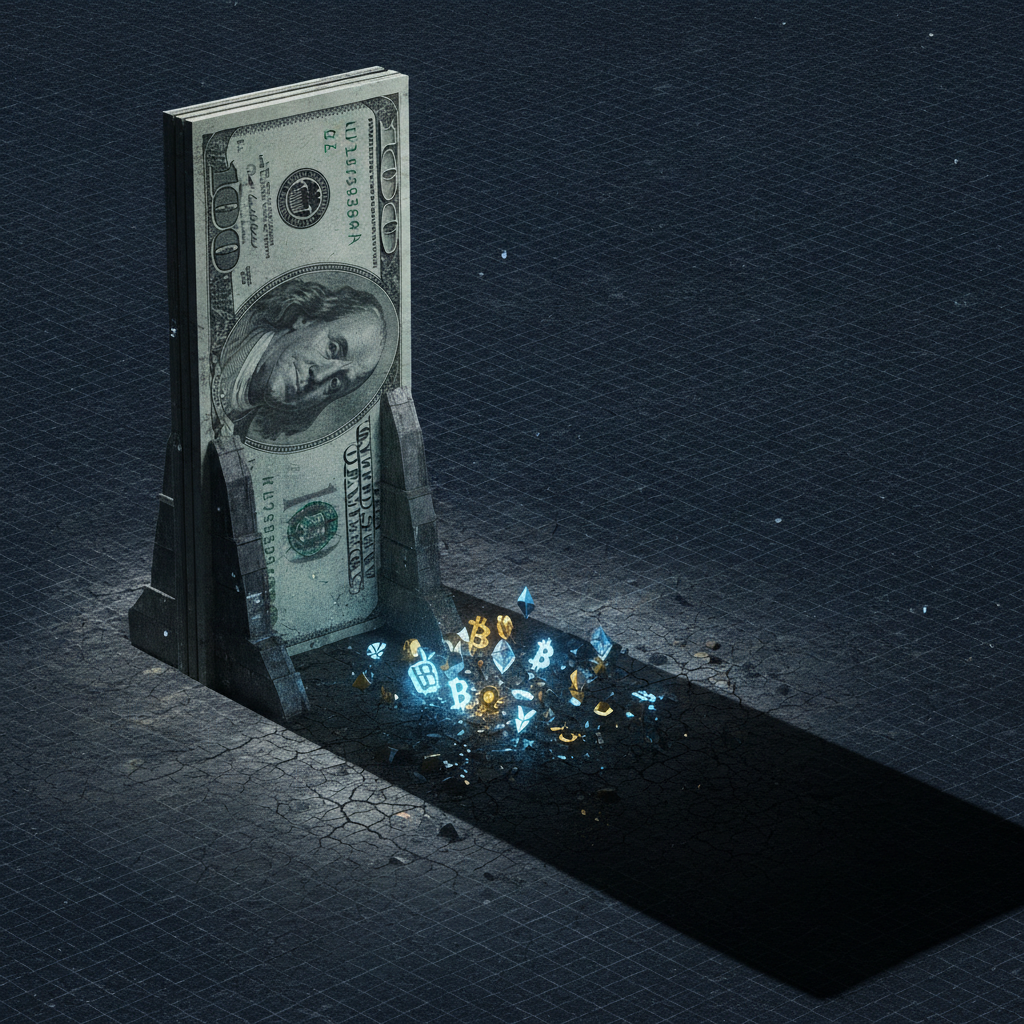
The biggest topic in the market right now is undoubtedly the direction of monetary policy by the U.S. Federal Reserve (Fed). The U.S. 10-year Treasury yield is at 4.65%, and the 2-year Treasury yield is at 4.31%, maintaining a robust spread of 0.34%. However, Citadel Securities warns that a hawkish shift is being underestimated, evaluating the probability of an interest rate hike at 37.9%, and prediction markets are not ruling out a 'surprise hike' by the Fed. This is a key factor stimulating overall market risk aversion.
The strong performance of the Dollar Index, reaching 120.7105, is also a negative signal for the global liquidity environment. Considering that 87% of Bitcoin's price movements are determined by global liquidity, as analyzed by Raoul Pal, a strong dollar could shrink liquidity supply to the cryptocurrency market. Furthermore, the re-emergence of geopolitical risks from the Middle East, with the U.S. Central Command announcing it intercepted a ballistic missile launch by Iran's Revolutionary Guard, is also a factor dampening investment sentiment.
Yesterday, the U.S. stock market showed mixed trends, with the S&P 500 rising by +0.24% while the NASDAQ 100 fell by -0.97%. The decline in the NASDAQ, in particular, reflects weakened investor sentiment towards AI-related tech stocks that have recently led the market. Major semiconductor companies like Nvidia (NVDA) and SK Hynix plunged due to fears of China's self-sufficiency in semiconductor equipment and the burden of AI investments, sending shockwaves through global stock markets.
The VIX Fear Index recorded 21.24, indicating that market uncertainty persists. In the domestic stock market, KOSPI and KOSDAQ plunged to the point of triggering circuit breakers, showing that the sell-off in U.S. tech stocks is spreading to Asian markets. This has also directly impacted the cryptocurrency market, with analyses suggesting that Bitcoin (BTC) experienced a 'bloodbath' following the collapse of Asian semiconductor stocks.
Bitcoin (BTC) is currently trading around $64,007.41, but it has shown unstable movements recently, with the $63,000 support level on the verge of collapsing. A triple whammy of Fed interest rate decision uncertainty, AI stock sell-off, and weakening institutional demand is directly impacting Bitcoin's price. Market leverage is also being significantly unwound, with $157.53 million worth of BTC futures long positions liquidated in 24 hours.
The funding rate remains slightly positive at +0.01%, but open interest (OI) has decreased to $0.0B, indicating a stronger wait-and-see attitude among market participants. As analyses suggest, "BTC is rebounding, but risk aversion sentiment remains... possibility of a fake rally," it is uncertain whether the current modest rebound will lead to a sustained uptrend. Fidelity estimated Bitcoin's unrealized profits at approximately $108 billion, suggesting it could be an attractive entry point for long-term investors.

Ethereum (ETH) is showing a relatively robust trend compared to Bitcoin, rising by +0.50% to trade around $1,884.00. The inflow of $11.75 million into BlackRock's Ethereum (ETH) ETF, surpassing Bitcoin ETF inflows, and Morgan Stanley's launch of Ethereum (ETH) and Solana (SOL) ETFs indicate growing institutional interest in Ethereum. The fact that the number of wallets holding Ethereum has exceeded 200 million is also a positive sign.
On the other hand, Ripple (XRP) and Solana (SOL) are showing joint weakness amidst interest rate fears, with warnings of a breakdown below their lows. XRP faces the risk of breaking its $1 support level, and Solana is struggling, having fallen to $73 despite achieving its highest network performance ever. However, institutional interest persists, with Morgan Stanley initiating Solana ETF trading and Ark Invest buying Solana staking ETFs.
Meanwhile, Real World Asset (RWA) tokens showed the best performance in the cryptocurrency market in July, recording a median return of 10%. The total market capitalization of on-chain RWAs increased to $32.2 billion, reaching an all-time high and once again proving that the tokenization of traditional financial assets is a key growth driver for the market.
Currently, the Fear & Greed Index is at 29, remaining in the 'Fear' zone. This indicates that overall investor fear dominates the market. Particularly, ahead of the FOMC meeting, concerns about the hawkish stance of the new Fed Chair Kevin Warsh and ongoing deleveraging movements persist.
However, amidst this fear, there are also perspectives that see opportunities. Tom Lee, Chairman of BitMine (BMNR), argues that the cryptocurrency market has already bottomed out, emphasizing that Ethereum is showing stronger performance than Bitcoin. Fidelity Digital Assets also analyzed that the NUPL (Net Unrealized Profit/Loss) for Bitcoin, Ethereum, and Solana is at historically low levels, potentially making it an attractive entry point for long-term investors.
The market currently has a high likelihood of increased short-term volatility. If BTC's supply concentration rises to 12% and it consolidates in the $62,000 to $66,000 range, analyses suggest that a strong upward or downward movement could eventually occur, leading to redistribution of supply. Investors need to closely monitor the upcoming FOMC meeting results and global liquidity flows, adopting a cautious approach.
Amidst a market dominated by risk aversion due to interest rate hike fears and AI semiconductor shock, Bitcoin is testing key support levels, while Ethereum and the RWA sector show relative strength, indicating a market seeking 'opportunities within fear'.
to leave a comment.