

to leave a comment.
On May 19, 2026, the cryptocurrency market is gripped by Extreme Fear. Bitcoin (BTC) is failing to hold the $77,000 level and is under downward pressure, while Ethereum (ETH) and major altcoins are also showing a synchronized decline. This is coupled with deteriorating macroeconomic indicators such as the re-escalation of geopolitical risks surrounding the U.S. and Iran, and soaring oil prices and bond yields, significantly dampening investor sentiment.
Notably, large-scale capital outflows from Bitcoin spot ETFs are amplifying market anxiety. Even amidst this situation, some altcoins are showing strength due to individual positive catalysts, making the market's direction even more complex. Let's sharply analyze where the market is looking now through key indicators.
| Indicator | Current Value | 24h Change Rate | 7d Change Rate |
|---|---|---|---|
| Bitcoin (BTC) | $76952.00 | -0.62% | -5.94% |
| Ethereum (ETH) | $2128.49 | +0.02% | -9.04% |
| XRP | $1.39 | -0.85% | -5.59% |
| Solana (SOL) | $85.28 | +0.14% | -12.50% |
| Dogecoin (DOGE) | $0.104632 | -3.83% | -6.10% |
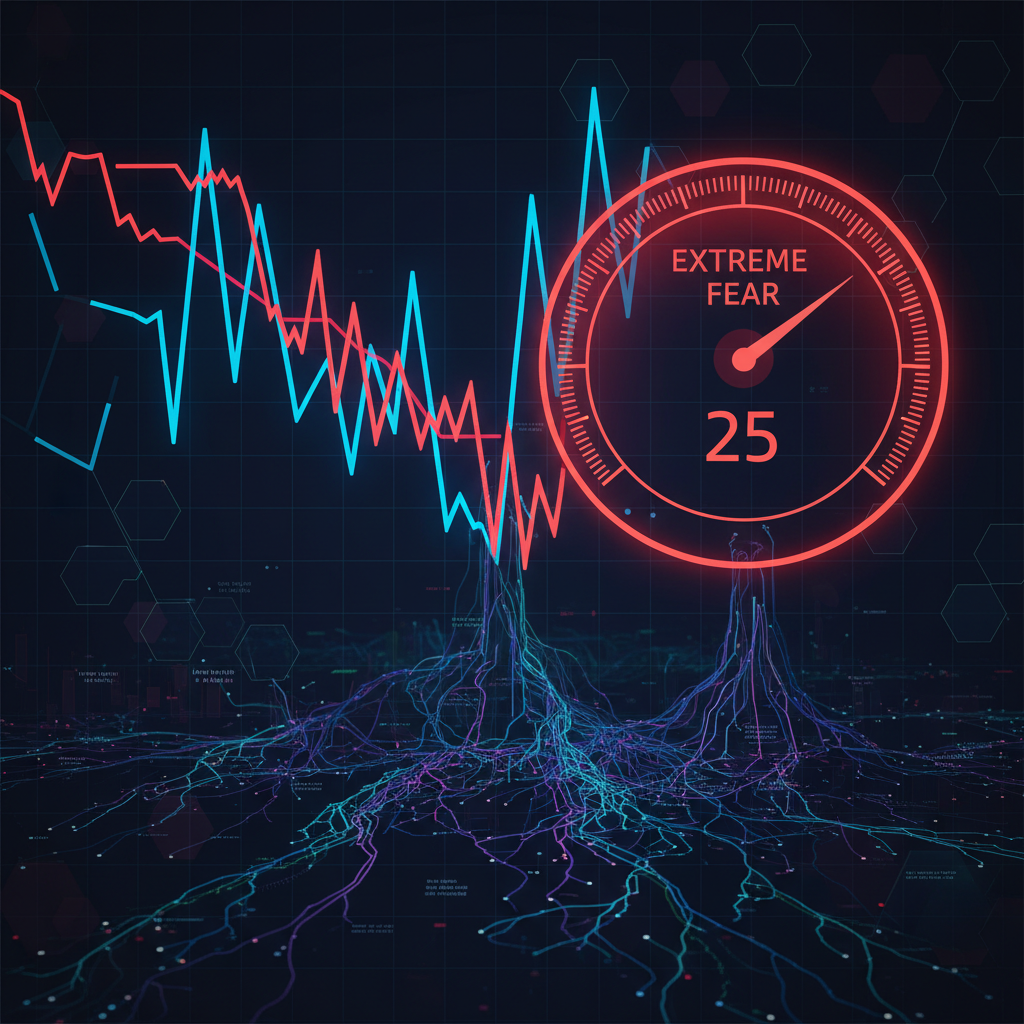
| Fear & Greed Index | 25 (Extreme Fear) | Previous Day: 28 (Fear) | - |
| Nasdaq 100 (QQQ) | $705.88 | -0.43% | - |
| S&P 500 (SPY) | $738.65 | -0.07% | - |
| VIX Fear Index | 26.30 | - | - |
| US 10-Year Yield | 4.59% | - | - |
| BTC Funding Rate | 0.000052 | +0.01% | - |
| ETH Funding Rate | 0.000100 | +0.01% | - |

The market is currently suffering from the double whammy of geopolitical risks and a hawkish macroeconomic environment. Rising tensions surrounding the U.S. and Iran continue to stimulate risk-off sentiment, despite President Trump's announcement of a temporary halt to military action against Iran. Iran's insistence on a ceasefire without nuclear concessions and the White House's rejection of it, reviewing the resumption of military action, are key factors increasing market uncertainty.
The surge in oil prices and U.S. Treasury yields is also adding to selling pressure on risk assets. The U.S. 10-year Treasury yield has reached 4.59%, and the new bond king, Jeffrey Gundlach, warned that inflation would enter the 4% range and that a Fed rate cut would be impossible. This relatively reduces the attractiveness of risk assets like cryptocurrencies and, in particular, leads to a decrease in the relative appeal of Ethereum staking yields (around 2.5%), negatively impacting ETH prices.
The dollar index recording a high of 119.2825 also suggests the possibility of global liquidity contraction. The weakening yen and the potential for the Bank of Japan's market intervention are also increasing concerns about a global liquidity squeeze due to the unwinding of yen carry trades. EU Commissioner Valdis Dombrovskis mentioned the possibility of a stagflation shock if the Iran conflict prolongs, viewing the global economic outlook pessimistically.
U.S. stocks closed mixed. The S&P 500 fell by -0.07% and the Nasdaq 100 by -0.43%, while the Dow Jones rose by +0.3%. However, the VIX Fear Index maintaining a high level of 26.3 indicates that underlying market anxiety persists. This suggests that stock market volatility could expand, continuously burdening the cryptocurrency market.
Meanwhile, the U.S. Securities and Exchange Commission (SEC) is set to unveil an 'innovation exemption' plan allowing stock token trading, and news that cryptocurrency derivatives platform Ostium has partnered with Nasdaq suggests a strengthening link between traditional finance and the crypto market. While these efforts to integrate into the institutional framework could enhance market stability and credibility in the long term, short-term macroeconomic anxieties are having a greater impact.
Bitcoin (BTC) fell by -0.62% over the past 24 hours and -5.94% over 7 days, reaching $76,952.00. Notably, $1.07 billion was net-outflowed from digital asset investment products last week, ending a six-week streak of net inflows, with $980 million exiting Bitcoin alone. This appears to reflect risk-off sentiment due to the escalating geopolitical risks related to Iran.
On-chain data indicates that over 7.8 million BTC are currently in a loss position, and selling pressure from short-term investors is increasing. However, paradoxically, some analyses suggest that a short-term rebound is more likely when market fear sentiment is at its peak. The Fear & Greed Index reaching 25 (Extreme Fear) and entering the extreme fear phase can be interpreted as an opportunity for contrarian investors.
Furthermore, news that Strategy additionally purchased $2 billion worth of Bitcoin and SpaceX holds $630 million worth of Bitcoin demonstrates institutional investors' long-term confidence in Bitcoin. BlackRock is also indirectly increasing its Bitcoin exposure by purchasing additional Strategy shares. This indicates that despite short-term market volatility, Bitcoin's position as a long-term store of value remains robust.
The funding rate for BTC is a negligible +0.01% at 0.000052, maintaining a neutral level for now. According to Coinglass data, if BTC breaks above $80,634, $1.771 billion worth of short positions could be liquidated, suggesting the possibility of a strong short squeeze during a short-term rebound.
Ethereum (ETH) showed a flat trend with +0.02% over the past 24 hours but fell by -9.04% over 7 days, reaching $2,128.49, showing a larger decline than Bitcoin. A massive net outflow of $249 million occurred from ETH spot ETFs, and Tom Lee, co-founder of Fundstrat, analyzed that rising oil prices were a major factor in the decline of ETH's price. The relative decrease in the attractiveness of Ethereum staking yields due to rising U.S. 10-year Treasury yields is also increasing selling pressure on ETH.
However, Tom Lee predicted that an ETH rebound is possible if oil prices fall, and Bitmine continues to accumulate, purchasing an additional 89,026 ETH even during ETH's bearish phase. Controversies surrounding key personnel departures from the Ethereum Foundation and the rsETH bridge hacking incident highlight internal challenges within the Ethereum ecosystem, but movements seeking survival strategies, such as the Layer 2 transition, are also being observed.
XRP fell by -0.85% over the past 24 hours and -5.59% over 7 days, reaching $1.39. While funds are flowing out of Bitcoin and Ethereum, XRP spot ETFs saw a 70% surge in 7-day inflows, nearing their highest monthly inflow. News that Goldman Sachs sold off all its XRP ETFs in Q1 is negative, but previous reports of major Wall Street financial firms successively holding XRP spot ETFs suggest the need to closely monitor institutional position changes.
In particular, expectations for regulatory clarity in the U.S., such as the anticipated Senate floor vote on the 'CLARITY Act' within 30 days, are reigniting bullish sentiment for XRP. The XRP Ledger's 121% growth in the Real-World Asset (RWA) tokenization sector in just one month is also a positive sign. News that a Ripple partner has joined Musk's payment network also enhances XRP's potential for real-world use expansion.
Solana (SOL) showed the largest decline among major altcoins with -12.50% over the past 7 days, but saw a slight rebound with a 24-hour change rate of +0.14%. Messari analyzed that Solana is evolving from a meme coin-centric image into a tokenized finance and payment infrastructure, highlighting the adoption of the Solana ecosystem by institutions such as BlackRock, Ondo Finance, and Franklin Templeton. The fact that global payment companies like Visa, Stripe, and PayPal are also utilizing Solana is positive. However, there are signs of individual investor exodus, making the defense of the $80 support level crucial.
Dogecoin (DOGE) fell by -3.83% over 24 hours. However, practical use cases for meme coins are increasing, such as Revolut launching a physical cryptocurrency card with a Dogecoin theme. Nevertheless, controversies surrounding bot trading and insider selling across the meme coin market warrant caution for investors.
The Fear & Greed Index recorded 25, entering the 'Extreme Fear' phase. This is a further deterioration from the previous day's 28 (Fear), indicating that overall market investor sentiment is at rock bottom. Historically, extreme fear is often interpreted as a bottom signal, but premature optimism should be avoided given the current macroeconomic and geopolitical instability.
In the futures market, BTC funding rate is 0.000052 and ETH funding rate is 0.000100, both maintaining negligible positive values. This indicates that long positions are slightly dominant over short positions, but the strength is very weak. Notably, over the past 24 hours, $180 million in long positions were forcibly liquidated from BTC, $250 million from ETH, and $27.94 million from SOL, with liquidation ratios of 88.25% for BTC, 95.08% for ETH, and 95.9% for SOL, showing that long positions suffered overwhelmingly greater losses. This demonstrates that leveraged long position investors were severely hit when the market moved sharply downwards.
The market is currently facing 'extreme fear' amidst a confluence of negative factors: geopolitical risks, concerns about sustained high interest rates, and massive ETF outflows. While Bitcoin and Ethereum are under downward pressure, institutional investors' long-term accumulation continues, and XRP and Solana are showing differentiated movements due to RWA and regulatory clarity expectations. In the short term, a highly volatile market is expected to persist, and given the sharp long position liquidations, further downside potential should be considered. However, from a long-term perspective, it's crucial to remember that current fear can be an opportunity for the future.
Today's market in a nutshell: A market trapped in 'extreme fear' amidst intensifying geopolitical risks and macro instability; a time to watch for long-term accumulation opportunities amid increased short-term volatility.
to leave a comment.
bravebison67
·하락은 곧 기회
luna93
·ㅋㅋ ㄹㅇ 공포네. 걍 관망ㄱㄱ
quietowl41
·두려워 말고 존버하면 무조건 승리합니다
시끄러운vibe
·글쎄, 언제까지 이 지랄이 계속될까.
소심한ridge
·어휴, 험난하네.